Op-Art / Style prompt
Vasarely Vega Bulge Optical (Style-Only, Image-Conditioned)
Style register: Victor Vasarely Vega series 1968 to 1979 geometric grid distorted by simulated spherical bulge, the picture surface appearing to swell or recede via systematic warping of an otherwise regular grid of squares.
Customize this prompt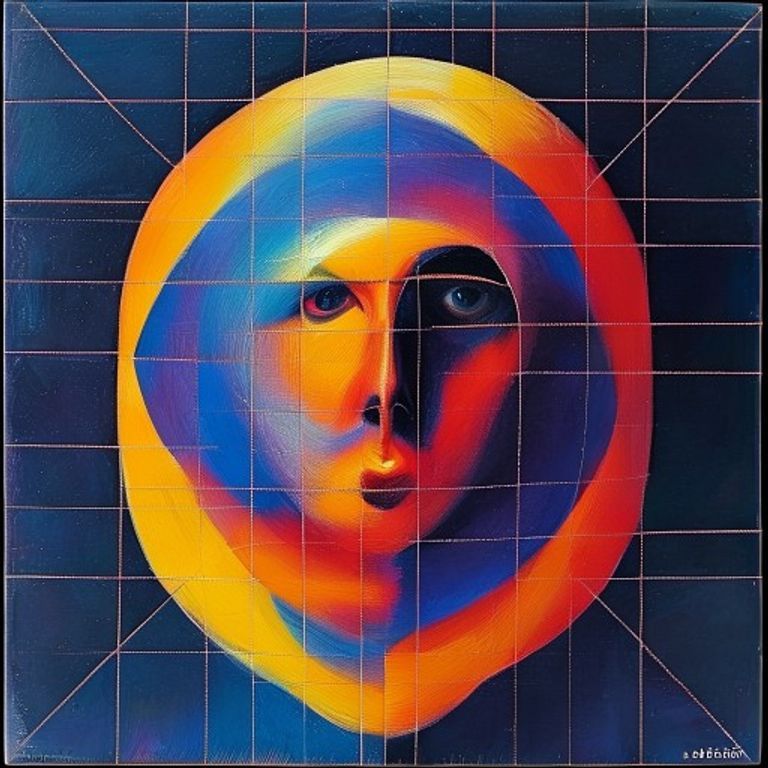
The prompt
Re-render this image in the visual register of a Victor Vasarely Vega-series painting, circa 1968 to 1979. Treat the picture surface as a regular grid of small squares (approximately 30 to 50 cells per dimension) that is then systematically distorted as if a hidden sphere were pressing outward from behind the canvas: squares near the center are enlarged and slightly bowed, squares near the edges remain near-original size, and the transition between bulge and edge follows a smooth radial gradient. The underlying subject is integrated into the bulge, its mass acting as the swelling region. Color each cell from a tightly controlled palette of saturated optical complementaries (deep ultramarine adjacent to chrome orange, viridian green adjacent to cadmium red, violet adjacent to lemon yellow), with cell color shifting in chromatic bands that follow the bulge geometry. Edges between cells are razor-precise, no painterly softness, no anti-aliasing, the geometry plotted as if on a programmable plotter. The eye should read both the flat grid AND the implied three-dimensional swelling simultaneously, producing the characteristic Op-Art retinal vibration. Mood: optical, systematic, the picture as a perceptual experiment rather than a representation. Strictly no on-canvas text, no legible lettering, no signature, no watermark, no logos. Preserve the subject, pose, and composition of the source image exactly, change only the medium and rendering. Aspect ratio matches source.
What it is doing
Vasarely treated the picture not as something to look at but as something to provoke the retina with. The Vega series proves that the medium of Op-Art is not paint, it is human visual cortex. The political consequence, easy to miss in the disco-poster afterlife of the style, is unsettling: if perception can be reliably manipulated by a grid plus a color rule, then perception is not a neutral channel through which we see the world. It is a set of exploitable mechanisms. Vasarely belongs to the same intellectual moment as advertising's discovery of subliminal cueing and the early cognitive-science framing of vision as computation. The bulge is a proof-of-concept for engineered seeing.
Ways to change it
Pick any of these in the gallery and the choice is added to the prompt you copy.
- Bulge intensity: moderate sphere pressing outward (signature) vs subtle gentle swell vs extreme dramatic pucker
- Cell density: 30 to 50 per dimension (signature) vs coarse 15 per dimension vs fine 80 per dimension
- Palette: optical complementaries (signature) vs analogous warm-only vs pure black and white only
- Color banding: radial bands following bulge (signature) vs concentric circles vs random per-cell
- Edge precision: razor plotter (signature) vs slightly hand-painted vs soft-photographic
Style lineage
Learn the visual culture this draws from: TheArtStory.
Related prompts
See all 6 prompts in the Op-Art grammar