Riley Wave Black White Moire (Style-Only, Image-Conditioned)
Style register: Bridget Riley 1961 to 1966 early black-and-white phase, undulating wave patterns, variable stripe widths producing moire shimmer and bodily destabilization, no color, no gradient, only the systematic geometry of contrast.
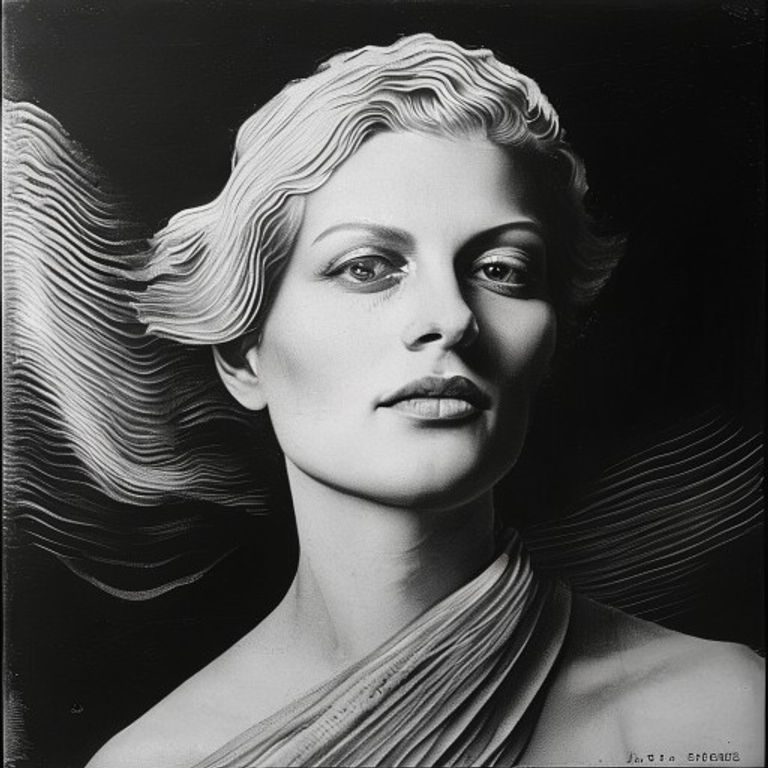
The prompt
Re-render this image in the visual register of a Bridget Riley early black-and-white wave painting, circa 1961 to 1966 (Current, Fall, Crest era). Treat the picture surface as a field of pure black and pure white undulating bands, no greys, no halftones, no color anywhere. The bands flow as smooth sinusoidal or parabolic waves across the canvas, with band widths systematically varied (narrow in zones of high curvature, wider in zones of lower curvature) so that the eye reads moire shimmer and apparent depth where there is only flat geometry. The underlying subject is integrated into the wave field as a region of denser frequency or sharper curvature rather than as a separately drawn figure. Edges between black and white are razor-precise, perfectly hard, no anti-aliasing whatsoever, the absolute binary contrast that produces retinal vibration when stared at. Paint surface is matte tempera or acrylic on pristine white gesso, no brushwork visible, the geometry plotted as if by a mathematical curve-fitter. Mood: vertiginous, somatic, the painting as a bodily event rather than an image. The viewer should feel slightly seasick standing too close. Strictly no on-canvas text, no legible lettering, no signature, no watermark, no logos. Preserve the subject, pose, and composition of the source image exactly, change only the medium and rendering. Aspect ratio matches source.
What it is doing
Riley's early black-and-white work was treated by male critics as decorative until people standing in front of the paintings started reporting nausea, motion sickness, and afterimages that lasted minutes. The reframing was forced by the body, not the discourse. The buried claim is that abstract painting can produce involuntary physiological response, that the viewer is not a detached intellectual observer but a body the painting is happening to. This is the closest geometric modernism gets to physical assault as method. Riley fought all her life against the fashion-industry appropriation of her work into print dresses, because the dress turned a somatic event back into a decoration.
Tuning knobs
- Wave type: `sinusoidal smooth` (signature) vs `parabolic compressed` vs `sawtooth angular (more violent)`
- Band width variance: `narrow at high curvature` (signature) vs `uniform width throughout` vs `extreme variance for stronger moire`
- Surface: `matte tempera or acrylic on gesso` (signature) vs `gloss enamel` vs `paper print flat`
- Pure binary: `absolute black and white only` (signature) vs `one accent stripe in red` vs `near-binary deep blue and cream`
- Wave frequency: `medium 15 to 25 bands` (signature) vs `dense 40 plus bands` vs `sparse 8 to 12 bands`
Style lineage
Learn the visual culture this draws from: TheArtStory.
Related prompts
See all 6 prompts in the Op-Art grammar · Open in the gallery