Cannon Golan-Globus 80s Schlock
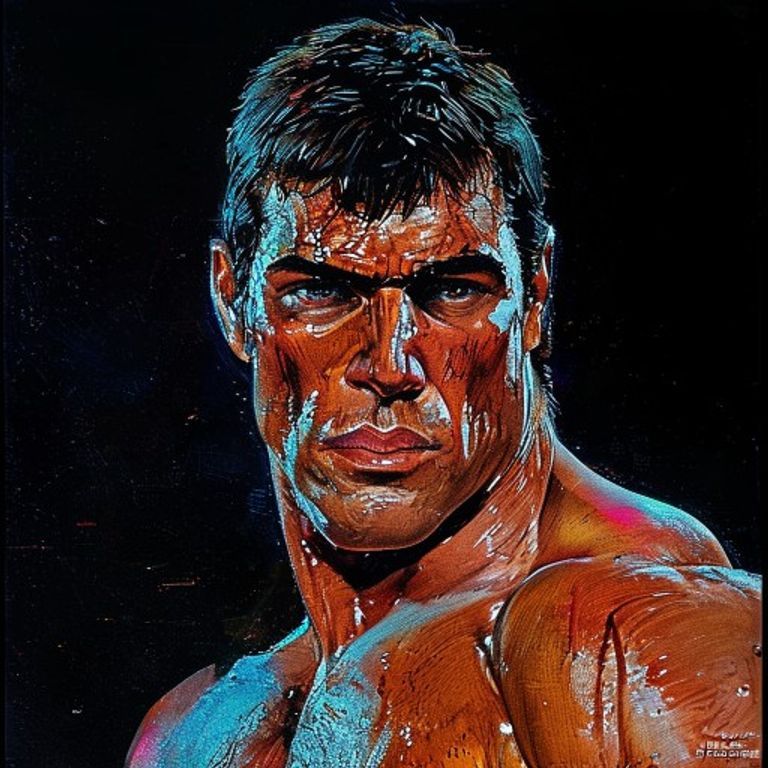
Cannon Group extreme action cinema (1980s, Golan and Globus, Rambo sequels, Chuck Norris, Jean-Claude Van Damme, Sylvester Stallone action vehicles). Airbrushed and overlit, violence rendered as hyperreal spectacle.
The prompt
Re-render this image in the visual register of Cannon Group 1980s exploitation action cinema (Menahem Golan and Yoram Globus era, late 1980s blockbuster action posters for Rambo sequels, Chuck Norris, Van Damme, Stallone vehicles, street-level martial-arts and war-action franchises). Airbrushed with extreme technical control and hyperreal saturation, the image surfaces as polished and impossible, the brushwork invisible and the finish gallery-smooth. Palette violently saturated: electric blues, acid yellows, hot pinks, blood reds, neons pushed to the edge of legibility against a deep black or charcoal background, often with metallic gold or silver used for accents and highlights. Lighting theatrical and hyperreal: hard direct light on the subject, often multiple light sources creating an impossible geometry, rim light creating separation, the figure emerging from the background with almost graphic clarity. Figure rendering: musculature exaggerated and visible, sweat or blood suggested with gleaming highlights, fabric rendered with mechanical precision, every material distinct and reflective. Weapons and vehicles rendered with obsessive detail and polish, treated as objects of desire and spectacle. Composition dynamic and often asymmetric: the action figure occupying a commanding pose, often mid-motion or mid-violence, secondary figures compressed into background or corners, explosions or environmental chaos treated as graphic elements rather than destruction. Texture: smooth and polished as sheet metal, no visible hand work, the surface reading as industrial production rather than art. Mood: unironic adrenaline, hypermasculine fantasy, the violence beautiful and consequence-free. Strictly no on-canvas legible text, no titles, no taglines, no credits, no watermark, no studio marks. Preserve the subject, pose, and composition of the source image exactly, change only the medium and rendering.
What it is doing
Mishima asked: is it beautiful enough to die for? The Cannon Group answered by airbrushing every drop of sweat and blood into a spectacle so polished it becomes abstraction. The violence is not realistic, it is hyperreal, a fever-dream of consequence-free action rendered at such saturation and technical perfection that it becomes almost sacred. The poster does not apologize. It is too much because enough does not exist. Excess is the only honest response to what the frame can contain.
Tuning knobs
- Airbrush finish: `mirror polish perfect` vs `slightly visible brush` vs `visible airbrush texture`
- Saturation dial: `maximum neon` vs `hyperreal but balanced` vs `acid oversaturated`
- Musculature emphasis: `athletic realistic` vs `exaggerated superhuman` vs `almost abstract anatomical`
- Violence dial: `action-ready stance` vs `mid-movement combat pose` vs `explosive destruction spectacle`
- Background treatment: `simple dark field` vs `suggested environment` vs `chaotic action environment`
Style lineage
Learn the visual culture this draws from: Hollywood Reporter.
Related prompts
See all 34 prompts in the Movie-Poster grammar · Open in the gallery