Taiyo Matsumoto Loose Expressive (Style-Only, Image-Conditioned)
Style register: Taiyo Matsumoto 1988 through present manga grammar, Tekkonkinkreet / Ping Pong / Sunny / Cats of Louvre, loose hand-drawn line, naive distorted anatomy, Moebius and French BD influence felt throughout, the manga as a personal-drawing medium.
The prompt
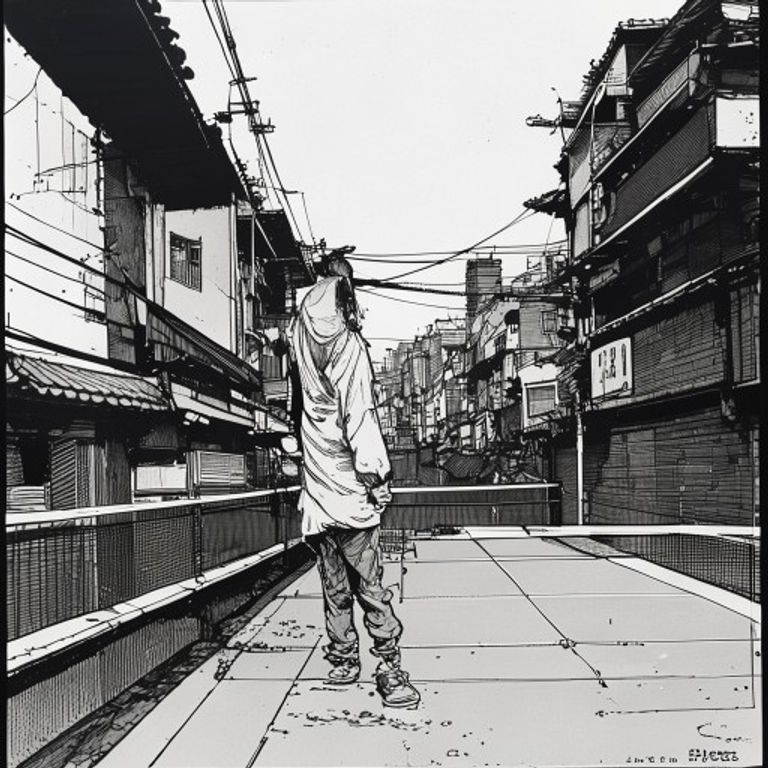
Re-render this image as a Taiyo Matsumoto manga panel in the visual register of Tekkonkinkreet (1993-94), Ping Pong (1996-97), Sunny (2011-15), and Cats of the Louvre (2016-17). LOOSE WOBBLY hand-drawn ink line, deliberately uncorrected, the line shaking and breathing, naive in feel but actually highly controlled, the line of an artist who could draw cleanly but chose not to. Pure black india ink on white paper, with restrained screentone for atmospheric grey only, OR with delicate hand-rendered watercolor wash in muted color (sage, dusty mustard, pale terracotta, washed cyan) added as flat patches over the ink. Character anatomy: deliberately distorted, slightly off-model, oversized hands and feet, smaller heads, the kids in Sunny drawn like a child might draw them but with adult perspective control, the influence of Moebius and the entire French BD tradition (especially Mezzo) felt openly. Background: simplified urban architecture rendered with the same wobbly hand-drawn line, rooftops and chain-link fences and concrete underpasses, the texture of Tokyo's residential sprawl reduced to line-impression rather than detail. Composition: loose, often diagonal, the panel feeling like a hurried plein-air sketch made from life, the artist present in the line. Panel borders: hand-drawn ruled lines, irregular thickness, sometimes broken or omitted entirely. Mood: tender, melancholy, the loneliness of children and the elderly, the bittersweet register of growing up in a city. No on-canvas text, no Japanese or French lettering hallucinated onto the frame, no speech bubbles, no signature. Preserve the subject, pose, and composition of the source image exactly, change only the medium and rendering.
What it is doing
Matsumoto draws like an alternative-comics artist who happens to publish in mainstream Japanese manga magazines. His line is wobbly on principle: the smoothness has been deliberately refused in favor of the hand-of-the-artist-present-on-the-page. The Moebius and Mezzo influence is the European-comics rebellion against the Japanese-manga production line, the assertion that the manga page can be a personal drawing rather than an industrial product. The loose line is the entire ethical position.
Tuning knobs
- Line wobble: `deliberately uncorrected breathing line` (signature) vs `slightly cleaner late-Matsumoto` vs `extreme naive distortion (Sunny kids register)`
- Watercolor wash: `delicate flat-patch muted color` (signature for color editions) vs `pure black-and-white ink` vs `richer color (Cats of Louvre)`
- Anatomy distortion: `oversized hands and feet, smaller heads` (signature) vs `closer to anatomical`
- Background: `wobbly Tokyo residential sprawl` (signature) vs `Parisian (Cats of Louvre register)` vs `featureless`
- Mood: `tender melancholy children` (signature for Sunny) vs `urban-violence energy (Tekkonkinkreet)` vs `sports-kinetic (Ping Pong)`
- Influence dial: `Moebius European BD register` (signature) vs `more Japanese-traditional`
Related prompts
See all 6 prompts in the Manga grammar · Open in the gallery