Naoki Urasawa Realist Thriller (Style-Only, Image-Conditioned)
Style register: Naoki Urasawa 1986 through present manga grammar, Monster / 20th Century Boys / Pluto / Master Keaton, realist character anatomy, controlled atmospheric crosshatch, the manga as a sober adult thriller medium.
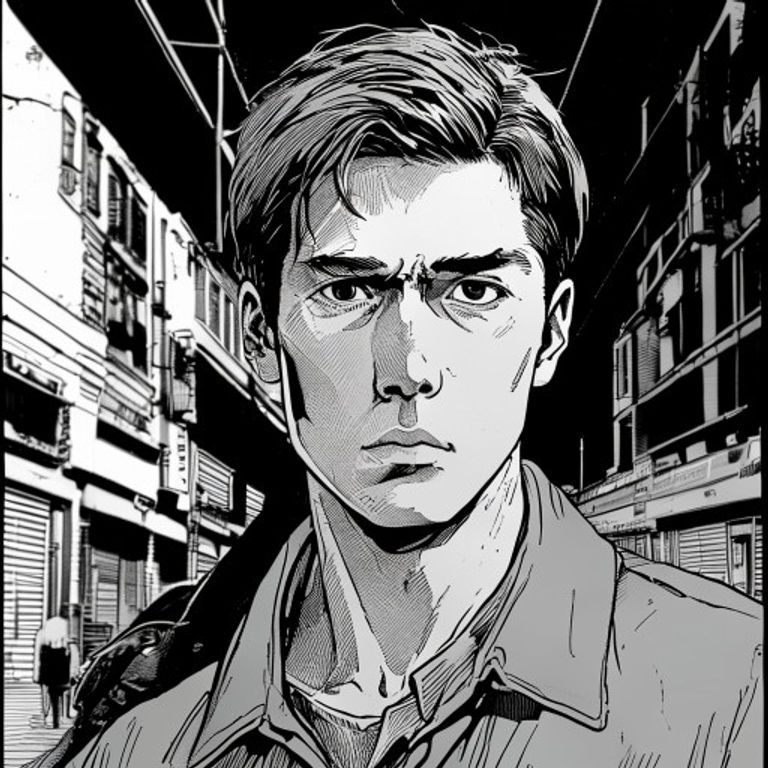
The prompt
Re-render this image as a Naoki Urasawa manga panel in the visual register of Monster (1994-2001), 20th Century Boys (1999-2006), Pluto (2003-09), and Master Keaton (1988-94). Pure black india ink on white paper, with disciplined application of grey screentone for shadow modeling, NO color. Character anatomy: REALIST proportions, accurate head-to-body ratio, individuated facial features that read as specific actual humans rather than archetype manga faces, characters distinguishable by nose shape, jawline, ear position, the way real people are distinguishable. Line: clean controlled medium-weight ink line drawn with brush and G-pen, confident but never flashy, the line refusing to call attention to itself, the technique invisible in service of the storytelling. Faces: subtle expression work, micro-expressions captured in eyebrow tilt and mouth corner, the manga equivalent of an Anthony Minghella close-up. Screentone use: controlled, professional, used for skin shadow, fabric, hair shadow, and atmospheric grey in interiors, rarely overused, the page reading as a tonal grey ladder rather than pure black and white. Backgrounds: photo-reference-accurate European urban environments (Prague stone streets, German autobahn, Tokyo subway interior), drawn with architectural precision and atmospheric perspective. Composition: cinematic but quiet, frequent eye-level mid-shot of a single character in a real environment, the panel earning its drama through specificity rather than spectacle. Panel borders: clean black rules, generally consistent grid, the layout sober and adult. Mood: psychological thriller, sustained dread without horror-genre theatricality, the European mood (Kafka, Le Carre) translated into manga discipline. No on-canvas text, no Japanese or European lettering hallucinated onto the frame, no speech bubbles, no signature. Preserve the subject, pose, and composition of the source image exactly, change only the medium and rendering.
What it is doing
Urasawa's character anatomy is unfashionably accurate. His Johan Liebert in Monster looks like a specific real Czech adolescent, not a manga archetype. The realism is a moral claim: the thriller deserves bodies that could be the bodies of actual people you might pass on a Prague street. The Urasawa register refuses the visual shortcuts of genre manga and asserts that the medium can support a Kafka-grade or Le-Carre-grade adult fiction. The drawing IS the maturity.
Tuning knobs
- Anatomy: `realist individuated proportions` (signature) vs `slight manga stylization`
- Screentone load: `controlled atmospheric tonal ladder` (signature) vs `pure ink, no screentone (early Master Keaton register)` vs `heavier toner (Pluto AI-cool register)`
- Background environment: `photo-reference European urban` (signature) vs `Tokyo interior` vs `featureless room`
- Era: `1988 Master Keaton expository` vs `1994 Monster psychological peak` (signature) vs `2003 Pluto cool-Tezuka-tribute` vs `1999 20th Century Boys epic`
- Expression scale: `micro-expression subtle` (signature) vs `slightly larger emotion`
- Panel grid: `sober consistent` (signature) vs `more dynamic action variant`
Style lineage
Learn the visual culture this draws from: VIZ Media.
Related prompts
See all 6 prompts in the Manga grammar · Open in the gallery