Junji Ito Horror Hatching (Style-Only, Image-Conditioned)
Style register: Junji Ito 1987 through present manga grammar, Tomie / Uzumaki / Gyo, obsessive black-ink crosshatching, body horror rendered with the patience of a botanical engraver, dread escalated through pure visual density.
The prompt
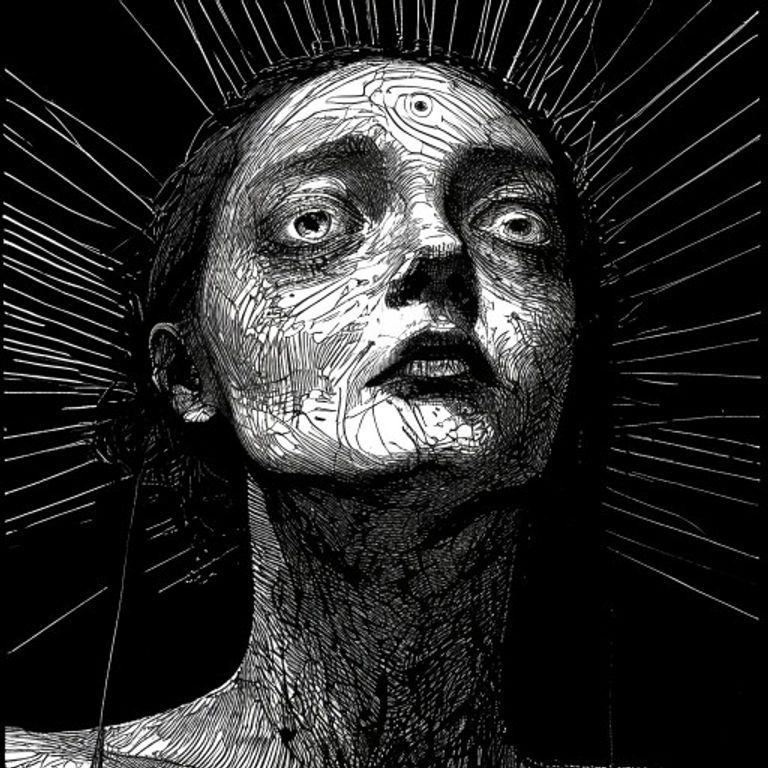
Re-render this image as a Junji Ito horror manga panel in the visual register of Tomie, Uzumaki, Gyo, The Enigma of Amigara Fault, and the Souichi short stories. Pure black india ink on white paper, NO color, NO grey wash, NO digital tone, everything achieved through line density alone. Obsessive crosshatching technique: deep shadows built through three or four layered cross-passes of fine parallel lines, mid-tones rendered through single-direction hatching at varying spacing, highlights left as pure untouched paper. Line weight: extremely fine, surgical, drawn with a sharp G-pen and bottle ink, every stroke deliberate, no shortcuts, no toner. Faces: rendered with botanical-illustration precision, every eyelash individually drawn, every pore suggested, the figure UNCANNILY DETAILED in a way mundane reality never is, the detail itself triggering the horror response. Body horror suggestions baked into the line: a single hair too many, a faint spiral pattern visible in skin texture, an extra small dark dot where there should not be one, the wrongness emerging from over-rendering rather than distortion. Background: dense black void rendered as full-ink-flood with the figure carved out of it through reverse-line work, OR obsessively crosshatched architectural interior with hundreds of fine parallel lines on every wall surface. Mood: the dread of being looked at too closely, the dread of detail itself. Panel border implied as a thin clean black rule. No on-canvas text, no Japanese kanji or hiragana hallucinated onto the frame, no speech bubbles, no sound-effect lettering, no signature. Preserve the subject, pose, and composition of the source image exactly, change only the medium and rendering.
What it is doing
Junji Ito's horror works because he draws ordinary people with the patience of an Audubon plate. The terror is not distortion, it is OVER-DETAIL: a face rendered more carefully than any face has a right to be looked at. The reader's eye, trying to absorb every line, eventually finds the wrong line, and that is where the dread lives. The Ito register is the assertion that crosshatching, given enough hours, becomes its own genre. Horror as draftsmanship discipline.
Tuning knobs
- Hatch density: `four-layer cross-pass deep shadow` (signature) vs `single-direction hatching only` vs `extreme density (Uzumaki spiral wall register)`
- Body horror leak: `subtle wrongness from over-rendering` (signature) vs `overt body-horror distortion` vs `pure portrait with no horror`
- Background treatment: `full-ink black void with reverse-line carve` (signature) vs `obsessive architectural crosshatch interior` vs `bare white paper`
- Subject affect: `unsettlingly serene, eyes too clear` (signature) vs `mid-scream` vs `caught mid-transformation`
- Era: `1987-92 early Tomie ink-density` vs `1998-99 Uzumaki peak` (signature) vs `2002 Gyo body-horror`
- Spiral motif inclusion: `subtle spiral in skin / hair / background` (Uzumaki register) vs `no spiral`
Style lineage
Learn the visual culture this draws from: VIZ Media.
Related prompts
See all 6 prompts in the Manga grammar · Open in the gallery