Manga / Style prompt
Tezuka Classic Rounded (Style-Only, Image-Conditioned)
Style register: Osamu Tezuka 1947 through 1989 manga grammar, Astro Boy through Phoenix and Buddha, rounded large-eye Disney-influenced character design, cinematic page layout, the panel as a movie frame, the originating language of all post-war manga.
Customize this prompt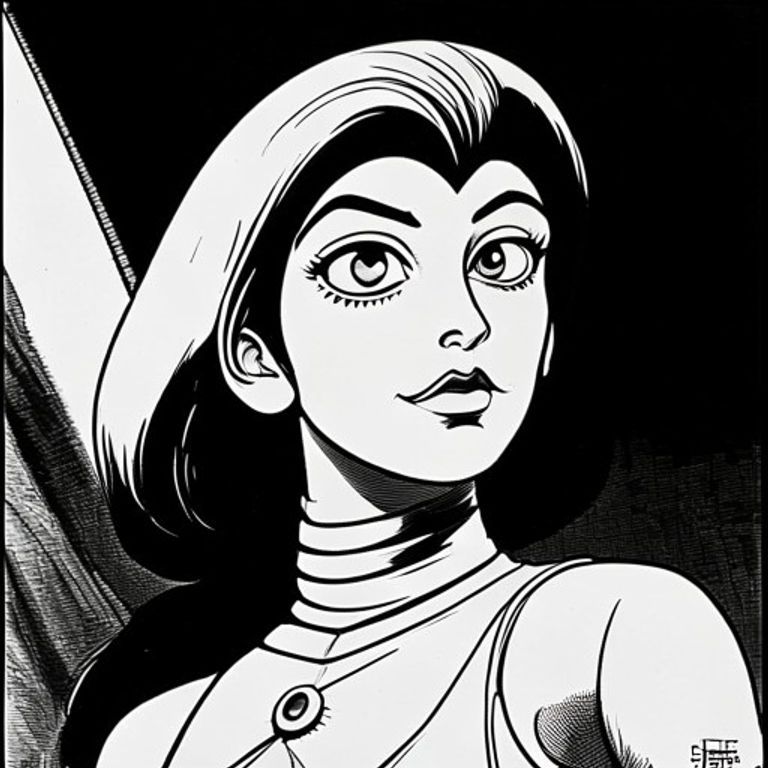
The prompt
Re-render this image as an Osamu Tezuka manga panel from the classic Mushi Production era, between the late 1950s and the 1980s, in the visual register of Tetsuwan Atomu / Astro Boy (1952-68), Jungle Emperor Leo / Kimba (1950-54), Phoenix / Hi no Tori (1967-88), Black Jack (1973-83), and Buddha (1972-83). Pure black india ink on white paper, optionally with one or two grey screentone fills for shadow on hair or clothing, NO color. Character construction: rounded oversized eyes with multiple light-catch highlights (the Tezuka eye, descended from Disney via Bambi, the foundational manga eye that every later manga inherits and modifies), button nose, simplified rounded face, ROUNDED shape language in every form. Line: clean confident varying-weight ink line, drawn with brush and G-pen, thicker on the outer silhouette, thinner on internal detail, every line elegant and economical. Backgrounds: minimal, often blank white or simple speed-line / focus-line fill, OR detailed architectural cross-section drawn with engineering precision (Tezuka was a trained doctor, his anatomical and architectural studies are obsessive). Composition: CINEMATIC layout influenced by Tezuka's love of Disney and French film, dynamic camera angles within the panel, frequent close-up to wide-shot cuts within a single page, the page reading like a storyboarded movie. Panel borders: clean black rules, varying panel size and shape for rhythm. Mood: optimistic, humanist, post-war Japan rebuilding itself through bright-eyed protagonists with internal moral conflict. No on-canvas text, no Japanese kanji or hiragana or katakana hallucinated onto the frame, no speech bubbles, no signature. Preserve the subject, pose, and composition of the source image exactly, change only the medium and rendering.
What it is doing
Tezuka is called the God of Manga because he invented the visual language. The big eye, the cinematic panel cut, the rounded shape, the white space, the entire post-war manga industry descends from his desk in Toshima. To apply the Tezuka register is to return to the source: the foundational vocabulary before every later subgenre split off (shojo, shonen, seinen, horror, sports). The rounded face is humanist, post-war, optimistic, the assertion that the cartoon body is allowed to be soft.
Ways to change it
Pick any of these in the gallery and the choice is added to the prompt you copy.
- Eye treatment: oversized rounded with 2-3 light catches (signature) vs more naturalistic late-Tezuka vs extreme Astro Boy super-rounded
- Screentone use: none, pure ink (signature for early work) vs one or two grey screentones added (signature for 70s/80s)
- Background detail: blank or speed-lines (signature for action) vs obsessively detailed architectural cross-section (Phoenix register)
- Composition cinematic-ness: dynamic camera angle within panel (signature) vs static frontal
- Era: 1950s Astro Boy look: bouncy rubber-hose bodies, huge sparkly eyes, cheerful faces vs late-1960s Phoenix look: sweeping cosmic vistas, flowing robes, dense starfield screentone vs 1970s Black Jack look: angular scarred faces, heavy black shadows, gritty surgical detail
- Line weight variation: confident varying brush-and-G-pen (signature) vs uniform fine line
Related prompts
See all 6 prompts in the Manga grammar