Guerilla / Style prompt
Myanmar Spring Revolution Gen-Z Resistance Cadre
The Myanmar youth in Yangon and Mandalay, Gen-Z defiance against the junta, the moment when TikTok and courage conspired.
Customize this prompt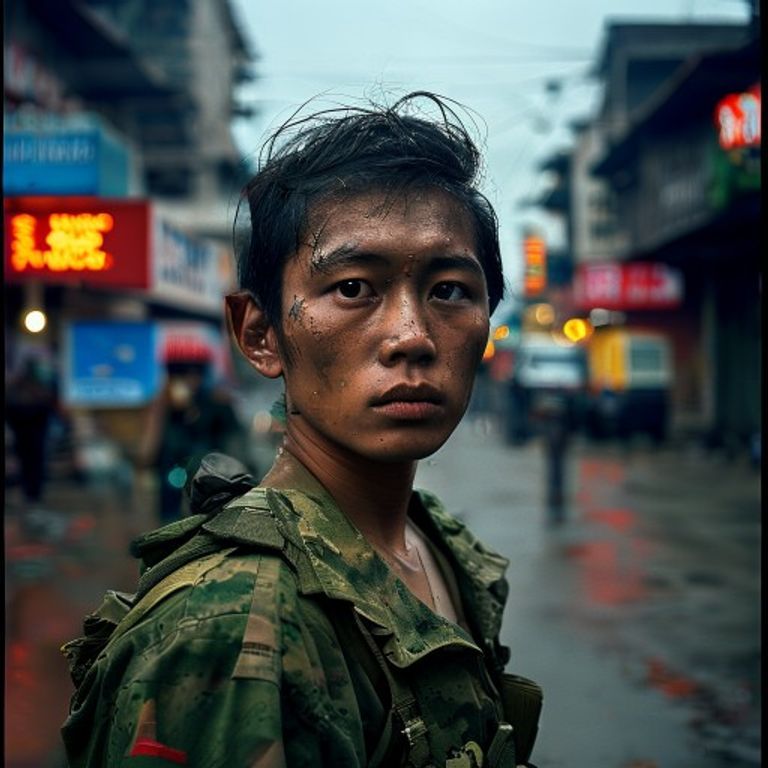
The prompt
Render in the visual register of a 2021 through 2024 Myanmar Spring Revolution photograph from the urban resistance, the documentary and social-media mode of Gen-Z activists and international news photographers capturing the uprising against the military coup. Medium: contemporary digital photography and smartphone capture, available outdoor daylight in tropical monsoon climate, often overcast or night-street-light illumination. Palette: warm concrete-grey and weathered urban architecture, bright casual clothing worn by youth (t-shirt and jeans primary palette), the distinctive forest-green of Myanmar military uniform in sharp contrast, overcast sky pale grey-white, occasional roadblock fire warm orange in night scenes, water-reflection from wet streets. Texture: worn urban grit and monsoon-dampened concrete, casual contemporary fabric worn by youth, the heavy canvas and metal of military fatigues and hard-riot gear, sweat-sheen visible on exertion, festival-banner and homemade-protest-sign fabric in evidence. Lighting: soft overcast daylight or night street-light from shop-fronts and traffic, occasional headlamp from military vehicles, the warm glow of small fires from roadblock resistance, muzzle-flash and tear-gas haze if in confrontation zones. Mood: the Gen-Z activist who understands the junta is betting on generational replacement and time-attrition, the photograph of youth who decided they would not wait for the generals to die, the visible unity of strangers thrown into the same street by the same coup and the same refusal to accept military rule. No legible text, no NLD insignia, no military slogans, no named party symbols. Preserve the subject, pose, and composition of the source image exactly, change only the medium and rendering.
What it is doing
The Myanmar junta understood that revolutions age out and new generations accept their fathers' accommodations. The Spring Revolution happened because the Gen-Z population refused the junta's timeline. The coup attempted to reset the clock to 1990. The youth understood they were fighting for the next thirty years, not the next election. Social media converted the dispersed urban population into a coordinated force without a formal command structure. The junta understood small-arms suppression but did not understand a youth movement that weaponized its own indispensability to the economy. The photograph of the Gen-Z activist in the street is the proof that the junta has already lost, it just hasn't accepted the timeline.
Ways to change it
Pick any of these in the gallery and the choice is added to the prompt you copy.
- Urban setting: Yangon commercial street (maximum witness) vs Mandalay alley (condensed confrontation) vs roadblock encampment (holding terrain) vs night street gathering (defiant assembly)
- Youth organization: solo individual (courier or witness) vs small affinity group (five-seven) vs larger march scene (mass assembly)
- Resistance marker: homemade banner or sign (symbolic) vs casual clothing defiance (normalized resistance) vs face-covering tradecraft (sustained campaign) vs first-aid or support role (solidarity)
- Junta presence: visible military vehicles (siege mood) vs distant uniformed line (confrontation imminent) vs absent but pervasive (curfew enforcement) vs tactical police riot line (urban containment)
- Lighting era: daytime plaza gathering (mass action) vs night street organizing (curfew defiance) vs monsoon-wet evening (summer surge)
- Campaign phase: early 2021 mass street marches, homemade signs, raised three-finger salutes in daylight (signature) vs 2022 underground flash protest, masked youth unfurling a banner and scattering at dusk vs 2023-2024 jungle resistance camp, youth in mismatched fatigues with rifles, bamboo shelters
Style lineage
Learn the visual culture this draws from: Myanmar Spring Revolution (2021 Gen Z resistance).
Related prompts
See all 33 prompts in the Guerilla grammar