Guerilla / Style prompt
Kashmiri Stone-Pelter Urban Resistance
The Kashmiri youth in the street moment, stone as signature and political claim, the asymmetry of rock against riot-gear.
Customize this prompt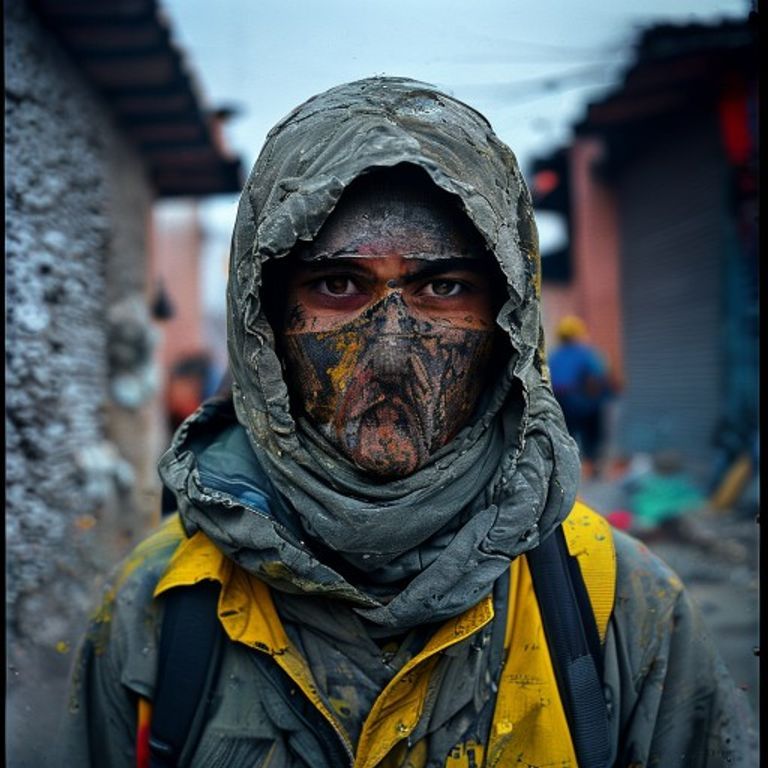
The prompt
Render in the visual register of a 2010 through 2024 Kashmiri stone-pelter street photograph, the documentary and social-media mode of youth activism and international news photographers capturing urban confrontation in Srinagar, Jammu, and other contested zones. Medium: high-speed digital photography or contemporary smartphone capture, available outdoor daylight often overcast Himalayan foothills or street-light supplemented. Palette: grey-blue overcast sky, faded concrete and blast-damaged urban architecture, worn dark denim and casual hoodie worn by youth, the bright yellow-green-black of Indian paramilitary riot gear in sharp contrast, asphalt grey and brick-dust ochre, occasional blood-red in injury. Texture: fine concrete dust from explosive rounds, worn fabric of casual clothing, the hard plastic of riot helmets and shields, sweat and fear-response on visible skin, urban grime press into seams. Lighting: cool daylight in overcast conditions, occasional sharp tactical light from security forces, the warm interior glow from windows of adjacent buildings. Mood: the moment the stone-pelter understands that fire-discipline and witness are the only weapons available, the photograph that says to the world this is not a military conflict it is a population claiming its own body as territory, the visible unity of strangers thrown into the same street by the same occupation. No legible text, no named slogans, no military insignia, no named organizations. Preserve the subject, pose, and composition of the source image exactly, change only the medium and rendering.
What it is doing
The stone-pelter is the asymmetric response to the paramilitary occupation. The stone-pelter cannot win militarily but the stone-pelter does win symbolically every time the image reaches an audience. One rock breaks the riot shield's propaganda of omnipotent state force. The young Kashmiri understands this is not a fight won by logistics but by image-production. Every peltrade is a media operation. The state has helicopters and artillery. The youth have the moral clarity of the stone and the witness-bearing of the camera. The photograph of the stone-pelter in the street is the only arena in which the occupied can claim equality with the occupier.
Ways to change it
Pick any of these in the gallery and the choice is added to the prompt you copy.
- Street setting: open plaza (exposed) vs alley with cover (tactical) vs commercial street (civilian zone witness)
- Youth detail: mid-pelt frozen moment (action) vs loaded posture (about to throw) vs retreat (suppressive fire) vs aid to injured (moral frame)
- Opposing force visibility: close paramilitary riot line (high tension) vs middle-distance deployed (siege mood) vs distant vehicles (asymmetry visible)
- Injury markers: thin streak of blood on the forehead, dust-caked face vs no visible injury, clean face set in a steady stare vs white gauze bandage wrapped around the head, taped cheek vs arm in a makeshift sling, torn sleeve, bruised knuckles
- Weather: grey overcast (cold distance) vs rain and tear-gas mist vs snow (winter siege) vs bright sun (harsh clarity)
- Era dial: 2010, grainy early phone photo, crowded street, sparse riot gear vs 2016, sharp news-camera frame, masked youth, thick tear gas haze vs 2019 to 2024, near-empty street, razor wire, shuttered shops, muted tones
Related prompts
See all 33 prompts in the Guerilla grammar