Graffiti-Mural / Style prompt
Berlin Wall East Side Gallery Concrete Mural
The post-November-89 painted-on-the-wall-itself register, 118 artists across 1316 meters, the literal instrument of containment converted to canvas.
Customize this prompt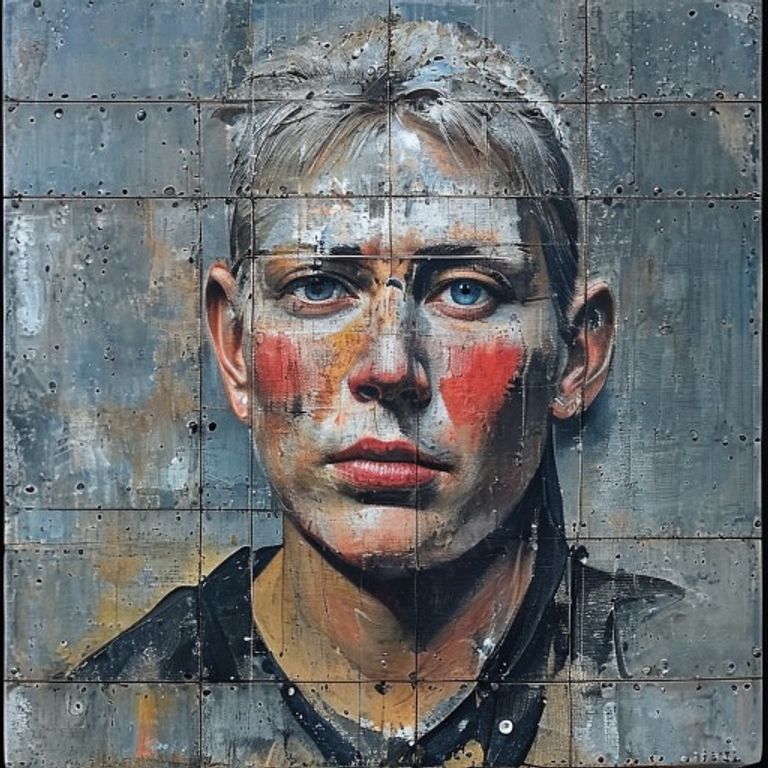
The prompt
Render in the visual register of an East Side Gallery panel painted on the Mauer concrete sections in the months immediately after November 1989 and through the canonical 1990 phase of the Wall painting. Medium: exterior masonry house-paint and acrylic applied with brushes and rollers directly onto the precast concrete L-section panels of the former Berlin Wall, characteristic of the open-call international-artist phase. The brushwork is gestural and unprimed onto the slightly textured concrete face. Palette: cold East Berlin overcast palette as base, with bold saturated paint laid over: cadmium red, ultramarine blue, cadmium yellow, ivory black, titanium white, occasional metallic silver, the muted grey-beige of the underlying concrete showing at edges and through thin paint. Texture: precast concrete surface texture clearly visible under paint, the slight relief of formwork seams in the panel, occasional drip and roller-stipple, weathering streaks from rain runoff on east-facing slabs. Lighting: typical Berlin overcast, soft and flat, occasional break of low northern sun. Mood: the dignity of the most aggressive recontextualization in late twentieth century public art, the wall-that-killed-people-trying-to-cross repurposed as a continuous open-air canvas by the people who survived it. Do not render any legible text, slogans, dates, signatures, logos, watermarks, named hate symbols, or defamatory likeness of real persons; all text-feel and visual elements are abstract painted forms only. Preserve the subject, pose, and composition of the source image exactly, change only the medium and rendering.
What it is doing
The East Side Gallery is the most efficient act of public-space recontextualization in modern history because it answered the question every other post-authoritarian transition fumbles: what do you do with the instrument? You do not tear it down. You do not preserve it as a museum. You hand it to 118 painters and tell them to make it into a canvas. The Wall that killed dozens of escapees became, within months, the longest continuous open-air mural on Earth. The lesson is universal: every instrument of containment that survives the regime should be converted into a substrate for the population's own narration. Statues come down; walls get painted over.
Ways to change it
Pick any of these in the gallery and the choice is added to the prompt you copy.
- Weathering stage: fresh-1990 vs weathered-2000s vs restored-2009
- Paint application: thin-wash-concrete-showing vs full-saturation vs heavy-impasto
- Light hour: flat-overcast vs raking-low-sun vs blue-evening
- Camera angle: square-on panel vs angled-perspective vs wide-stretch-of-wall
- Palette restraint: bold-primary vs muted-restrained vs monochrome
- Era reference: 1990 original vs 2000s weathered vs 2009 restoration
Style lineage
Learn the visual culture this draws from: East Side Gallery, Berlin (118 artists from 21 countries painted 1990, world's longest open-air gallery).
Related prompts
See all 15 prompts in the Graffiti-Mural grammar