Graffiti-Mural / Style prompt
Palestinian Separation-Wall West-Bank Mural
The West Bank separation-wall mural register, eight-meter concrete slabs painted with murals visible from Bethlehem and Ramallah streets, the blockade as canvas.
Customize this prompt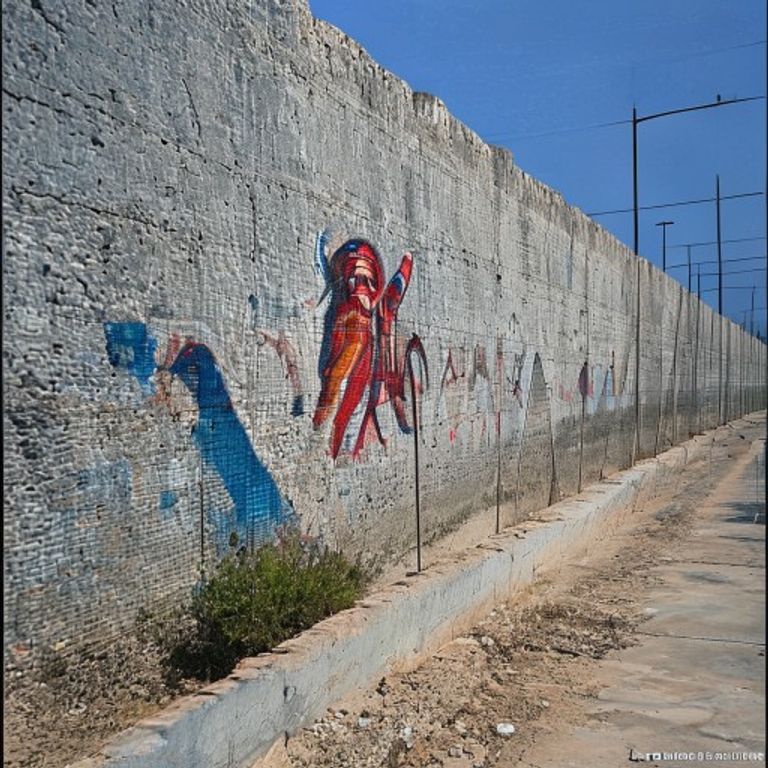
The prompt
Render in the visual register of a mural painted on the Palestinian side of the West Bank separation barrier in Bethlehem, Ramallah, or Qalandiya, the international and local artists wave from roughly 2003 through the present. Medium: exterior masonry paint, aerosol, and roller-applied house paint on the smooth poured-concrete face of an eight-meter precast separation-barrier slab, working at architectural scale with brushes, rollers, and aerosol cans on extending poles, characteristic of both the well-known international artist contributions and the much larger volume of local Palestinian painters. Palette: cold concrete-grey of the barrier as base, with paint applied in either restrained near-grayscale tones with single accents, or full-saturation expressive color depending on the work, the high-summer sun-bleach evident in older works. Texture: precast concrete with visible formwork seams between slabs, occasional rebar mark, the slight rain-runoff weathering streaks on east and west faces, paint with the cup of years of harsh sun and winter cold, occasional layer-palimpsest where one mural was painted partially over another. Lighting: harsh Levantine sun, hard shadows, the high-contrast clarity of dry Mediterranean climate. Mood: the dignity of the medium that takes the instrument of separation and converts it into the most-photographed concrete on Earth, the calculated inversion in which the barrier's purpose of invisibilization fails because the painters made it the most visible wall in modern political geography. Do not render any legible text, slogans, dates, signatures, names, logos, watermarks, named hate symbols, identifiable national flags rendered as recognizable insignia, or defamatory likeness of real persons; all text-feel and political symbols are abstract painted forms only without specific identifying details. Preserve the subject, pose, and composition of the source image exactly, change only the medium and rendering.
What it is doing
The Israeli separation barrier was designed to make the Palestinian population invisible to the Israeli population. The Palestinian-side mural project inverted the engineering objective in the most efficient way possible: by making the wall the most-photographed concrete on Earth and ensuring that every photograph of the wall is necessarily a photograph from the Palestinian side. The barrier achieves its physical objective and fails its informational objective in the same act, because the engineers did not think about what happens when the population you are trying to invisibilize is also the population with access to paint. The wall is now the longest political broadsheet in the world. This is the universal lesson: any wall built to suppress a population becomes, within a decade, the population's largest publication. There is no version of this that does not happen, and there is no counter-measure that does not look worse than the wall itself.
Ways to change it
Pick any of these in the gallery and the choice is added to the prompt you copy.
- Wall section: Bethlehem-Aida vs Ramallah-Qalandiya vs Bil'in-rural
- Mural register: restrained-near-grayscale vs full-color expressive vs naive-folk
- Weathering: fresh-recent vs five-year vs decade-deep palimpsest
- Light hour: harsh-noon vs late-afternoon-warm vs blue-evening
- Camera angle: square-on-slab vs angled-perspective vs wide-stretch-of-barrier
- Wall Era: fresh gray slabs, few sparse stenciled pieces, clean concrete between vs dense overlapping murals edge to edge, bright saturated color, fresh paint (signature) vs layered palimpsest of faded sun-bleached murals, newer tags painted over
Style lineage
Learn the visual culture this draws from: West Bank separation barrier art (Palestinian muralists).
Related prompts
See all 15 prompts in the Graffiti-Mural grammar