Graffiti-Mural / Style prompt
Belfast Political Mural Sectarian
1970s through post-Good-Friday Belfast and Derry gable-wall mural register: Falls Road republican and Shankill loyalist visual grammars, hand-painted on terraced-house end walls.
Customize this prompt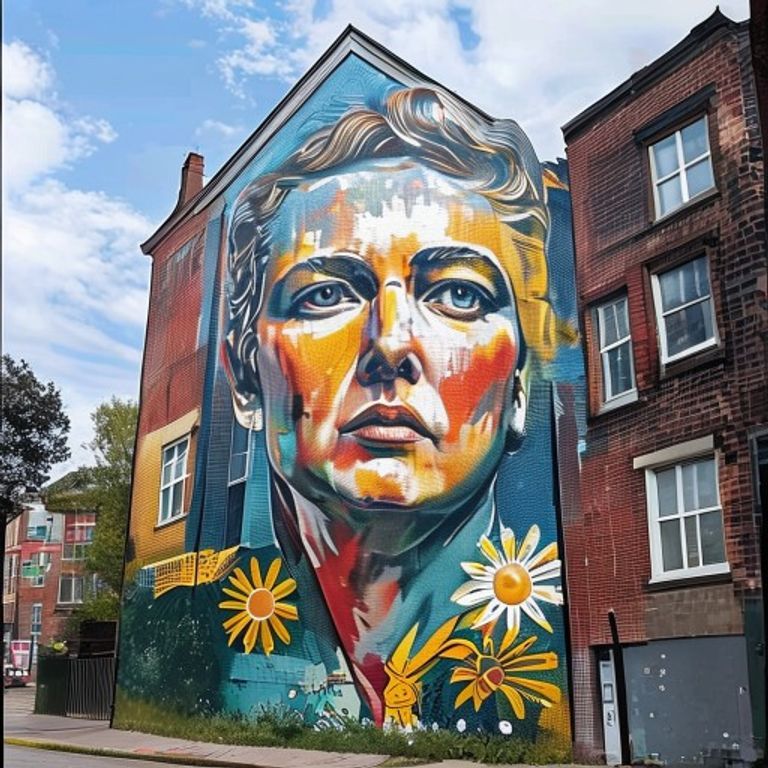
The prompt
Re-render this image in the visual register of Belfast and Derry political gable-wall murals from the 1970s through the post-1998 Good Friday period (the body of hand-painted exterior murals produced on terraced-house end walls along the Falls Road, Shankill Road, Bogside, and Ardoyne, by both republican and loyalist communities, documented extensively by an academic studying political murals). Hand-painted exterior wall aesthetic: flat house-paint emulsion on rendered pebbledash or smooth painted brick gable end, large-scale mural occupying an entire two-story end wall. Palette dependent on factional register: republican-tradition palette runs forest green, white, gold-yellow, sky blue, with black and white photographic-portrait elements; loyalist-tradition palette runs Union red, royal blue, orange, white, with stark black-and-white historical-portrait elements. Both registers use saturated flat color with hard outline and a slight house-paint glossiness. Rendering: figure painted with photographic ambition but mural simplification, hand-painted portrait with reasonable likeness but no fine detail, surrounded by symbolic-element architecture (sunbursts, banners, harps, lilies, or rampant lions, fists, gauntlets, depending on faction). Surface: pebbledash texture visible under the paint, occasional drainpipe or window-edge intruding into the composition (handled as compositional feature not problem), drip-streaks down from cornice from rain wash, faded patches where southern light bleached pigment. Light: flat documentary daylight, terraced-street photography frontal-on, ladder-bay slightly off-axis, the wall photographed by a passerby. Composition: monumental single figure or paired figures occupying the gable, symbolic field around the figure organized as heraldic banner, the composition reads as a flag-as-wall. Mood: claimed territory, sectarian assertion as community signature, the wall declares which side of which road this is. Strictly no on-canvas legible text, no Tiocfaidh ar la, no UVF or UDA lettering, no IRA lettering, no Easter Rising dates, no King Billy lettering, no street names, no slogans, no watermark. Preserve the subject, pose, and composition of the source image exactly, change only the medium, surface, and palette register. Aspect ratio matches source.
What it is doing
The Belfast gable wall is the most legible territorial-claim infrastructure in late twentieth century Europe. Collins would recognize the logic immediately, the wall declares whose flying column controls this street, the symbolic vocabulary is pre-agreed inside the community and instantly readable to outsiders. The mural is not decoration, it is the printed front page of a community newspaper that runs continuously for years. Faction determines palette before anyone paints a single figure.
Ways to change it
Pick any of these in the gallery and the choice is added to the prompt you copy.
- Faction dial: republican Falls Road green-white-gold vs loyalist Shankill red-white-blue vs republican Bogside Derry vs loyalist Ardoyne tactical commemorative
- Period dial: 1970s emerging vs 1981 hunger-strike peak vs 1990s ceasefire transitional vs post-1998 commemorative-historical
- Symbol-density dial: single monumental portrait vs portrait plus heraldic banner vs paired figures plus symbolic field vs pure symbolic no portrait
- Wear dial: freshly painted commemorative vs weathered five years vs decades-old faded vs painted over by community-relations program
- Surface dial: rendered pebbledash texture vs smooth painted brick vs concrete render flat vs partially boarded wall
Related prompts
See all 15 prompts in the Graffiti-Mural grammar