Graffiti-Mural / Style prompt
Basquiat Neo-Expressionist Crown Scrawl
Late-1970s SAMO through 1988 studio register: oil-stick and acrylic on door, plywood, and primed canvas, scrawled diagrammatic figures with three-point crown overhead and aggressive cross-outs.
Customize this prompt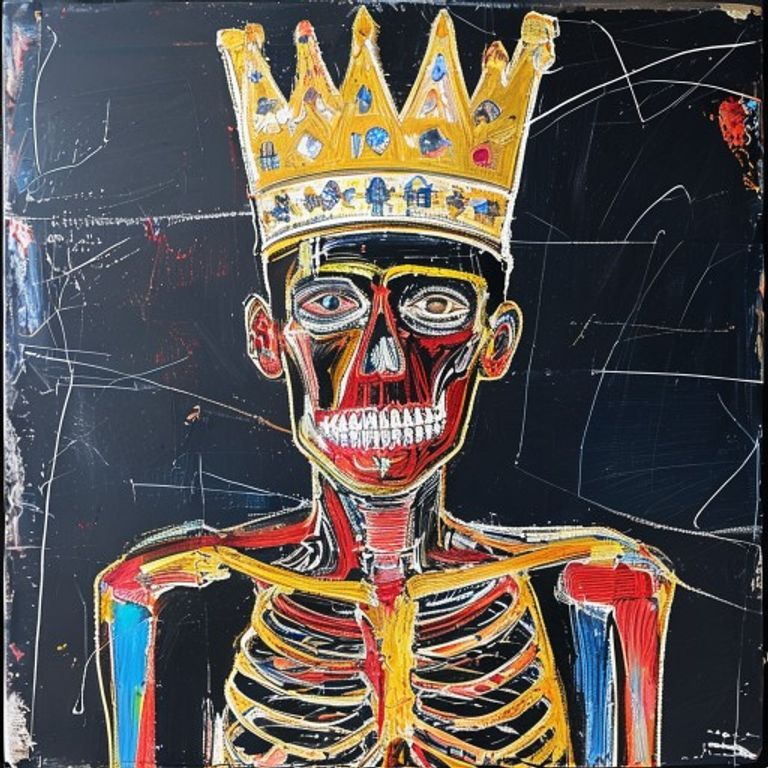
The prompt
Re-render this image in the visual register of Jean-Michel Basquiat from the late 1970s SAMO tags through the 1981 to 1988 studio paintings (the body of work spanning the early downtown Manhattan wall and door scrawls and the stretcher-canvas neo-expressionist paintings produced in his Crosby Street and Great Jones Street studios). Oil-stick and acrylic on raw substrate aesthetic: unprimed plywood, found door, or primed canvas with the priming visible and uneven. Palette saturated and clashing: cadmium red, cadmium yellow, ultramarine and cobalt blue, white, with thick black oil-stick as the dominant drawing color, plus occasional metallic gold or copper for crown elements. Rendering: anatomically schematic figures with exposed ribcage, internal organs sketched as diagrammatic anatomy-textbook references, teeth and skull elements emphasized, hands oversized, eyes asymmetric and emotionally charged. Line: aggressive oil-stick scrawl with visible re-drawing, lines crossed out and re-drawn beside the cross-out (the cross-out is part of the composition not a correction), heavy black contour over flat color zones. Crown motif present somewhere in the composition: a simple three-point spiked crown rendered in black or gold oil-stick floating above or beside the figure. Surface: paint-drip down the canvas, oil-stick smear at the edges, occasional collaged paper element (without legible text), thumb-prints in wet paint at corners. Light: flat picture-plane, no atmospheric depth, every element on the same surface plane, occasional grid or arrow indicating spatial logic without rendering it. Composition: aggressive, asymmetric, cropped figures pushing against the frame, lists of crossed-out words SUGGESTED by horizontal banding (without legible letters). Mood: confrontational sovereignty-claim, the artist asserting kingship over a downtown that did not yet recognize him, jazz-record-cover and anatomy-textbook fused. Strictly no on-canvas legible text, no SAMO tag, no legible word-lists, no copyright marks, no legible letters of any kind, no signature, no watermark. Preserve the subject, pose, and composition of the source image exactly, change only the medium, line, and surface. Aspect ratio matches source.
What it is doing
The three-point crown is one of the great engineered personal symbols of the late twentieth century, Bernays-class brand work disguised as scrawl. Basquiat understood that the SAMO tag was disposable but the crown was transferable, and he ported it from doors to plywood to canvas to the Sotheby's catalog. The aesthetic claims sovereignty before the institution grants it, the painting is the coronation. The cross-out is not error correction, it is sovereignty asserted by visibly choosing.
Ways to change it
Pick any of these in the gallery and the choice is added to the prompt you copy.
- Substrate dial: raw plywood vs found door vs primed canvas studio vs wall mural exterior
- Crown dial: single three-point black crown above figure vs gold crown beside figure vs multiple crowns floating vs implied crown spike only
- Anatomy dial: ribcage exposed diagrammatic vs internal organs labeled (without legible labels) vs skull-and-teeth emphasis vs whole-figure scrawl no anatomy detail
- Crossout dial: single crossed-out element vs repeated crossed-out lists banded horizontally vs no crossouts pure figure vs dense crossout field as background
- Era: 1978 street tag: black marker scrawl on a battered found door, almost no color vs 1981 early canvas: one stark oil-stick figure and crown on mostly bare ground vs 1984 peak density: layered figures, collaged paper, flat cadmium red and yellow blocks vs 1987 late work: crowded diagram fragments and arrows over a dark, muddy ground
Style lineage
Learn the visual culture this draws from: Jean-Michel Basquiat (artist, 1960-1988, SAMO tag co-founder).
Related prompts
See all 15 prompts in the Graffiti-Mural grammar