Ghibli-Meme / Style prompt
The Wind Rises Drafting-Table (2013)
Jiro hunched over the drafting table, slide-rule and pencil, the obsessive engineering frame. The craftsman as Ghibli hero, not the witch.
Customize this prompt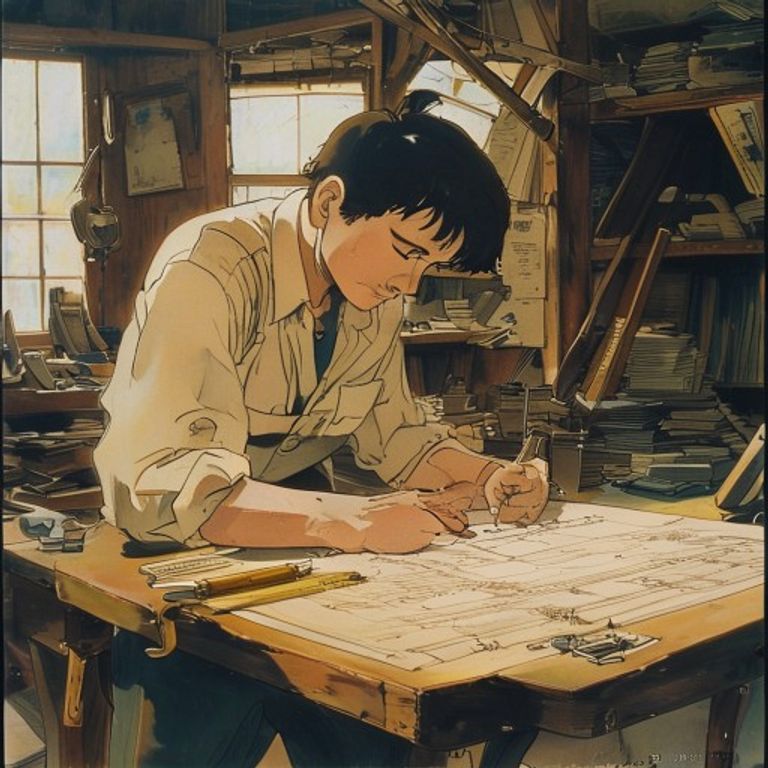
The prompt
Re-render this image as a key frame from Studio Ghibli's The Wind Rises (2013), expressive hand-painted animation direction, verdant watercolor background art, hand-painted cel animation. Subject framed in medium close-up or wider three-quarter angle, the central figure rendered as a hunched-over solitary engineer-draftsman at a wooden drafting table, leaning forward with pencil in one hand and slide-rule or set-square in the other, working on a large sheet of cream-colored drafting paper covered in airframe schematics (wings, fuselage sections, rib structures, dimension lines, the technical engineering vocabulary rendered as authentic linework patterns without legible numbers or labels). The figure's posture is the entire emotional weight: leaning in obsessively, lost in the page, the world outside the page erased by concentration. Setting: a quiet 1930s Japanese workspace (cluttered with reference texts, T-square hung on wall, single brass desk-lamp, window-light from one side, perhaps a discarded teacup half-finished and forgotten), with the painted background rendered in warm watercolor wash, predominantly warm wood-tones, ochre walls, soft-faded paper textures, the light always streaming in from one specific direction. Lighting: single warm key from upper-left window or desk-lamp, raking across the drafting paper and the figure's shoulder, casting soft shadow on the opposite side, the entire scene in golden-hour-warmth or quiet afternoon-glow. Cel-linework: confident single-weight ink lines on figure and drafting-table furniture, fine detail linework on the schematic drawings (which read as authentic engineering documents through pattern rather than legibility), background rendered painterly without heavy outline. Color palette: warm dominant (ochre, sepia, warm wood-brown, cream paper), with cool accents only in shadow areas, the entire frame trending warm and contemplative. Mood: obsessive craftsmanship, the vitalist devotion to the work, the film's engineer-artist self-portrait register, the dignity of head-down skilled labor. Composition leaves moderate negative space (upper background area or right side) suitable for top-and-right caption insertion without obscuring the drafting paper or the figure's working hands. No legible text in image, no readable schematics labels, no studio watermark, no fan-art signature, no hallucinated Japanese characters. Aspect ratio 16:9 matching source. Preserve the subject and composition of the source image exactly, change only the medium and rendering.
What it is doing
The Wind Rises is a deeply personal film and the figure of Jiro Horikoshi (the engineer obsessively designing the Zero) is a self-portrait of the obsessive-craftsman mindset. Re-rendering in this register reclaims the Ghibli aesthetic for skilled work, drafting, engineering, study, and writing rather than for the kawaii-spirit-creature merchandise the brand became.
Ways to change it
Pick any of these in the gallery and the choice is added to the prompt you copy.
- Angle dial: tight close on hands and paper vs three-quarter over-shoulder vs medium full-figure at table vs wide environment with figure small
- Light dial: golden-hour warm window from upper-left vs cool grey afternoon overcast vs single brass-lamp warm interior vs dawn cold blue starting to warm
- Subject relation dial: hunched fully absorbed (signature) vs pause to consider, pencil lifted vs head down forehead on hand (exhausted moment) vs looking out window briefly (break)
- Schematic dial: airframe ribs and fuselage (Zero) vs propeller-curve calculations vs wing-section profile vs general dimension-line layout
Style lineage
Learn the visual culture this draws from: Studio Ghibli / The Wind Rises (2013).
Related prompts
See all 15 prompts in the Ghibli-Meme grammar
Read the full free book. All thirty-six chapters and the companion 657-prompt image library are free.