Futurism / Style prompt
Balla Iterative Motion: Stroboscopic Repetition
Giacomo Balla's 1912 mode where every limb is multiplied into a flickering sequence of its own travel.
Customize this prompt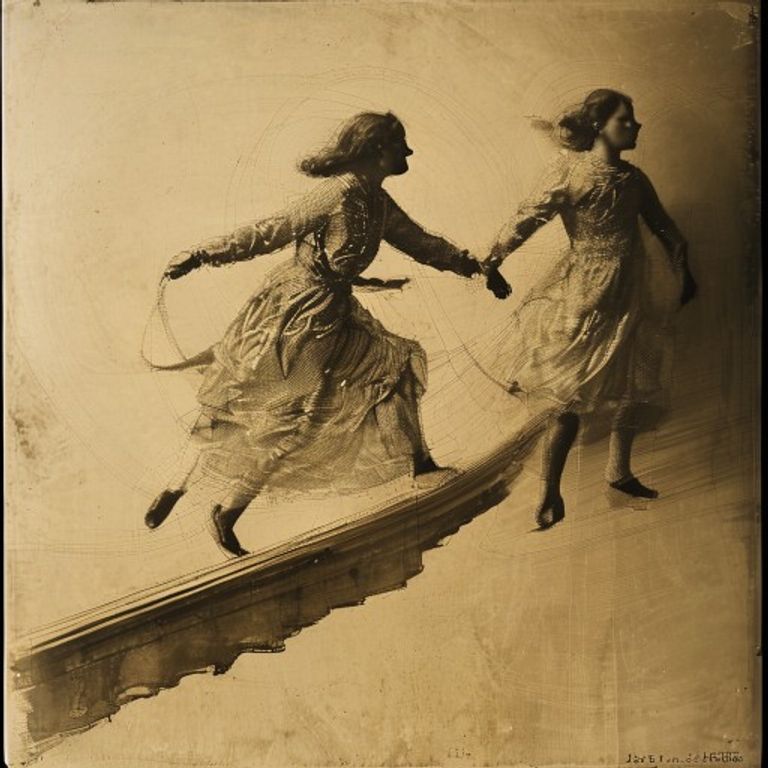
The prompt
Re-render this image in the visual register of Giacomo Balla circa 1912, in the manner of Dynamism of a Dog on a Leash and Girl Running on a Balcony. Multiply every moving element into eight to sixteen stroboscopic repetitions along its arc of travel, the way chronophotography by Marey and Muybridge captured locomotion as overlapping ghost frames. Each ghost slightly transparent, slightly offset, fanning forward in the direction of motion. Palette of warm sepia, raw umber, pewter, and dusty rose against a flat cream ground. Soft pointillist dabs blending into broader sweeps. Curved arcs of trajectory crossing the canvas. Strictly no on-canvas text, no legible lettering, no signature, no watermark, no logos. Preserve the subject, pose, and composition of the source image exactly, change only the medium and rendering. Aspect ratio matches source.
What it is doing
Balla discovered that if you paint the same dachshund's legs sixteen times you have not painted motion, you have painted the death of the single moment. The thesis is that the instant is a bourgeois fiction. Only the sequence is real. Industrial time, factory time, frame-by-frame time replaces the lived time of the body. This is the same logic the assembly line was about to install.
Ways to change it
Pick any of these in the gallery and the choice is added to the prompt you copy.
- Ghost count: 4 frames sparse vs 8 frames classical vs 16 frames full chronophoto
- Ground tone: cream flat vs sepia warm vs pewter cool
- Trajectory rendering: discrete frames only vs frames plus arc lines vs arc lines dominant
- Brushwork: pointillist dab vs soft scumble vs crisp linear
- Era anchor: 1912 chronophoto-literal vs 1913 abstracted speed vs 1915 wartime hard-edge
Style lineage
Learn the visual culture this draws from: Britannica.
Related prompts
See all 12 prompts in the Futurism grammar
Read the full free book. All thirty-six chapters and the companion 657-prompt image library are free.