Kiefer Materialist Archaeology (Style-Only, Image-Conditioned)
Style register: Anselm Kiefer 1980s onward, the subject layered with photographs, lead, straw, concrete, and burnt earth, painting as archaeological excavation, the past embedded in the material itself.
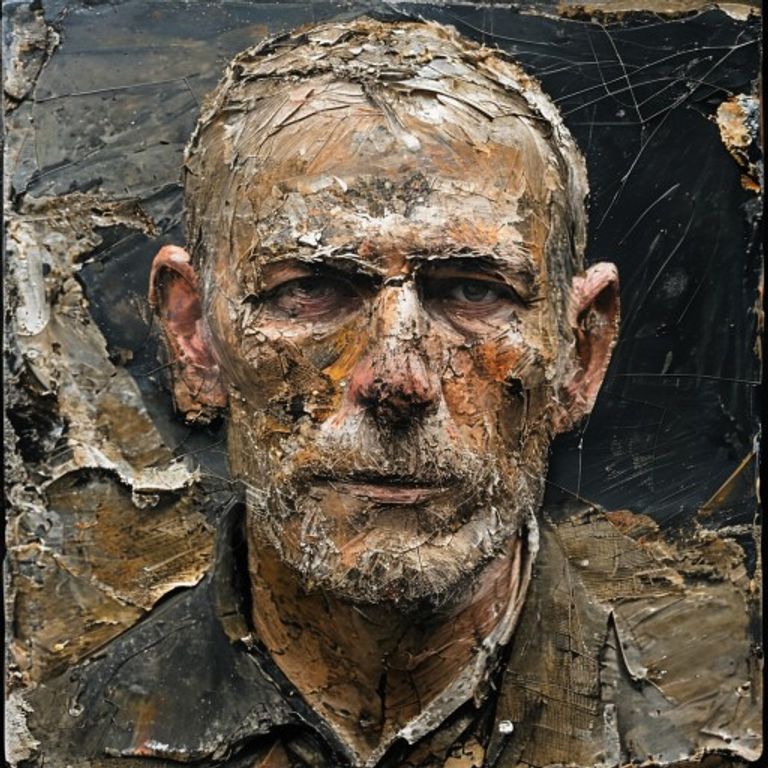
The prompt
Re-render this image as an Anselm Kiefer mixed-media painting from the 1985 to 2000 period. The surface constructed as a dense archaeological layer: a base of photographed or printed imagery (often landscape, ruin, or historical document) overpainted with oil and acrylic in muted earth tones (burnt sienna, raw umber, ivory black, zinc white, ochre). Embedded into the surface: actual materials carrying historical weight: fragments of lead sheet (with oxidized patina), raffia, straw, or string creating raised texture, dried botanical matter, sand or concrete dust mixed into the paint creating a gritty, scarred surface. The overall tonality heavy and somber, the atmosphere post-war, ash-covered, the colors those of scorched earth and corroded metal. The subject suggested but not clearly depicted, the power residing in the excavation itself, the sense that something is being uncovered layer by layer. Edges rough and unfinished, the paint applied with violence or indifference, no decorative finish. Aspect: mournful, occluded, the past literally stuck in the material. No legible text on canvas, though letters or fragments may be buried and partially erased. Preserve the subject, pose, and composition of the source image exactly, change only the medium and rendering.
What it is doing
Kiefer asks: what does it cost to make art after Auschwitz? Not morally, literally. What materials will speak the truth of what happened? He chose lead (poisonous, heavy, the metal of the printing press and the bullet), straw (the substance of concentration camp bunks), photographs (the medium of documentation and propaganda), and fire (the erasure tool of genocide). The painting is not about history; the painting IS history, archaeologically layered. There is no separation between form and content. The weight is the meaning.
Tuning knobs
- Material complexity: `dense embedded actual materials (lead, straw, sand)` (signature) vs `material suggested through paint` vs `minimal embedded material`
- Tonal range: `burnt earth monochromatic low-key` (signature) vs `broader value range` vs `occasional high-key accent`
- Layering density: `heavily worked, multiple overpainting passes` (signature) vs `single layer visible` vs `transparent luminous glaze`
- Photographic base: `printed photograph or document visible beneath` (signature) vs `painted from memory` vs `no photographic layer`
- Edge treatment: `rough, unfinished, crumbling` (signature) vs `sharp defined edge` vs `soft blurred edge`
- Texture intention: `industrial archaeological scarred` (signature) vs `gestural expressive` vs `smooth refined`
Style lineage
Learn the visual culture this draws from: German mixed-media artist (1945–).
Related prompts
See all 20 prompts in the Fine-Art grammar · Open in the gallery