Fine-Art / Style prompt
Hokusai Ukiyo-e Woodblock (Style-Only, Image-Conditioned)
Style register: Katsushika Hokusai late Edo period woodblock print grammar, 1820s through 1840s, flat planes of mineral pigment over confident black outline, Prussian blue from Dutch trade goods, the everyday world transfigured by line.
Customize this prompt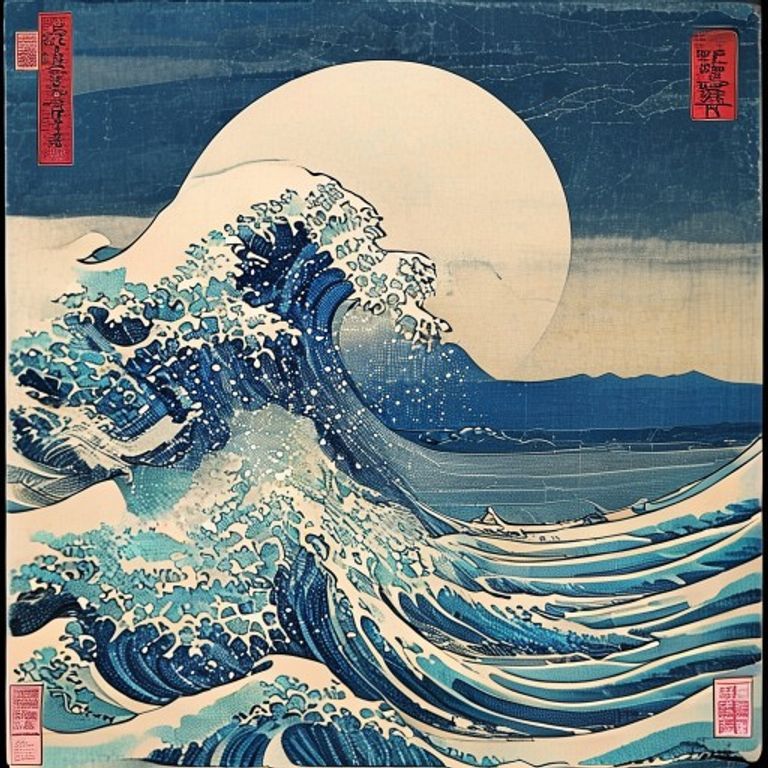
The prompt
Re-render this image as a Katsushika Hokusai ukiyo-e woodblock print from the late Edo period, circa 1830 to 1840, in the visual register of the Thirty-six Views of Mount Fuji series. Hand-cut cherrywood block aesthetic: confident black keyline of varying weight pulled in sumi ink, lines tapered at the ends, no cross-hatching, all shading achieved through bokashi gradient blocks. Flat planes of mineral pigment in registered overlays: Prussian blue (the imported aizuri pigment from Dutch traders, the signature Hokusai blue), vermilion (beni), yellow ochre, sumi black, a single pale flesh tone, occasional touches of green from yellow over blue. Skies rendered as horizontal bokashi gradients, dark Prussian blue at top fading to white at horizon. Water rendered as stylized curl-patterns of pure outline with no internal shading, the famous claw-wave grammar. Distant elements rendered smaller AND in lighter ink-load to suggest atmosphere, the only depth cue. Composition flat, no Western single-point perspective, multiple ground planes stacked vertically. Subtle washi paper grain visible throughout, slight registration misalignment between color blocks adding artisanal warmth. No on-canvas text, no kanji or hiragana hallucinated onto the image, no studio seal, no signature. Preserve the subject, pose, and composition of the source image exactly, change only the medium and rendering.
What it is doing
Hokusai discovered in his sixties that everything was line. He kept drawing every day until ninety, claiming he would only become a real artist at one hundred and ten. The woodblock register strips the Western post-Renaissance machinery (perspective, modeling, chiaroscuro) and asserts that contour, flat color, and one imported blue pigment are enough to render Fuji in thirty-six different moods. The aesthetic is a discipline of subtraction.
Ways to change it
Pick any of these in the gallery and the choice is added to the prompt you copy.
- Series register: Fuji series flat-landscape (signature) vs Hundred Ghost Tales horror outline vs Manga sketchbook loose
- Color count: 4-color registration (sumi + blue + red + yellow) (signature) vs aizuri-e blue-monochrome only
- Bokashi presence: sky and water gradient blocks (signature) vs flat color only, no gradient
- Line weight: tapered brush-line varying (signature) vs uniform fine line (more Hiroshige)
- Paper register: slight color-block misregistration (signature) vs clean modern reprint look
- Depth cue: stacked planes, no perspective (signature) vs loose atmospheric perspective
Style lineage
Learn the visual culture this draws from: Japanese ukiyo-e master (1760–1849).
Related prompts
See all 20 prompts in the Fine-Art grammar