Fine-Art / Style prompt
Rembrandt Chiaroscuro Portrait (Style-Only, Image-Conditioned)
Style register: Rembrandt van Rijn 1650s to 1660s self-portrait and group-portrait grammar, single warm light source carving the face out of brown ground, paint built up in scumbled impasto on the highlights and laid in thin glaze on the shadows.
Customize this prompt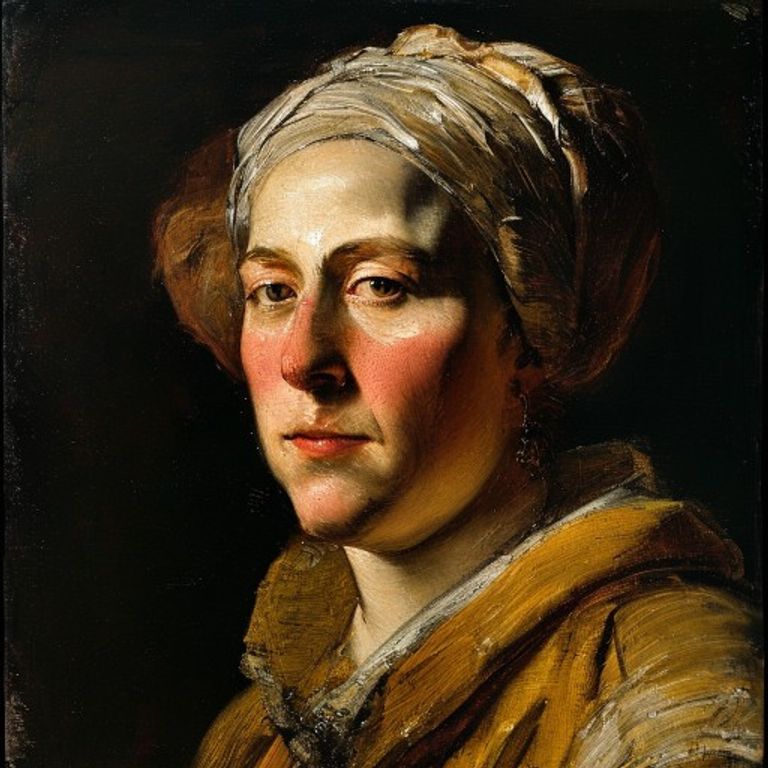
The prompt
Re-render this image as a Rembrandt van Rijn oil portrait from the late Dutch Golden Age, circa 1655 to 1665. Single warm raking light from the upper left, the rest of the canvas falling into a deep umber and bitumen ground. Build the lit cheek, brow, and nose in thick scumbled impasto, paint laid on with palette knife and stiff bristle brush, visible ridges and tooth catching real light. Shadows rendered as thin transparent glazes of burnt umber and indigo over the warm imprimatura, never opaque black, always atmospheric. Palette restricted to Naples yellow, lead white, raw and burnt sienna, burnt umber, bone black, vermilion in the cheek and lip only, a single touch of lead-tin yellow at the hottest highlight. Edges lost into the ground on the shadow side, found only at the lit jaw and the wet catch-light in the eye. Linen canvas weave visible through the thinnest passages. Patina of two-hundred-year-old varnish, faint craquelure across the dark passages, slight bituminous yellowing in the mid-tones. Mood: interior, reflective, the sitter caught mid-thought rather than posed, the painter present in the brushwork itself. No on-canvas text, no signature legible, no studio mark, no frame. Preserve the subject, pose, and composition of the source image exactly, change only the medium and rendering.
What it is doing
Rembrandt's late style is the original photography-of-the-soul. He used chiaroscuro not for drama but for confession: the lit side is what the sitter shows the world, the lost side is what they protect. To render any contemporary face in this register is to claim that face has interiority worth carving out of darkness, an inherently anti-influencer move. The technique itself is a moral assertion: paint that takes a year to dry tells you the subject was worth a year.
Ways to change it
Pick any of these in the gallery and the choice is added to the prompt you copy.
- Light angle: upper-left raking (signature) vs top-down rim vs front-flat (less Rembrandt, more Ter Borch)
- Impasto load: thick palette knife on highlights (signature) vs medium bristle vs smooth (Vermeer-adjacent)
- Ground tone: warm umber imprimatura (signature) vs cool grey vs red bole (Caravaggio drift)
- Varnish age: 200-year amber yellowing vs freshly painted clean vs darkened bitumen Reynolds-look
- Costume era: leave to source vs add period collar suggestion if reference allows
- Edge treatment: lost-and-found, shadow side dissolved (signature) vs crisp all around (more academic)
Style lineage
Learn the visual culture this draws from: Dutch Baroque painter (1607–1669).
Related prompts
See all 20 prompts in the Fine-Art grammar