Fashion-Editorial / Style prompt
Guy Bourdin Surreal-Saturated Fashion
Re-render as a 1970s Charles Jourdan Bourdin campaign: hyper-saturated color, fragmented body, the product implied or partial, surreal narrative payload.
Customize this prompt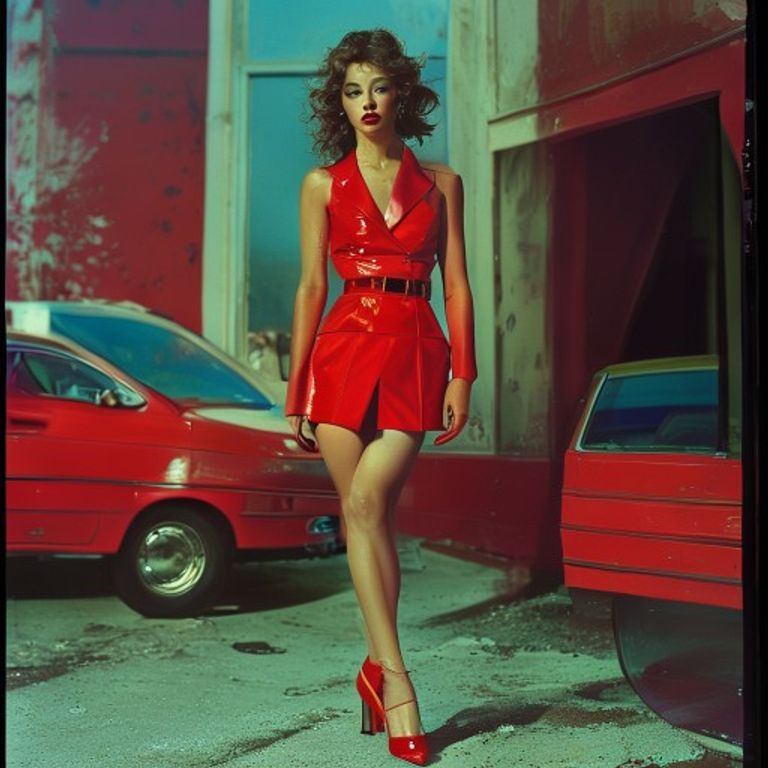
The prompt
Re-render this image as a fashion editorial or campaign photograph in the manner of Guy Bourdin's work for Charles Jourdan, Vogue Paris, and Pentax (1968 to 1985), exposed on slide film (Kodachrome or Ektachrome) for hyper-saturated color, lit with hard direct flash or studio strobe producing crisp shadow edges. Palette: extreme saturation, dominant reds (signature Bourdin red, often a pure unmodulated lacquer-red against complementary green or blue), with selective high-saturation accents (yellow taxi, magenta wall, electric blue swimming pool, white cigarette) and crushed mid-tones, the color so vivid it reads as artificial-cinematic rather than naturalistic. Setting: surreal staged scenarios that imply but never resolve a narrative (a single shoe on a wet street with no model, a leg emerging from under a car, a model on a beach with a circle of strangers walking past, a body partially in frame against a swimming pool, a bedroom mirror with only the reflected leg visible, a roadside with crashed luggage), the setting designed to make the viewer assemble a story that the image refuses to complete. Wardrobe styling cue: 1970s Charles Jourdan stiletto, lacquered nail, lipstick, swimwear, garter, the product often only one element in an otherwise wider setting. Subject: often partial (legs only, hand only, profile only, back of head only), occasionally absent entirely with only an object or body fragment standing in, never a conventional fashion-model frontal portrait pose. Lighting: hard direct frontal flash with crisp sharp shadow on background wall, or bright sun with deep contrasty shadow, the artificial-feeling illumination part of the surreal stylization. Composition: surprising, off-center, with strong geometric architectural elements (corners, mirrors, doorways) framing the subject or fragment, often dramatic crop that excludes conventional focal points. Mood: erotic, threatening, unresolved, cinematic-without-cinema, the surreal narrative as engine. Forbid: any flattering soft beauty lighting, any glossy retouched skin, any visible legible signage (no hallucinated text), any commercial product-shot flatness, any watermark. Preserve the subject, pose, and composition of the source image exactly, change only the medium and rendering.
What it is doing
Bourdin's working theory: the product (a shoe, a handbag, a lipstick) can occupy ten percent of the image and the other ninety percent can be surreal narrative, and the product still sells. This inverted the commercial-photography premise that the product must be the focus. Re-rendering in this register asserts that narrative noise around a subject is amplification, not distraction.
Ways to change it
Pick any of these in the gallery and the choice is added to the prompt you copy.
- Color dial: signature Bourdin lacquer-red dominant vs electric-blue swimming-pool tone vs green-and-red complementary clash vs magenta-and-yellow neon
- Subject-fragment dial: full figure (less Bourdin) vs partial body (legs, hand) vs subject absent, object only
- Setting dial: wet street with single object vs swimming pool partial body vs bedroom mirror reflected fragment vs roadside with crashed luggage
- Light dial: hard direct flash crisp shadow vs bright sun deep contrasty shadow vs tungsten warm uncorrected
Style lineage
Learn the visual culture this draws from: French fashion photographer (1928–1991).
Related prompts
See all 7 prompts in the Fashion-Editorial grammar