Ex-Voto-Retablo-Devotional / Style prompt
Milagro Ex-Voto with Banner Scroll
The milagro: a tiny cast-metal charm shaped like the body part healed, or the scene of salvation. Pinned to the saint's robes. Thousands of them, a swarm of gratitude in metal.
Customize this prompt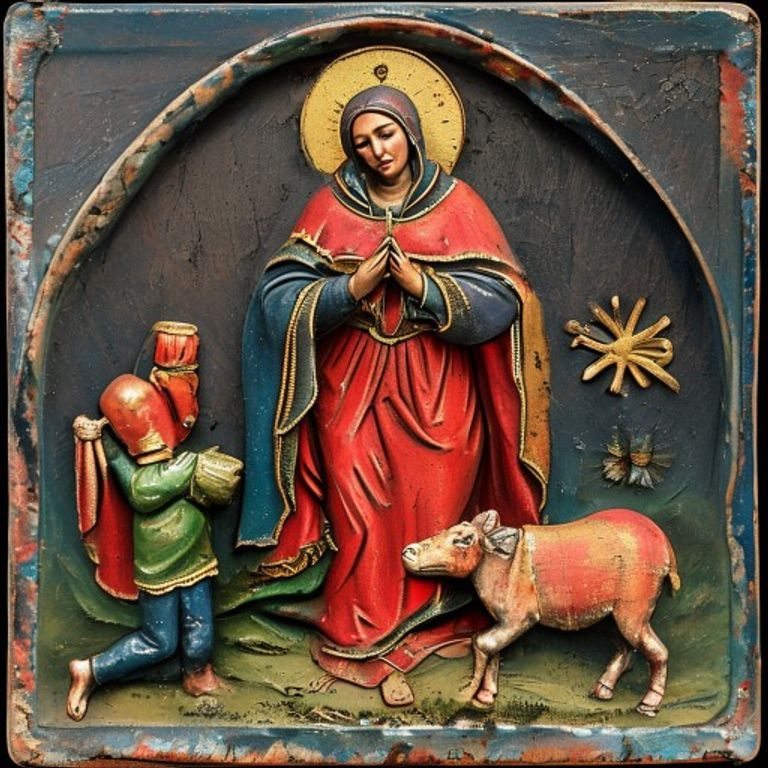
The prompt
Re-render this image as a traditional milagro ex-voto scene: a folk-Catholic votive composition showing a healed or saved person in the moment of their gratitude, alongside a depicted saint or sacred figure. The main scene rendered in naive perspective on a small painted tin or wood panel (4 to 8 inches, portrait orientation). The composition shows: one or more small human figures (proportions unidealized, proportional distortion indicating importance or emotion) in active postures of prayer, healing, or rescue; a larger or more formally rendered figure of the saint (standing, frontal, with halo indicated by thin gold or pale outline, no legible lettering on any banner or scroll that may appear). The palette saturated and flat: reds, blues, yellows, greens applied without shading or atmospheric depth. The landscape or interior setting indicated by simple geometric shapes (a cross, a threshold, a horizon line). A text-free banner or scroll in the composition (unfilled, color-blocked, or leaving the lettering space empty). Small details rendered with a child's clarity: a crutch set aside, a figure kneeling, a hand reaching upward, a donkey or cart, the specific instrument of the miracle rendered small but vivid. The surface shows age-patina consistent with centuries of chapel light and votive candle soot. If multiple milagro metal charms are rendered, show them as small cast metal forms (legs, hands, eyes, hearts, breasts) pinned across the composition in a scattered votive arrangement. The overall effect is urgent, grateful, and deeply particular to one person's answered prayer. Preserve the subject, pose, and composition of the source image exactly, change only the medium and rendering.
What it is doing
The milagro is not a work of art; it is a receipt. Someone was healed. Someone was saved. Someone promised the saint that if the prayer was answered, they would pin a small metal charm to the saint's statue or shrine as a permanent record of the debt paid. The charm is cast in the shape of the body part that was healed, or the object that represents the miracle. A leg, because I could walk again. A heart, because I did not die of grief. An eye, because I could see again. Thousands of them get pinned to the robe of the saint, and after centuries the saint is covered in a swarm of promises kept. The milagro is the closest thing to a social media feed that pre-industrial Catholicism produced. Everyone's answer to prayer. Everyone's salvation in metal. The gallery would call it folk art or outsider art. The village calls it the proof that the saint listens.
Ways to change it
Pick any of these in the gallery and the choice is added to the prompt you copy.
- Scene-complexity dial: single healed figure with saint vs narrative scene with multiple figures and action vs intimate scene of prayer or laying-on-of-hands
- Milagro-prominence dial: metal charms scattered across composition vs one large charm pinned prominently vs charms barely visible, focus on the painted scene
- Color-intensity dial: vibrant saturated primary colors vs muted folk palette vs gold-heavy with reds and deep blues
- Banner-treatment dial: decorative text-free scroll with color block vs blank unfilled banner with no frame vs banner shaped like a saint's ribbon or scroll
- Age-patina dial: relatively fresh, colors bright vs moderate chapel patina from candle-soot vs heavy aging, paint abraded, surface weathered
- Metal-charm-style dial: simple flat cast forms vs detailed tiny cast charms with features vs combination of cast charms and painted milagro objects
Style lineage
Learn the visual culture this draws from: Ex Voto Vintage.
Related prompts
See all 7 prompts in the Ex-Voto-Retablo-Devotional grammar