De-Stijl / Style prompt
De Stijl Architectural Color Plan (Style-Only, Image-Conditioned)
Style register: Theo van Doesburg and Hans Arp Cafe Aubette 1926 to 1928 architectural color-plan grammar, axonometric and orthographic renderings of interiors with primary-color planes applied to walls, ceilings, and floors as a totalizing environment.
Customize this prompt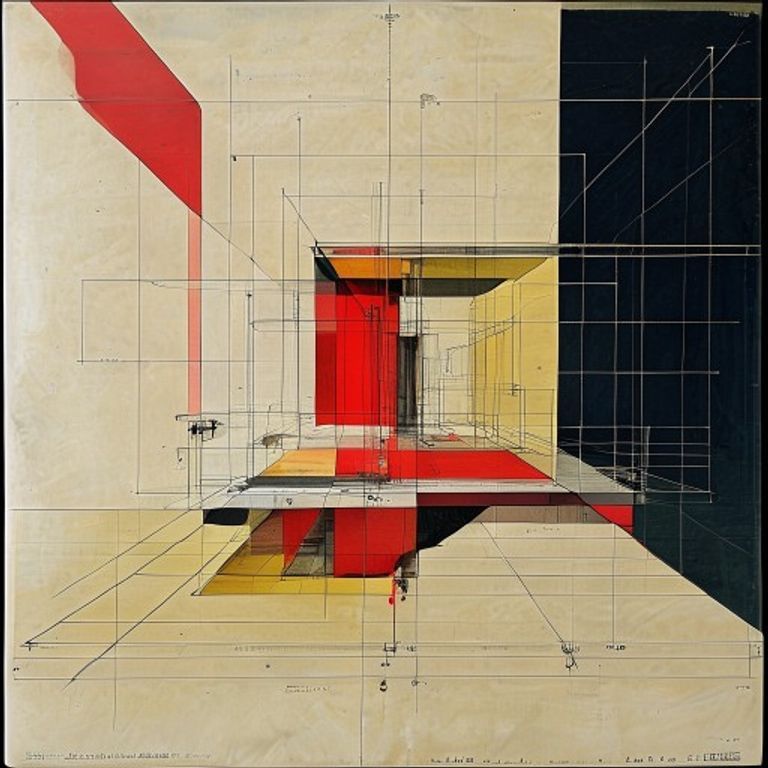
The prompt
Re-render this image in the visual register of a De Stijl architectural color-plan or axonometric study, in the tradition of the Cafe Aubette interior (Van Doesburg with Hans Arp, Strasbourg 1926-1928). Treat the picture surface as a flat orthographic or axonometric diagram: the subject reads as if pulled up into plan view or 30-degree axonometric projection, with all surfaces unfolded and presented flat. Apply primary-color planes (cadmium red, chrome yellow, ultramarine blue, chalk white, lampblack) to the unfolded surfaces, each plane a single unmodulated color, separated by heavy lampblack rule lines at 4mm to 10mm weight. Hairline construction lines and tick marks at plane intersections suggest blueprint precision. No perspective convergence, no atmospheric depth, the entire composition is flat and diagrammatic. Paper ground is unbleached drafting-vellum cream, slight tooth visible. Mood: programmatic, prescriptive, the diagram as instruction for how a space should look and therefore how it should be lived in. The De Stijl ambition reaches its endpoint here: the room itself becomes a Mondrian. Strictly no on-canvas text, no legible lettering, no signature, no watermark, no logos. Preserve the subject, pose, and composition of the source image exactly, change only the medium and rendering. Aspect ratio matches source.
What it is doing
The Cafe Aubette is the moment De Stijl pulled off and immediately got crushed. Van Doesburg and Arp converted the Aubette interior in Strasbourg into a total Mondrian environment, every wall, ceiling, and floor a primary-color plane. The local public hated it. Within ten years the interior was painted over. The buried lesson is what happens when a movement actually succeeds at imposing its grammar on inhabited space: people stop wanting to inhabit it. The color-plan is the most ambitious form De Stijl took and the one that proved the doctrine had a ceiling.
Ways to change it
Pick any of these in the gallery and the choice is added to the prompt you copy.
- Projection type: axonometric 30 degrees (signature) vs pure orthographic plan view vs isometric 45 degrees
- Surface unfolding: walls and ceiling unfolded flat (signature) vs single elevation only vs full nested plan-section-elevation
- Color plane density: every surface a primary or white (signature) vs sparse primary accents on white vs dense black with primary inserts
- Construction-line visibility: hairline ticks at intersections (signature) vs no construction lines vs heavy blueprint annotation marks
- Ground: drafting-vellum cream with tooth (signature) vs pure white vs blueprint cyan reverse
Style lineage
Learn the visual culture this draws from: MoMA.
Related prompts
See all 6 prompts in the De-Stijl grammar