De-Stijl / Style prompt
Van der Leck Figural Primary Reduction (Style-Only, Image-Conditioned)
Style register: Bart van der Leck 1917 to 1920 De Stijl figural compositions, the human figure reduced to flat geometric shards in primary colors against a white ground, sitting between figuration and full abstraction.
Customize this prompt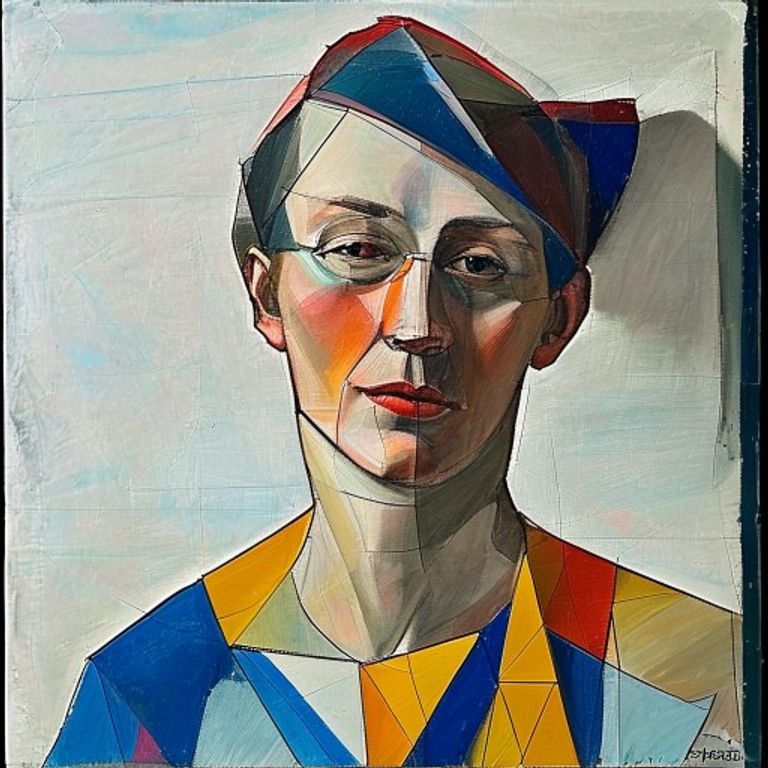
The prompt
Re-render this image in the visual register of a Bart van der Leck early De Stijl figural composition, circa 1917 to 1920. Treat the subject as if it were reconstructed entirely from flat angular geometric shards: triangles, rhombi, narrow rectangles, occasional circles, each shard a single unmodulated primary color (cadmium red, chrome yellow, ultramarine blue) or lampblack, set against an unprinted chalk-white ground. The figure or subject is recognizable but reduced, never volumetric, no shading, no contour line connecting shards, the white ground bleeds between shards so each colored element floats discretely on the field. Shards are slightly tilted at small angles to suggest implied posture and direction. No black grid lines, no Mondrian rectangle, the structure comes from the arrangement of shards themselves. Painted in flat oil or gouache on linen, slight visible weave through the white ground, no atmospheric softening anywhere. Mood: contemplative, primitive-modern, the figure dignified through reduction rather than caricatured by it. The quiet, less-dogmatic alternative to Mondrian's full grid. Strictly no on-canvas text, no legible lettering, no signature, no watermark, no logos. Preserve the subject, pose, and composition of the source image exactly, change only the medium and rendering. Aspect ratio matches source.
What it is doing
Van der Leck is the De Stijl member nobody talks about because he kept the figure. He showed that you could obey the primary-color and flat-plane discipline of the movement and still allow the human form to remain visible, broken into shards but recognizable. This was treated by Mondrian and Van Doesburg as a halfway compromise. In retrospect it may have been the most humane position in the movement: that reduction is a method, not an ideology, and that the human body does not have to disappear for the doctrine to work. The shard-figure is the De Stijl path that admits people exist.
Ways to change it
Pick any of these in the gallery and the choice is added to the prompt you copy.
- Shard density: moderate, white ground visible between shards (signature) vs dense, near-tiling vs sparse, mostly white with few shards
- Tilt angle: small 5 to 15 degree implied posture (signature) vs strict orthogonal vs dramatic 30 to 45 degree
- Color balance: all three primaries plus black (signature) vs red and black only (Suprematist drift) vs single primary accent
- Ground: chalk-white linen weave visible (signature) vs smooth gesso white vs warm cream
- Figure recognizability: clearly readable through shards (signature) vs near-abstract, barely figural vs caricature-readable
Style lineage
Learn the visual culture this draws from: Tate.
Related prompts
See all 6 prompts in the De-Stijl grammar