De-Stijl / Style prompt
Rietveld Spatial Primary Plane (Style-Only, Image-Conditioned)
Style register: Gerrit Rietveld 1918 to 1925 Red and Blue Chair and Schroder House grammar, neoplastic doctrine translated into three-dimensional space, lacquered primary planes intersecting at right angles, structural members in lampblack.
Customize this prompt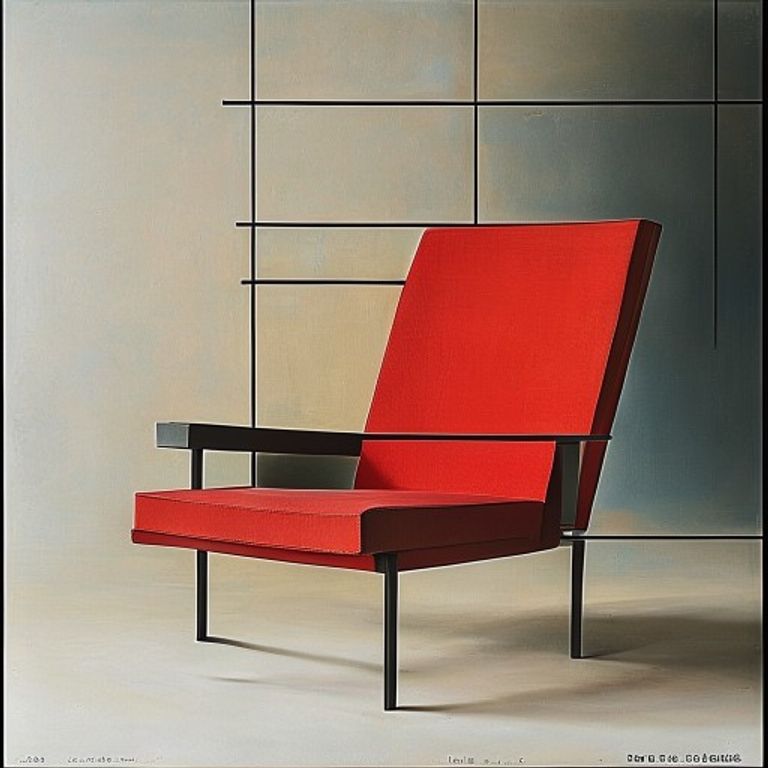
The prompt
Re-render this image in the visual register of a Gerrit Rietveld De Stijl object or interior, somewhere between the Red and Blue Chair (1918) and the Schroder House (1924). Treat the subject as if it were rebuilt from intersecting flat planes and slender black-lacquered structural members. Planes are painted in flat unmodulated cadmium red, chrome yellow, ultramarine blue, and chalk white, each plane one solid color, no gradient, no atmospheric shading. Structural members (the equivalent of the chair's wooden battens) are lampblack-lacquered slender bars, square in cross section, terminating cleanly at exposed cut ends. Planes float and intersect at right angles only, slight visible gap or shadow where they meet, never welded into mass. Render against a neutral warm-grey or unbleached-cotton ground that lets the primary planes pop. Surface is lacquered, faint sheen, no brushwork visible, the finish of furniture-grade enamel rather than oil paint. Mood: domestic, didactic, the doctrine of De Stijl applied to the apparatus of daily living. The composition feels like the Mondrian grid stepped out of the canvas and demanded you sit on it. Strictly no on-canvas text, no legible lettering, no signature, no watermark, no logos. Preserve the subject, pose, and composition of the source image exactly, change only the medium and rendering. Aspect ratio matches source.
What it is doing
The Rietveld chair is uncomfortable on purpose. So is the Schroder House. The doctrine was that the rectangular plane and the primary color, having been declared the moral foundation of painting, must extend into the chair, the cabinet, the staircase, the floor plan, eventually the city. The hidden claim is total: every object should obey the same grammar, and the human body that uses them should learn to fit. This is the line between the utopian and the totalizing. Rietveld was one of the most genuinely democratic of the De Stijl figures, but his chair still demands that you sit the way he says.
Ways to change it
Pick any of these in the gallery and the choice is added to the prompt you copy.
- Plane vs member ratio: balanced planes plus members (signature) vs member-dominant (skeletal chair-like) vs plane-dominant (Schroder-house-like)
- Color count: all three primaries plus white and black (signature) vs single primary accent vs red and blue only
- Plane gap: slight visible shadow at intersections (signature) vs flush welded mass vs wide dramatic floating gap
- Finish: lacquered furniture sheen (signature) vs matte chalk paint vs high-gloss automotive
- Ground: warm grey or unbleached cotton (signature) vs pure white void vs dark studio black
Style lineage
Learn the visual culture this draws from: Rietveld.
Related prompts
See all 6 prompts in the De-Stijl grammar