De-Stijl / Style prompt
Van Doesburg Elementarist Diagonal (Style-Only, Image-Conditioned)
Style register: Theo van Doesburg 1924 to 1930 Counter-Composition and Elementarist phase, the orthogonal Mondrian grid rotated 45 degrees and treated as a diagonal compositional engine, primary color and black-white discipline preserved.
Customize this prompt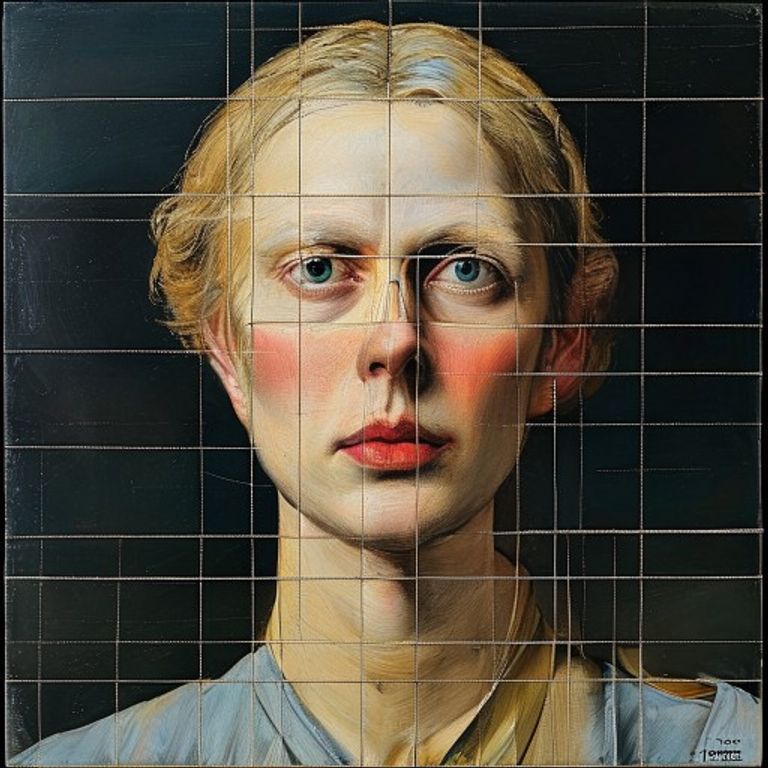
The prompt
Re-render this image in the visual register of a Theo van Doesburg Counter-Composition or Elementarist work, circa 1924 to 1930. Treat the picture surface as a Mondrian-discipline grid (heavy lampblack rule lines, chalk-white ground, primary color cells in cadmium red, chrome yellow, ultramarine blue) rotated 45 degrees so that all grid lines run as diagonals rather than horizontal-vertical. The underlying subject is re-read as boundaries within the rotated diagonal grid. Maintain the same flat unmodulated primary palette and the same heavy 4mm to 12mm black line weight as Mondrian, but every line runs at 45 degrees up-left or up-right, never horizontal or vertical. Color cells are sparse and load-bearing (3 to 5 colored, rest white). Slight oil-paint ridge at boundaries, faint stiff-bristle brushwork visible in raking light. Composition feels kinetic and unstable compared to Mondrian's repose, the eye reading motion and tension because the right angles are tilted off-axis. Mood: confrontational, dynamic, the doctrine of De Stijl pushed into its heretical phase. Strictly no on-canvas text, no legible lettering, no signature, no watermark, no logos. Preserve the subject, pose, and composition of the source image exactly, change only the medium and rendering. Aspect ratio matches source.
What it is doing
The Van Doesburg / Mondrian schism over the diagonal in 1924 looks pedantic from the outside but was the central doctrinal moment of De Stijl. Mondrian believed the horizontal stood for the earthly and the vertical for the spiritual and that the intersection of the two at right angles was the only honest visual language. Van Doesburg argued that the diagonal introduced time, movement, the modern condition of speed, and that the doctrine had to evolve to admit it. Mondrian quit the movement over this. The diagonal looks decorative; it was actually a refusal to remain quiet. Counter-composition is the Reformation of geometric abstraction.
Ways to change it
Pick any of these in the gallery and the choice is added to the prompt you copy.
- Rotation angle: strict 45 degrees (signature) vs 30 to 60 degree variable vs slight 15 degree tilt
- Color cell count: 3 to 5 cells colored (signature) vs single primary accent vs dense colored
- Line weight: 4mm to 12mm varied (signature) vs uniform thick 10mm vs delicate 2mm
- Diagonal tension: off-center diagonal cells, a few colors pulling toward one corner (signature) vs near-symmetric diamond grid, evenly spaced lines, colors balanced across vs dense cascade of tiny diagonal cells tumbling steeply down one side
- Brushwork: faint stiff-bristle (signature) vs industrial flat vs heavy impasto
Style lineage
Learn the visual culture this draws from: The Art Story.
Related prompts
See all 6 prompts in the De-Stijl grammar