Constructivism / Style prompt
Lissitzky Proun: Architectural Axonometric Float
El Lissitzky's Proun mode circa 1920 to 1925, geometric architectural forms floating in axonometric space.
Customize this prompt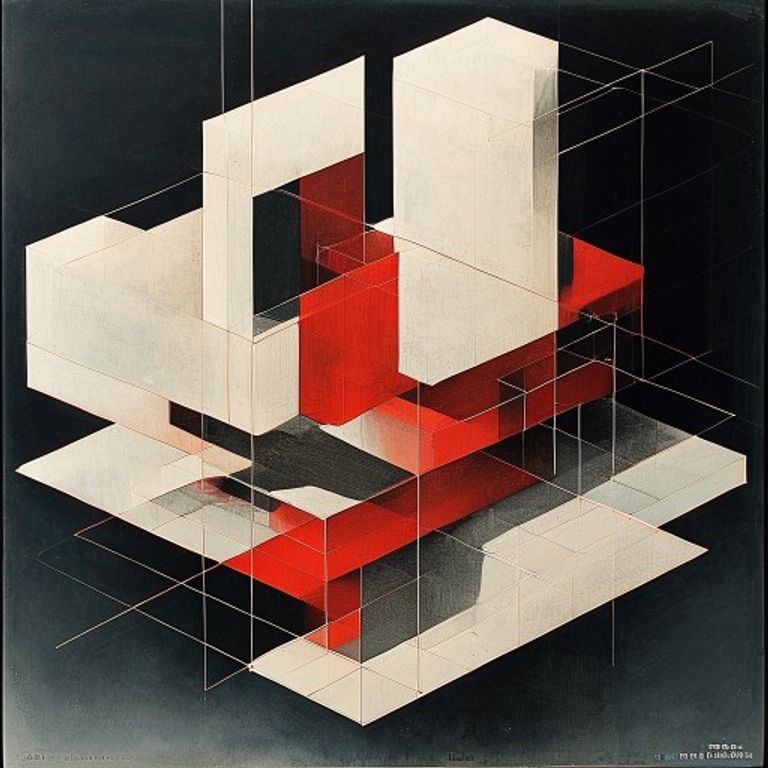
The prompt
Re-render this image in the visual register of El Lissitzky's Proun series circa 1920 to 1925 (proun = project for the affirmation of the new). Construct the composition as a floating architectural diagram in axonometric or isometric projection: flat geometric volumes (rectangles, triangles, circles, thin bars) suspended in non-gravitational space, casting no traditional shadow but interlocking through line-weight and color overlap. Palette of deep oxide red, ink black, cream, gunmetal grey, and one cold pale blue. Surface reads as gouache and ink on prepared board, perfectly flat color fields with hard precise edges. Compositional energy is structural and weightless, like a blueprint detached from the page. The subject of the source is rebuilt as a constructed geometric assembly within this floating field. Strictly no on-canvas text, no legible lettering, no signature, no watermark, no logos. Preserve the subject, pose, and composition of the source image exactly, change only the medium and rendering. Aspect ratio matches source.
What it is doing
Proun proposed an art form between painting and architecture: the project for the affirmation of the new. The honest reading is that it is the project for the affirmation of pure planning over actual building, of diagram over inhabitation. The state Lissitzky was designing for could draw beautiful blueprints and could not house its people. The aesthetic is exactly the gap: the dream rendered as if already complete, in the medium where it costs nothing to be perfect.
Ways to change it
Pick any of these in the gallery and the choice is added to the prompt you copy.
- Projection angle: isometric 30 degree vs axonometric 45 degree vs oblique 60 degree
- Element count: sparse 5 forms vs medium 12 forms vs dense 25 forms
- Float register: near-page anchored vs mid-space classical vs deep cosmic float
- Palette weight: oxide red dominant vs black and cream balanced vs blue and grey cool
- Proun phase: early Suprematist feel: rough textured paint, few heavy forms, black and red dominant vs room-scale planes: crisp volumes wrapping the frame, deep layered space, gray and cream vs late graphic precision: thin ruled lines, sparse floating bars, airy cream ground, blue accents
Style lineage
Learn the visual culture this draws from: MoMA.
Related prompts
See all 7 prompts in the Constructivism grammar