Constructivism / Style prompt
Lissitzky Red Wedge: Beat the Whites Civil War Poster
El Lissitzky's 1919 poster mode, pure geometric forms staged as military diagram.
Customize this prompt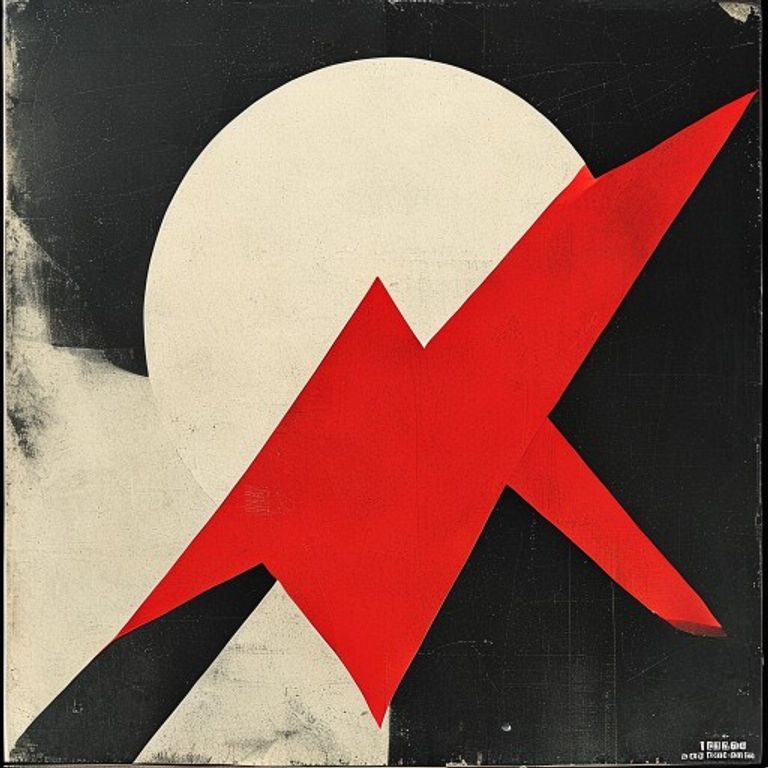
The prompt
Re-render this image in the visual register of El Lissitzky's 1919 civil war poster Beat the Whites with the Red Wedge. Construct the composition from pure flat geometric forms: a sharp red triangular wedge driving from one edge into a circular white form, with secondary thrust-shapes (rectangles, smaller triangles, thin lines) staging a diagonal battlefield. Compositional axis runs lower-left to upper-right at a steep angle. Palette is strictly five colors: vermilion red, ink black, cream off-white, deep grey, and a single accent of pure white. Surface reads as letterpress lithograph poster on coarse paper, slight ink-saturation bleed at edges, halftone density only where needed for shading on the source subject. Subject of source remains visible but is integrated into the geometric battlefield as a flat shape. Strictly no on-canvas text, no legible lettering, no signature, no watermark, no logos. Preserve the subject, pose, and composition of the source image exactly, change only the medium and rendering. Aspect ratio matches source.
What it is doing
Lissitzky's red wedge is a graphic invention of breathtaking economy and a battlefield report of breathtaking honesty. The painting names what the regime is doing: a sharp object penetrating a soft target. By making the invasion geometric the painting makes it admirable. Every minimalist political poster since (the "HOPE" political portrait, the Bauhaus, Italian fascist civic design) inherited the lesson that abstraction launders violence.
Ways to change it
Pick any of these in the gallery and the choice is added to the prompt you copy.
- Wedge sharpness: acute 30 degree vs medium 45 degree vs wide 60 degree
- Color count: strict 3 (red black white) vs classical 5 vs expanded 7
- Print register: crisp 1920 litho vs slight misregister vs degraded wartime
- Geometric secondary load: clean primary forms vs medium scatter vs dense secondary forms
- Era anchor: raw 1919 poster: crude wedge, rough paper, heavy ink bleed (signature) vs 1922 Proun style: floating axonometric blocks, clean tinted planes vs 1925 refined modernism: crisp edges, airy white space, precise grid
Style lineage
Learn the visual culture this draws from: Daily Art Magazine.
Related prompts
See all 7 prompts in the Constructivism grammar
Read the full free book. All thirty-six chapters and the companion 657-prompt image library are free.