Mignola Hellboy Shadow Block
Re-render with dominant heavy black forms defining the composition. The simplification IS the elegance. Dave Stewart color minimalism.
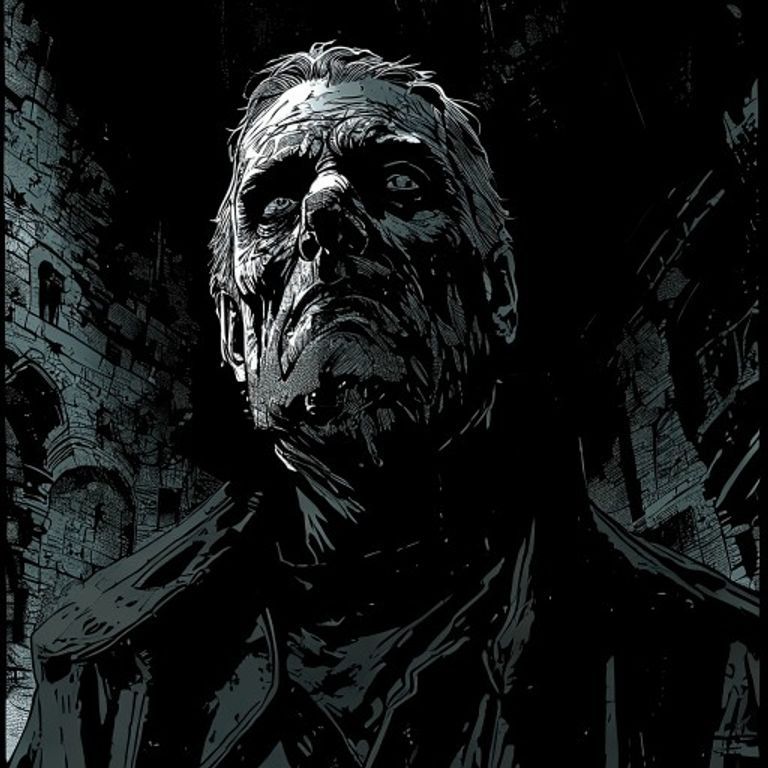
The prompt
Re-render this image as a comic book panel in the manner of Mike Mignola's Hellboy and B.P.R.D. work, colored in the restrained minimal palette of Dave Stewart. Apply Mignola's mature "blackshape" aesthetic: large flat areas of solid black ink describing entire portions of the image (clothing, shadow mass, foreground silhouette, architectural forms, ground plane), with white or colored negative shapes carved into the black to suggest form rather than render it. Linework is minimal and fragmented: single contour lines broken into suggestion, small interior detail marks (a button, a glint in an eye, a tooth, a worn edge), NO cross-hatching, NO stippling, NO blended modeling. The figure or subject emerges from the black shapes through negative space and silhouette, the contour broken as though obscured or exhausted. Color (Stewart palette): single-hue flat washes with very low saturation and restrained value range, each color washed across a panel area and left flat with no gradient or rendering, the saturation far lower than conventional comics, the palette limited to three or four colors total per panel. Setting: gothic or occult location (ruined European architecture, fog-shrouded forest at night, abandoned mine or crypt, weathered cemetery, decaying mansion interior, submarine wreck in deep water). Composition: heavy bottom-weight black mass or heavy top-weight shadow ceiling pressing down, the subject positioned in a narrow negative-space gap between black forms, or the subject rendered as silhouette against a pale background with black shadow-mass framing. Mood: exhausted melancholy, the world as old and worn and haunted, the figure as laborer in a doomed business. Forbid: any speech bubble or caption or sound-effect text on canvas, any photoreal rendering, any internal modeling inside black shapes, any digital airbrushed glow, watermark. Preserve the subject, pose, and composition of the source image exactly, change only the medium and rendering.
What it is doing
Mignola's discovery that simplification is the opposite of laziness changed how modern comics think about visual economy. The black shape is more legible at distance than the rendered figure. The silhouette conveys more emotion than the modeled face. Applied to any subject, the register asserts that subtraction is a form of addition: by removing what is unnecessary, the essential becomes visible.
Tuning knobs
- Black-mass-distribution dial: `large bottom-weight foreground block` vs `large top-weight oppressive ceiling` vs `side-weight architectural wall` vs `scattered nodal shadows throughout composition`
- Carving-detail dial: `extreme minimalism, only eye-glints and key marks` vs `medium detail suggesting form inside silhouette` vs `more rendered approach, less pure Mignola`
- Stewart-color-palette dial: `muted moss-green single-hue` vs `dusty rust-orange` vs `deep bruise-blue night` vs `sickly yellow-ochre decay`
- Setting-substrate dial: `decaying European gothic stone` vs `fog-obscured nature (trees, water)` vs `American boarded-house interior` vs `abstract architectural void`
- Composition-pressure dial: `light-compression minimal frame` vs `moderate shadow pressure` vs `extreme oppressive black-dominance`
Style lineage
Learn the visual culture this draws from: Longstride.
Related prompts
See all 16 prompts in the Comic-Book grammar · Open in the gallery
Get the free sample. The intro plus the first three chapters of The Liberation Engine, delivered as a PDF. The full book and the complete 557-prompt method are the paid edition.