Comic-Book / Style prompt
EC Horror Pre-Code Pulp
Re-render as an EC Comics interior splash from Tales from the Crypt era: rendered ink intensity, moral-parable staging, the horror is the consequence not the sensation.
Customize this prompt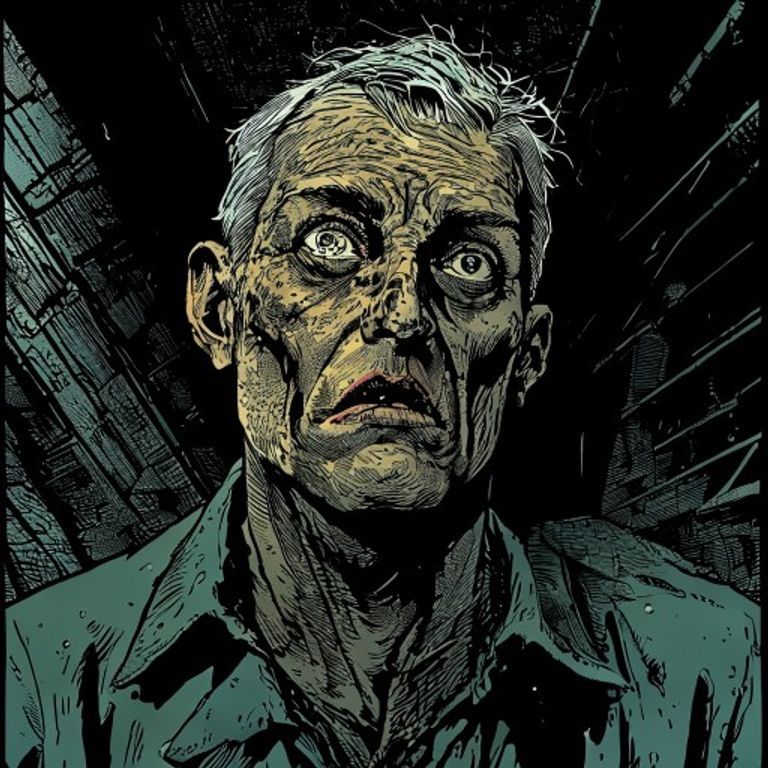
The prompt
Re-render this image as a comic book panel interior splash in the manner of EC Comics pre-Comics-Code horror titles (Tales from the Crypt, Vault of Horror, Haunt of Fear, 1950-1954), executed in the dense rendered-ink style of Graham "Ghastly" Ingels with his signature sweaty rotting-corruption aesthetic, or in the style of Johnny Craig's clean noir-staging method. Apply EC's heavy descriptive rendering: full cross-hatch and stipple rendering inside contour lines, dense shadow modeling with varied line-weight following form, every wrinkle, sweat-drop, texture-degradation, and decay-surface rendered with visual specificity. Color: four-color newsprint separation palette (pure cyan, magenta, yellow, black with limited overlay tints producing approximately sixteen mixed colors total), printed on absorbent newsprint paper with intentional slight register misalignment (cyan or magenta shifted one or two pixels) to read as authentic period offset-printing. Setting: gothic or punishment-consequence interior (a tomb with retribution visible, a kitchen where greed has manifested as decay, a surgery where vanity has become horror, a basement where cruelty is confronted by circumstance). Composition: high-impact splash framing the moment of consequence-reveal, not the act of violence but the moment the character realizes the trap is sprung or the consequence is irrevocable. Subject positioned at the peak of realization, expression registering dawning comprehension or shock. Lighting: theatrical and arranged, strong directional shadows, often with one corner containing a host-figure (the Crypt-Keeper or Vault-Keeper) framing the action. Mood: pulpy and morally severe, the story structure is always greed-punished or cruelty-confronted, the visual register reinforces the moral architecture. Forbid: modern digital coloring, photoreal smoothness, any dialogue or caption text on canvas, any airbrushed glow, watermark. Preserve the subject, pose, and composition of the source image exactly, change only the medium and rendering.
What it is doing
EC Comics in the early 1950s were conducting a form of visual moral philosophy that was more rigorous than the literary fiction of the same era. The rendering intensity was not gratuitous; it was encoding the principle that consequences are real and visible and inescapable. The Comics Code Authority destroyed this form in 1954 because it was effective. Re-rendering revives a form that died for being too good at its own work.
Ways to change it
Pick any of these in the gallery and the choice is added to the prompt you copy.
- Artist-rendering dial: Graham Ingels sweaty rotting-decay vs Johnny Craig clean noir-staging vs Reed Crandall classical restraint vs Jack Davis snarling-caricature
- Consequence moment: wide-eyed close-up as the character realizes the trap, sweat beading (signature) vs character standing alone amid wreckage after the doom, slumped and hollow vs mid-action as the trap snaps shut, hands thrown up, motion lines
- Moral setting: greed: miser's kitchen rotting around overflowing gold coins vs cruelty: basement where chained victims now loom over captor vs vanity: surgery mirror revealing a melting, decayed face (signature) vs deception: tomb opened to show the betrayed corpse pointing back
- Print registration: crisp clean registration, colors sitting exactly inside the black ink lines vs slight cyan and magenta offset, thin color fringes along ink edges (signature) vs heavy misregistration, color blocks sliding well outside lines with visible ghost edges
- Shadow-density dial: moderate hatching and modeling vs intense cross-hatch throughout vs selective deep-shadow only
Style lineage
Learn the visual culture this draws from: Bleeding Cool.
Related prompts
See all 16 prompts in the Comic-Book grammar