Alex Ross Painted Photoreal Hero
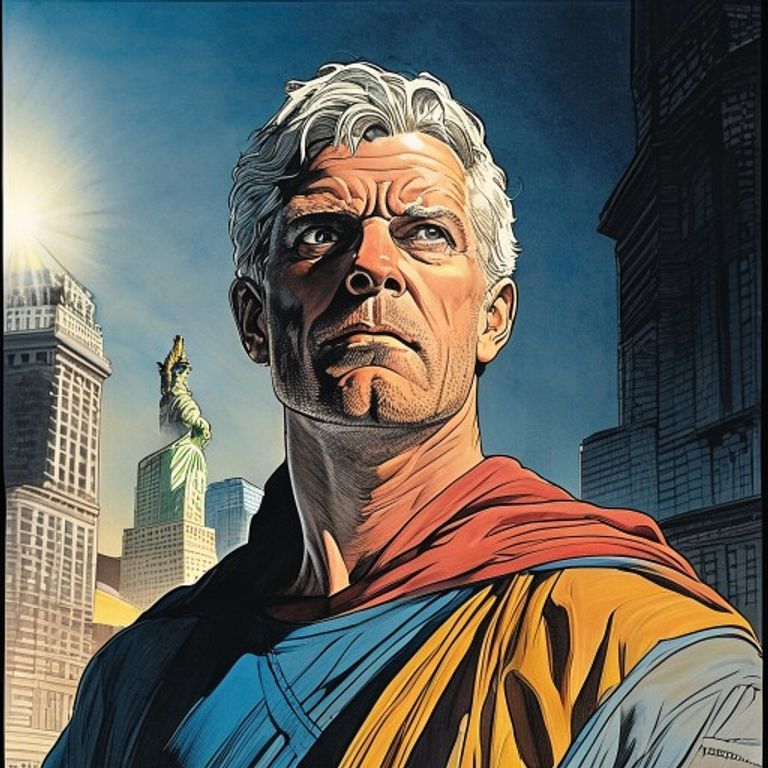
Re-render as an Alex Ross gouache-painted hero portrait: classical realism, low-angle dignified pose, Norman-Rockwell-meets-Marvel.
The prompt
Re-render this image as a comic book illustration in the manner of Alex Ross's painted work (Marvels 1994, Kingdom Come 1996, Justice 2005), executed in gouache and watercolor on illustration board with the visual feel of Norman Rockwell crossed with classical Renaissance portraiture applied to superhero or iconic subjects. Technique: full tonal range painting, no flat color, every surface modeled with light-to-shadow gradient, fabric folds rendered with subtle cast-shadow and ambient bounce-light, skin with sub-surface warmth and pore-level detail, hair as individual strands catching key light, metal surfaces with reflected-environment specular highlights. Composition: low-angle hero shot looking up at the subject from slightly below eye level, the camera-position dignifying the figure, often three-quarter pose with one hand on hip or extended in classical contrapposto, costume billowing slightly as if mid-stride or mid-arrest. Lighting: classical Rockwell-style window light or stage spotlight from upper left, warm key, cool ambient fill from the opposite side, distinct cast shadow on neck and under chin. Background: often softly rendered urban environment (skyscraper tops at dusk, statue-of-liberty silhouette, capitol dome, suburban small-town street) or a single-color painterly gradient that doesn't compete with the figure. Palette: rich and naturalistic, primary-hero colors (red, blue, yellow on costume) made plausible through painted shadow and reflected light rather than flat fill. Mood: dignified, mythic-but-human, the superhero rendered as if a Sargent portrait of an Edwardian statesman. Forbid: any flat-color cel rendering, any speech bubble or caption or sound effect text on canvas, any neon airbrush glow, any modern digital-illustration over-rendering, any watermark. Preserve the subject, pose, and composition of the source image exactly, change only the medium and rendering.
What it is doing
Ross's move was to take the cosmic spandex characters seriously enough to paint them with the same care a state-portrait painter would paint a senator. The implicit argument: if the iconography is going to survive the century, somebody has to render it with classical conviction. Re-rendering in this register confers Rockwell-grade dignity on the source.
Tuning knobs
- Pose dial: `low-angle classical contrapposto` vs `three-quarter portrait formal` vs `mid-action arrested mid-motion`
- Background dial: `urban dusk skyline behind` vs `single-color painterly gradient` vs `American small-town backdrop` (Rockwell-leaning)
- Light dial: `Rockwell warm-window upper-left` vs `stage-spotlight dramatic` vs `overcast neutral`
- Detail dial: `Marvels-era painterly looser` vs `Kingdom-Come-era tight photoreal` vs `Justice-era epic ensemble`
Style lineage
Learn the visual culture this draws from: Illustration History.
Related prompts
See all 16 prompts in the Comic-Book grammar · Open in the gallery
Get the free sample. The intro plus the first three chapters of The Liberation Engine, delivered as a PDF. The full book and the complete 557-prompt method are the paid edition.