Mike Mignola Hellboy Blackshape-Shadow
Re-render as a Mignola Hellboy page: huge flat black shapes, occasional silhouetted detail, Dave-Stewart-style muted color palette, gothic folk-horror.
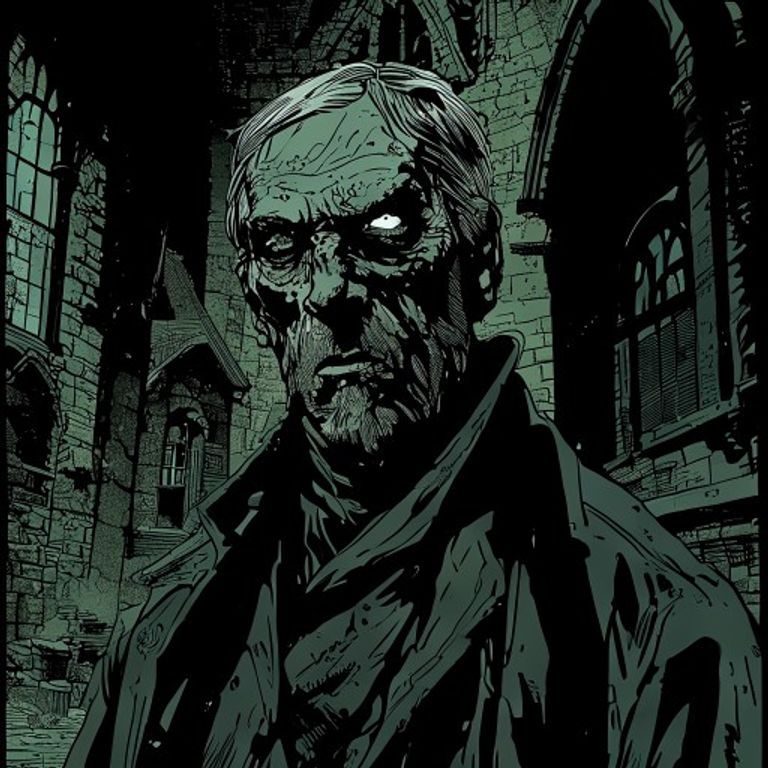
The prompt
Re-render this image as a comic book panel in the manner of Mike Mignola's Hellboy and B.P.R.D. work, colored in the manner of Dave Stewart. Apply Mignola's signature "blackshape" approach: large flat areas of solid black ink describing entire portions of the image (clothing, shadow, architectural mass, foreground silhouette) with white or colored shapes carved out as negative space to suggest form rather than render it. Linework is minimal: the contour line is broken, fragmented, and large areas of the figure are described by silhouette alone with only a few small interior detail marks (a single eye-glint, a button, a tooth). No cross-hatching, no stippled rendering, no halftone, no blended modeling. Color (Stewart palette): muted, restrained, dominated by single-hue washes per panel (overall sickly green for one panel, dusty orange for another, deep blue for a third), each color flat and matte with no gradient, the saturation low, the value contrast doing more work than the hue contrast. Setting: gothic folk-horror European location (decaying castle interior, fog-shrouded forest, ruined chapel, peasant village under thatched roofs, snow-covered graveyard, archaic museum vault), or occult-noir American (boarded-up house, fog-shrouded harbor, midnight cemetery). Composition: heavy bottom-weighted black mass with subject silhouette emerging from it, or top-weighted oppressive shadow ceiling pressing down on subject, the panel reading as graphic design first, narrative scene second. Mood: melancholy, occult, the world as old and tired and haunted, the hero as exhausted laborer in a doomed business. Forbid: any speech bubble or caption or sound effect text on canvas, any photoreal rendering, any heavy modeling or rendering inside the black shapes, any modern digital airbrush glow, any watermark or signature. Preserve the subject, pose, and composition of the source image exactly, change only the medium and rendering.
What it is doing
Mignola's career-defining discovery: a black shape is more legible at three feet than a rendered figure, and more atmospheric. He stopped rendering and started carving, and the panels gained gravity. Re-rendering in this register asserts that simplification is the opposite of laziness; it is selection.
Tuning knobs
- Black-mass dial: `large bottom-weight foreground` vs `large top-weight ceiling shadow` vs `large side-weight wall shadow` vs `figure as pure silhouette against pale field`
- Color dial: `Stewart muted single-hue green` vs `dusty orange` vs `deep blue night` vs `sickly yellow-ochre`
- Setting dial: `gothic castle interior` vs `fog forest` vs `ruined chapel` vs `American boarded-house`
- Detail dial: `extreme minimalism (eye-glint only)` vs `medium silhouette with key details` vs `more rendered (less Mignola, more Bernie Wrightson)`
Style lineage
Learn the visual culture this draws from: White Hot Magazine.
Related prompts
See all 16 prompts in the Comic-Book grammar · Open in the gallery
Get the free sample. The intro plus the first three chapters of The Liberation Engine, delivered as a PDF. The full book and the complete 557-prompt method are the paid edition.