Classical-Statuary-Marble / Style prompt
Fragmentary Museum Torso, Broken as Sublime
The classical torso without head, arms, or legs, the accident of survival. The fragment is more honest than the complete work because it shows what actually survives time. Beauty incomplete is the only beauty time allows.
Customize this prompt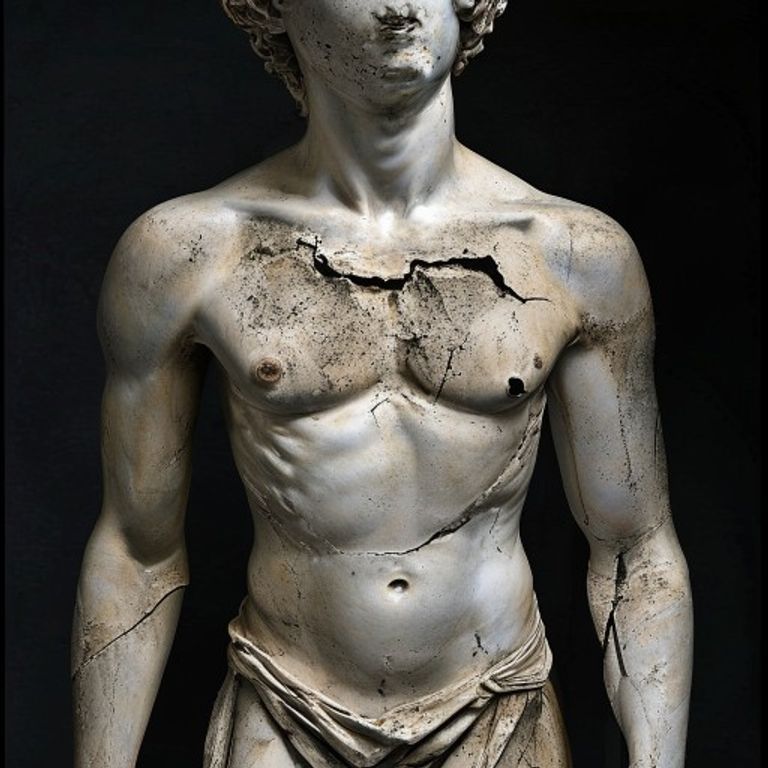
The prompt
Re-render this image as a fragmentary classical marble torso, the kind that survives because it is broken. The sculpture shows the trunk of a human figure: the chest, abdomen, and upper back are carved in high detail with anatomical precision (the pectoral muscles defined, the abdomen indicated, the ribs suggested beneath the skin). The surface finish varies: the front is smooth and polished, showing the original artist's hand, the back shows chisel marks where the work was less refined, possibly the back of a figure that was set against a wall. The figure is missing the head (broken cleanly at the neck), both arms are missing (broken at the shoulders), the lower abdomen and legs are missing (broken at the base). The break edges are not sharp, they are weathered and rounded from centuries of transport, burial, and museum handling. The marble shows age-weathering: subtle discoloration, mineral staining, hairline cracks, small areas where the surface is slightly spalled. The figure may be partially draped: a fold of garment (toga, cloak) carved at the side, trailing off or broken away. The base may be a modern museum plinth of dark stone, or the torso may be mounted on a metal support showing the break surfaces frankly. The lighting emphasizes the surviving anatomy: raking light shows the detailed musculature in sharp relief, while the broken edges cast shadow. The overall effect is simultaneously tragic and profound: the survival of this fragment is what makes it beautiful, not the imagined whole. The torso is displayed alone, not as a pedestal for a reconstruction, but as itself. Aspect ratio 3:2 vertical. Preserve the subject, pose, and composition of the source image exactly, change only the medium and rendering.
What it is doing
The fragmentary torso is the most honest form classical sculpture produces. Every complete bust is a lie about time. The torso tells the truth: this is what the gods allowed to survive. The head is gone, the arms are gone, the legs are gone. What remains is the essential architecture of the human form, the core of the body reduced to pure geometry and muscle. The weathering on the break edges shows centuries of survival, the small cracks show the stress of existing this long. The torso has no face to beautify it, no limbs to gesture, no base to elevate it. It is pure presence, pure structure. Museums mount torsos on plinths because they fear the incompleteness. The truth is the incompleteness is the point. The torso survived because the essential form could not be destroyed. Everything decorative is gone. Only the truth remains.
Ways to change it
Pick any of these in the gallery and the choice is added to the prompt you copy.
- Damage-degree dial: heavily fragmented, break edges weathered and rounded (long survival, high trauma) vs relatively intact torso, clean ancient breaks (shorter history) vs severe damage with spalling and cracks (critical condition)
- Anatomical-detail dial: highly detailed musculature, every tendon and rib marked (high-skill original) vs simplified geometric torso (less elaborate original) vs soft idealized form (classical idealism without anatomical specificity)
- Drapery-presence dial: fold of garment carved at the side (partially clothed figure) vs nude torso without textile indication (athletic ideal) vs deep drapery fold with detailed carving (formal garment)
- Break-edge-treatment dial: weathered rounded break edges showing time (honest fragmentation) vs rough unfinished break surface (sudden breakage condition) vs modern restoration attempt visible (conservation history)
- Surface-finish dial: mixed polished front and rough chisel-marked back (original two-plane work) vs overall matte surface (uniform aged patina) vs visible mineral staining and discoloration (burial history)
- Mount-style dial: museum dark-stone plinth (formal gallery presentation) vs modern metal support showing break surfaces (transparent fragmentation) vs simple wooden base (archival simplicity)
Related prompts
See all 7 prompts in the Classical-Statuary-Marble grammar