Classical-Statuary-Marble / Style prompt
Carved Stone Relief Frieze Profile
The classical relief portrait set into an architectural frieze, the profile frozen into sandstone or limestone as part of a temple or public building. The carving is shallow, the light does the work, the profile is a silhouette made stone.
Customize this prompt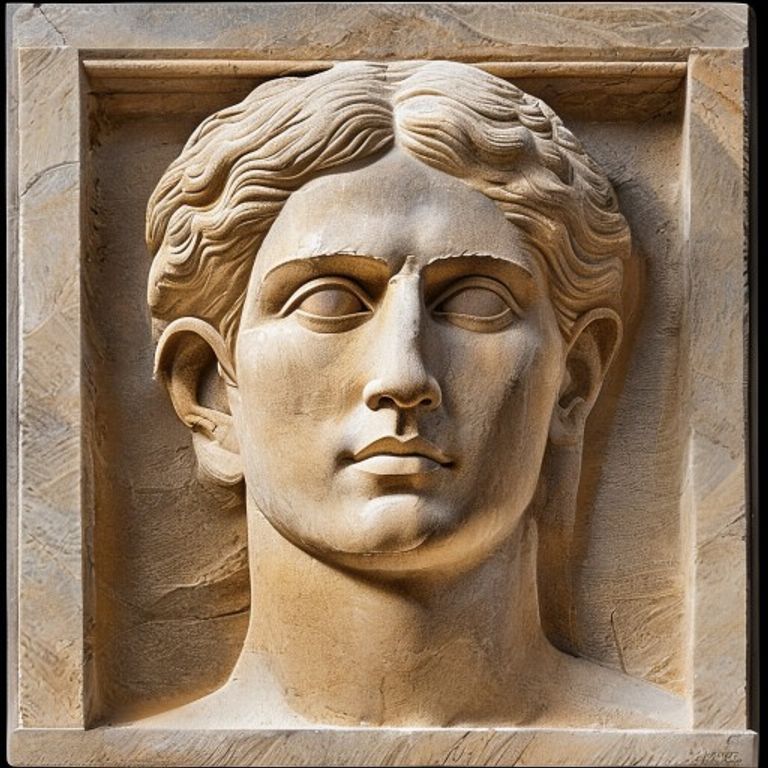
The prompt
Re-render this image as a carved stone relief portrait profile, the kind set into the frieze of a classical temple, civic building, or funeral monument. The subject's head is rendered in strict left profile, the face carved in shallow relief into a larger architectural panel (approximately 30 to 50cm wide, 20 to 30cm tall). The carving is low-relief, meaning the portrait projects only 2 to 3cm from the background plane. The profile is perfectly clean and readable: the forehead, nose, mouth, and chin defined by sharp continuous lines from the stone itself, not by heavy modeling. The hair is indicated by parallel grooved lines carved into the stone mass, suggesting waves or curls without deep undercutting. The eye is a simple almond-shaped incision (no pupil detail, the shadow in the carved line does the work). The neck is shown briefly before the stone transitions to an architectural element: perhaps a classical capital, a Greek key pattern border, or a simple border molding. The background plane is left flat and plain, possibly with a subtle receding background or a wide border of plain stone framing the portrait. The stone itself is warm golden sandstone or pale limestone, with visible fine grain texture and minute weathering. The carving shows chisel marks if closely examined, but from normal viewing distance the profile reads as a continuous flowing line. Museum or building lighting creates raking light across the relief, exaggerating the shallow modeling and making the profile leap out. Aspect ratio 4:3 horizontal. Preserve the subject, pose, and composition of the source image exactly, change only the medium and rendering.
What it is doing
The relief frieze portrait is the most economical form of immortality. You do not commission a full bust, you do not spend on marble, you rent space on a public building. Your profile is carved shallow into the stone and the building lasts. The architectural border frames your face and says: this person was important enough to be part of this wall. The profile is a silhouette made permanent. It requires almost no technique compared to a full bust, but it requires honesty. You cannot hide in profile. The nose says everything. The mouth says everything. The line from forehead to chin is a single argument. The frieze portrait turns a building into a autobiography written in stone. Walk the length of the frieze and you are reading the names and faces that the city decided to remember.
Ways to change it
Pick any of these in the gallery and the choice is added to the prompt you copy.
- Relief-depth dial: shallow low-relief, profile readable as a line (architectural frieze standard) vs mid-relief with modeling (higher relief allowing shadow play) vs nearly flat incised line (Egyptian relief minimal)
- Profile-characterization dial: idealized perfect features (ideal archetype) vs specific bone structure and individual nose (portrait-accurate) vs mask-like formal expression (heraldic neutrality)
- Hair-indication dial: parallel grooved waves (simple linear suggestion) vs curled locks with texture modeling (more elaborate) vs simple smooth mass (geometric simplification)
- Border-frame dial: plain flat background plane (minimal stone) vs architectural molding or Greek key border (decorative frame) vs narrative scene carved adjacent (frieze sequence)
- Stone-type dial: warm golden sandstone with fine grain (Mediterranean source) vs pale dense limestone (northern European) vs dark polished slate (dramatic contrast)
- Weathering-degree dial: sharp clean edges, minimal age-marking (recently carved simulation) vs soft weathered edges, subtle erosion (centuries of exposure) vs significant erosion and pitting (ancient fragment heavily worn)
Style lineage
Learn the visual culture this draws from: Britannica.
Related prompts
See all 7 prompts in the Classical-Statuary-Marble grammar