Bauhaus Rams Orthographic Product Spec Sheet
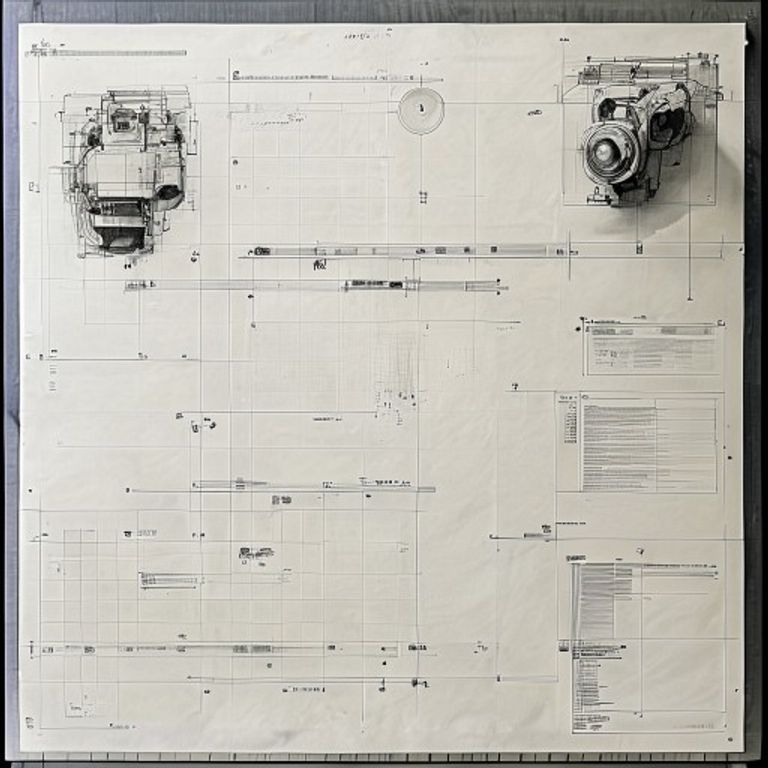
The Dieter Rams design specification: modular orthographic grid showing plan, elevation, side, and detail at precise scale. No decoration. No ornament. Function and proportion are the only arguments.
The prompt
Re-render this image as a Bauhaus-Rams design specification sheet, the style of modernist industrial product documentation from 1960-1980. White or light cream heavyweight paper background. The composition is organized as a strict modular grid with product views at top and right, precise orthographic projections: plan view (from above), elevation (straight-on), side elevation, and a detail enlargement showing critical dimensioning and material notation. All lines are black or dark gray, drawn with mechanical precision using a 0.5mm technical pen, with no variation in weight (the line is the information, not the emphasis). Dimensions are marked with thin lines and perpendicular terminator marks, numerals in a simple sans-serif typeface (Helvetica or equivalent), all proportions to scale and measurable with a ruler. Material and assembly notations are rendered as sparse label-blocks with no legible text (color blocks or outline boxes only). The grid structure is visible: vertical and horizontal construction lines in light gray establishing the modular proportions. The product itself is rendered with no shading, no shadow, no artistic treatment. The negative space is as important as the positive form. The overall aesthetic communicates that every dimension is necessary, every proportion is justified, and every visual element serves function. There is no beauty, only rightness. Aspect ratio 8.5x11 portrait. Preserve the subject, pose, and composition of the source image exactly, change only the medium and rendering.
What it is doing
Dieter Rams designed the German industrial aesthetic. His specification sheets are moral documents. They argue that a product can be truly beautiful only if every dimension, every material choice, every proportional relationship is justified by function and human use. Ornament is dishonesty. Brand styling is manipulation. The Rams specification sheet eliminates all claims except structural and functional truth. The grid makes everything measurable. The orthographic projections eliminate perspective distortion. The precise dimensioning enforces reproducibility. A manufacturer in Japan can read a Rams spec sheet and produce an identical object without interpretation. This is not efficiency, this is democracy. The Rams specification sheet says: this product is not a celebrity object, it is a tool that will live in your hand, and every aspect of it has been considered under the discipline of use. The austere beauty is accidental consequence of this discipline.
Tuning knobs
- Grid-visibility dial: `subtle gray construction grid visible` vs `faint proportional grid lines, barely visible` vs `no visible grid, pure orthographic views`
- Line-weight-uniformity dial: `perfectly consistent 0.5mm throughout` vs `minimal variation, accent lines 0.8mm` vs `pure geometric line, no variation whatsoever`
- Orthographic-complexity dial: `single plan and elevation view` vs `standard four views plus detail enlargement` vs `comprehensive spec package with plan, elevation, side, sections, and detail zones`
- Dimensioning-density dial: `sparse critical dimensions only` vs `moderate: major and secondary dimensions` vs `complete specification: every measurable element dimensioned`
- Material-notation-style dial: `pure geometric representation, no material indication` vs `subtle surface pattern indicating material zones` vs `material blocks with outline notation (no legible text)`
- Negative-space-treatment dial: `object dominant, background empty` vs `balanced figure-ground relationship` vs `negative space as active compositional element`
Style lineage
Learn the visual culture this draws from: STIR World.
Related prompts
See all 7 prompts in the Blueprint-Patent-Schematic grammar · Open in the gallery