Blueprint-Patent-Schematic / Style prompt
US Patent Line Drawing Numbered Callouts
The US Patent Office line drawing: black ink on white vellum, every element numbered, no shading, no compromise. This is an assertion of ownership rendered as geometry.
Customize this prompt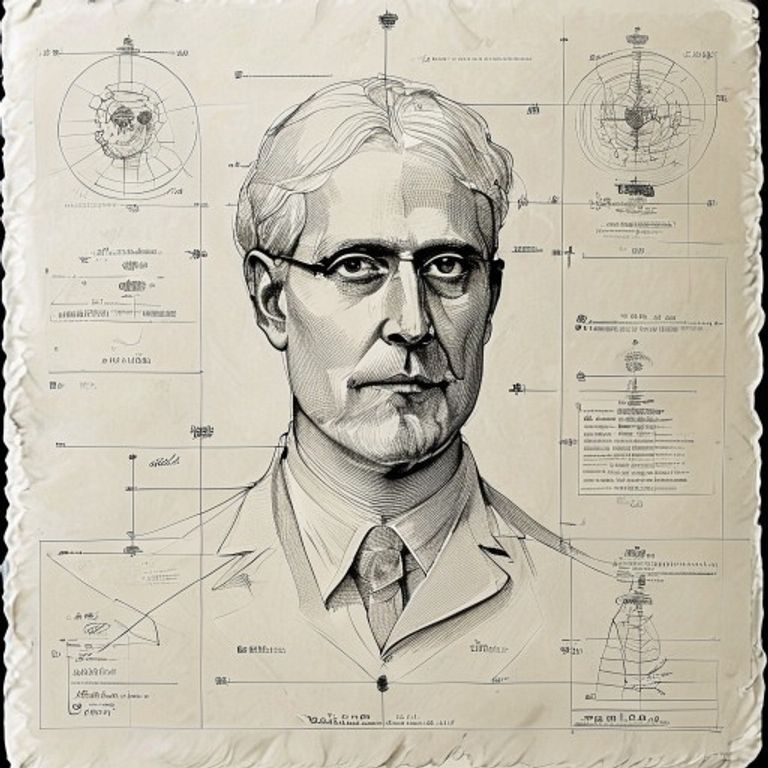
The prompt
Re-render this image as a US Patent Office line drawing, the style standardized for federal patent applications 1890-present. White vellum or heavy bond paper background. All lines are pure black India ink, rendered with mechanical precision using a drafting pen (width approximately 0.5 to 0.8mm for primary lines, 0.3mm for detail). No shading, no stippling, no artistic gradient. Every distinct element is identified with a numeral in a circle (reference numeral callout), positioned with a leader line that terminates at a right angle to the feature. The numerals themselves are block sans-serif, approximately 10 point, perfectly vertical (no italics, no artistic variation). The composition typically shows multiple orthographic views: plan view (from above), elevation (straight-on), side section, and detail enlargements at 2x or 4x scale, each view clearly separated with ruled borders. Dimension lines are thin continuous or dashed lines with perpendicular terminator ticks. No title block, no cartouche, no border frame (vignette edge into white). Surface finish is matte, paper texture slightly visible but not dominant. The intent of every mark is clarity of novelty claim, not aesthetics. Aspect ratio 8.5x11 portrait or 11x14 depending on source. Preserve the subject, pose, and composition of the source image exactly, change only the medium and rendering.
What it is doing
The patent drawing is a legal document masquerading as a technical drawing. Every circle numeral, every perpendicular leader, every orthographic view is there because the patent office requires it to reduce ambiguity in the claims section. The draughtsman cannot draw what the claims do not mention. The claims cannot reference anything not labeled in the drawing. The drawing and the claims are locked in a rigid reciprocal relationship: the drawing enforces the claims, the claims enforce the drawing. This creates a genre of line work that is maximally explicit and minimally beautiful. The genius of the design is that it prevents lying. A patent drawing cannot suggest or imply. It can only assert. This is why the style has barely changed in 130 years. Evolution would introduce ambiguity. The patent drawing is sovereignty made geometric. It is the moment the inventor stands before the law and says: I built this specific thing, in this specific way, and I own it.
Ways to change it
Pick any of these in the gallery and the choice is added to the prompt you copy.
- Ink-weight dial: fine crisp lines, 0.5mm vs bold structural emphasis, 0.8mm primary lines vs variable weight, critical elements bolder
- View-complexity dial: single orthographic view vs standard three-view (plan, elevation, side) vs complete technical package with detail enlargements
- Numeral-style dial: simple circled 1-20 vs circled numerals with leader-line terminals at right angles vs boxed numerals with horizontal reference lines
- Vellum-character dial: pristine white bond, freshly drafted vs aged cream vellum with storage creases vs heavily used drawing, erasure marks and re-drafting visible
- Detail-density dial: sparse, minimal components vs moderate 12-15 labeled elements vs dense technical assemblies, 30+ reference numerals
- Section-architecture dial: singular view vs standard multi-view layout with clear borders vs exploded multiple pages, imagined as single consolidated drawing
Style lineage
Learn the visual culture this draws from: Pinch Patent Drawings.
Related prompts
See all 7 prompts in the Blueprint-Patent-Schematic grammar