Bauhaus / Style prompt
Bauhaus Architecture Photo Plate Field (Style-Only, Image-Conditioned)
Style register: Lucia Moholy and Walter Gropius Dessau Bauhaus building photographic plates 1925 to 1932, large-format silver-gelatin documentation of modernist architecture, strict orthogonal framing, flat clear daylight, no atmospheric softening.
Customize this prompt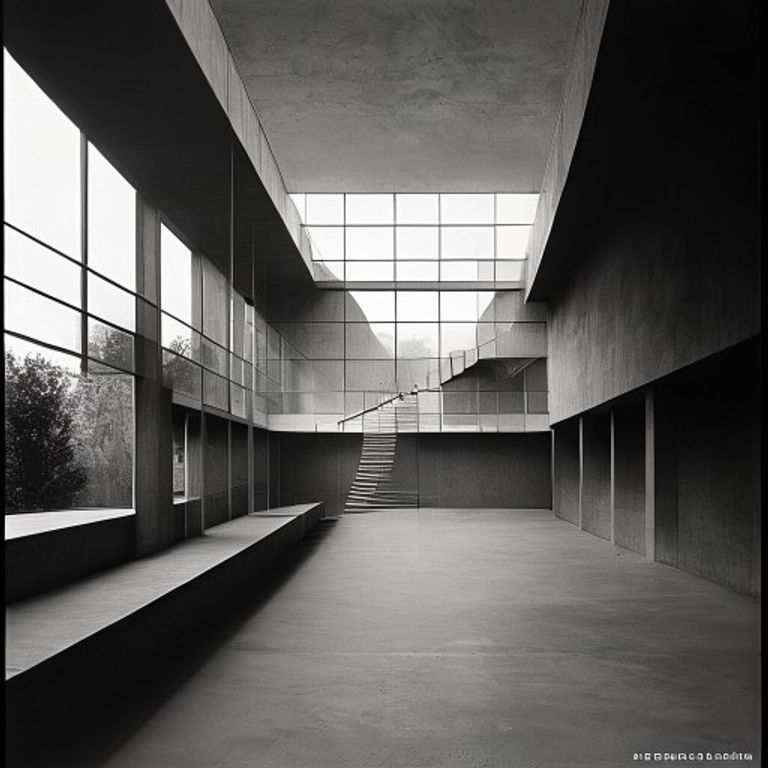
The prompt
Re-render this image in the visual register of a Lucia Moholy large-format silver-gelatin architectural plate of the Dessau Bauhaus building, circa 1925 to 1932. Treat the picture surface as a 4x5 or 8x10 view-camera plate: deep continuous-tone blacks, paper-white highlights, a long smooth ladder of mid-tone greys, no color anywhere. Subject rendered as if it were a Dessau workshop block: clean planar surfaces, orthogonal verticals corrected to true plumb (no keystone distortion), strong frontal or three-quarter view, the entire composition built on horizontal and vertical lines with rare diagonals. Flat overcast Central European daylight, shadows soft and even, no theatrical raking light. Glass and reflective surfaces rendered as luminous near-white planes, concrete and stucco as smooth mid-grey. Faintest grain at large magnification, the kind of grain a 1928 Agfa plate carries when contact-printed. Mood: documentary, evidentiary, the architecture treated as a designed object worthy of museum-quality recording. Strictly no on-canvas text, no legible lettering, no signature, no watermark, no logos. Preserve the subject, pose, and composition of the source image exactly, change only the medium and rendering. Aspect ratio matches source.
What it is doing
The Bauhaus building at Dessau was photographed by Lucia Moholy as a manifesto. The clean orthogonal framing, the corrected verticals, the absence of atmospheric romance, all of it argued that this building was a proof rather than a poem. The political claim was Le Corbusier's: the house is a machine for living, and the machine deserves the same evidentiary photographic respect as the locomotive. The trouble with that claim, then and now, is that machines do not have politics but the people who design them do. The Bauhaus housing experiment was utopian, and utopia tends to require somebody deciding what the right way to live looks like.
Ways to change it
Pick any of these in the gallery and the choice is added to the prompt you copy.
- Vertical correction: strict plumb no keystone (signature) vs slight natural tilt vs deliberate dramatic upward angle
- Light quality: flat overcast Central European (signature) vs low golden raking vs harsh noon shadow
- Tonality: full continuous-tone long grey ladder (signature) vs high-contrast black-and-white vs low-contrast muted
- Grain: faint Agfa plate at magnification (signature) vs clean digital vs heavy 1960s-photojournalism grain
- Framing: frontal orthogonal (signature) vs three-quarter vs corner detail close-up
Style lineage
Learn the visual culture this draws from: Tate.
Related prompts
See all 8 prompts in the Bauhaus grammar