Bauhaus / Style prompt
Klee Pedagogical Geometric Whimsy (Style-Only, Image-Conditioned)
Style register: Paul Klee Weimar Bauhaus 1921 to 1925 Pedagogical Sketchbook and Senecio-era grammar, hand-built geometric grids softened by watercolor wash, primary geometry meeting human warmth.
Customize this prompt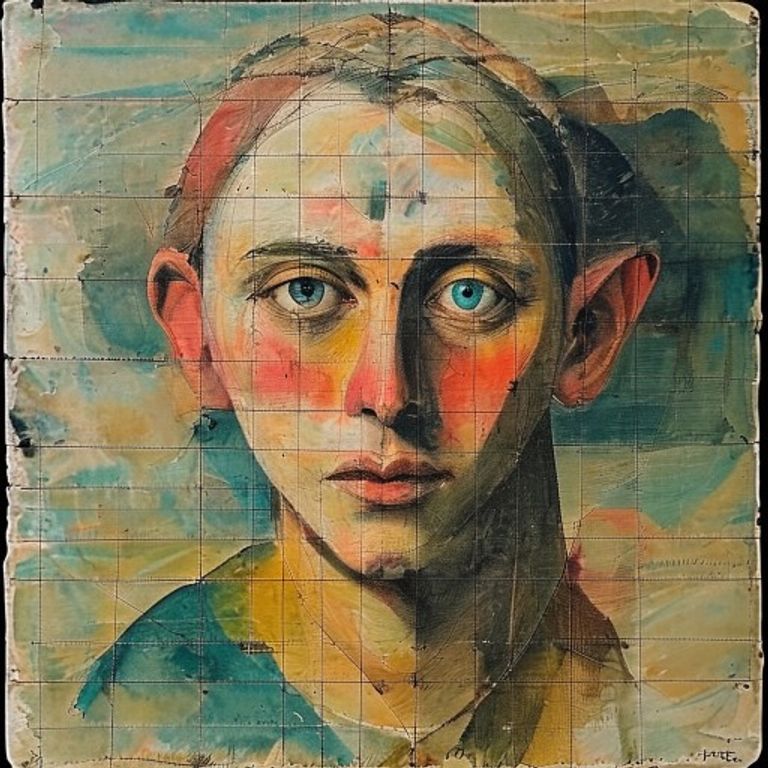
The prompt
Re-render this image in the visual register of a Paul Klee watercolor and oil-transfer composition from his Weimar Bauhaus period, circa 1921 to 1925. Treat the picture surface as a hand-built grid of small irregular rectangles, each one wash-painted in muted earth-primaries (terra rosa, mustard ochre, dusty teal, faded crimson, lampblack outline). The grid is drawn by hand, never mechanically perfect, lines slightly trembling as if drawn with a reed pen dipped in india ink. The underlying subject reads as a constructed pattern of grid cells, geometric features (circles for eyes, triangles for nose, rectangles for body planes) sitting calmly inside the grid like a Klee figure built from the elements. Watercolor wash bleeds gently inside each cell, leaving softer interior gradients while the outline stays crisp. Paper is rough cold-press, visible tooth catching pigment unevenly. Mood: pedagogical, playful, somewhere between a child's first geometry lesson and a mystic's diagram. The rigor of the Bauhaus grid relaxed by a Swiss-German sense of humor. Strictly no on-canvas text, no legible lettering, no signature, no watermark, no logos. Preserve the subject, pose, and composition of the source image exactly, change only the medium and rendering. Aspect ratio matches source.
What it is doing
Klee is the Bauhaus master who refused to take the Bauhaus entirely seriously. While Moholy-Nagy was photographing girders and Albers was measuring color, Klee was drawing fish and angels inside the same grid logic. The buried claim is that systematic discipline does not have to be cold, that the rationalist project can hold whimsy without collapsing into it. He is the answer to the accusation that geometric modernism is humorless, and his presence inside the Bauhaus is the school's best evidence that the rigor was a method, not a religion.
Ways to change it
Pick any of these in the gallery and the choice is added to the prompt you copy.
- Grid regularity: hand-trembling slightly irregular (signature) vs pristine ruler-built vs wildly loose Cobra-adjacent
- Palette warmth: muted earth primaries (signature) vs bright saturated primaries vs cool blue-grey dominant
- Wash bleed: gentle within cells (signature) vs dry-brush flat fill vs heavy bleed across cells
- Outline weight: fine reed pen (signature) vs heavy charcoal vs no outline pure wash
- Paper: rough cold-press tooth (signature) vs smooth hot-press vs tinted manila
Style lineage
Learn the visual culture this draws from: Lars Müller.
Related prompts
See all 8 prompts in the Bauhaus grammar