Bauhaus / Style prompt
Schlemmer Triadic Ballet Geometric Figure (Style-Only, Image-Conditioned)
Style register: Oskar Schlemmer Triadic Ballet 1922 and Bauhaus stage-workshop figural grammar, the human body reconceived as stacked spheres, cones, cylinders, and disks, painted in matte primary lacquer against neutral stage grounds.
Customize this prompt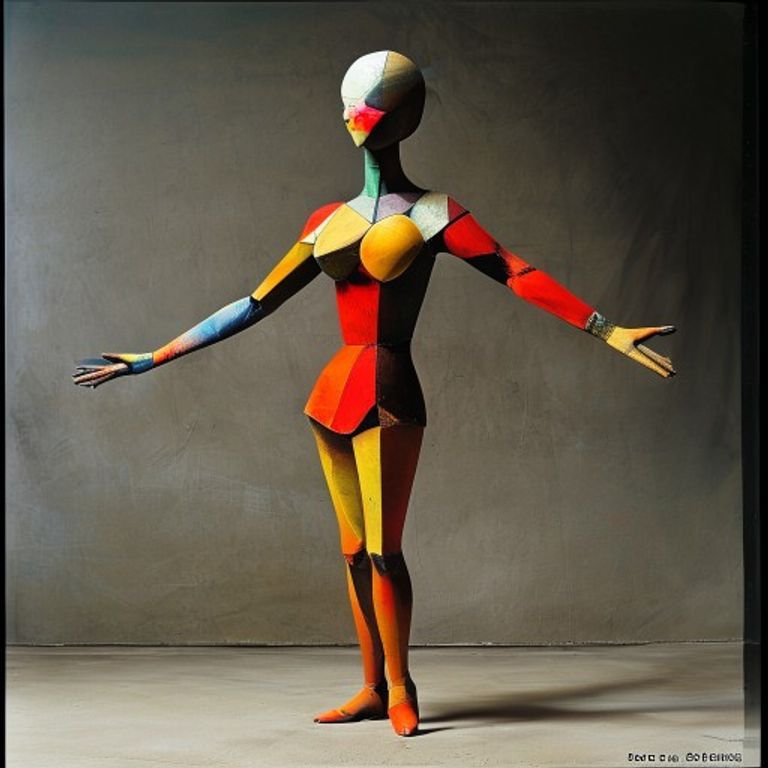
The prompt
Re-render this image in the visual register of Oskar Schlemmer's Triadic Ballet costume and stage compositions, circa 1922 to 1929. Reimagine the rendering of the subject as if the figure were re-built from primary geometric volumes: spheres at the head and joints, cones at the limbs, cylinders at the torso, flat disks where the silhouette flares. Apply matte enamel-lacquer surfaces in restricted primary colors (one dominant from cadmium red, cadmium yellow, ultramarine, plus chalk white and lampblack), each volume one solid unmodulated color with a single soft shadow underneath to anchor it as a three-dimensional object. Set against a neutral stage-grey or warm sand-beige flat backdrop, depth indicated only by a faint cast shadow on the floor plane, no environmental detail. Mood: ceremonial, somewhere between modern dance, mechanical puppet, and architectural model. The figure feels carved by a Dessau workshop carpenter rather than born. Strictly no on-canvas text, no legible lettering, no signature, no watermark, no logos. Preserve the subject, pose, and composition of the source image exactly, change only the medium and rendering. Aspect ratio matches source.
What it is doing
Schlemmer's Triadic Ballet asked a question the wider Bauhaus was too polite to ask directly: if you really believe in geometric primary form, what does the human body look like when you apply that doctrine to flesh? The answer was a costume so restrictive the dancers could barely move, and that constraint was the point. Schlemmer was testing how much of the human you could abstract away before the figure stopped reading as human. McQueen's later structural tailoring (Kingdom, Plato's Atlantis) walks the same line: the body as armature for geometry that violates the body.
Ways to change it
Pick any of these in the gallery and the choice is added to the prompt you copy.
- Volume vocabulary: spheres cones cylinders disks (signature) vs spheres and cubes only (more severe) vs add tori and prisms (richer)
- Color count per figure: 3 primaries plus B and W (signature) vs monochrome lacquer vs full primary plus secondary
- Surface finish: matte enamel lacquer (signature) vs high-gloss automotive vs chalk-flat tempera
- Backdrop: neutral stage grey (signature) vs pure white void vs warm beige sand
- Shadow: single soft anchor shadow (signature) vs hard architectural cast shadow vs no shadow floating
Style lineage
Learn the visual culture this draws from: Schlemmer Estate.
Related prompts
See all 8 prompts in the Bauhaus grammar