Toy-Packaging / Style prompt
Action-Figure Collector MOC Mint-On-Card Frame
The graded mint-on-card action figure in its sealed acrylic display slab. AFA or CAS-graded, encapsulated, scored, the package elevated from retail object to permanent reliquary.
Customize this prompt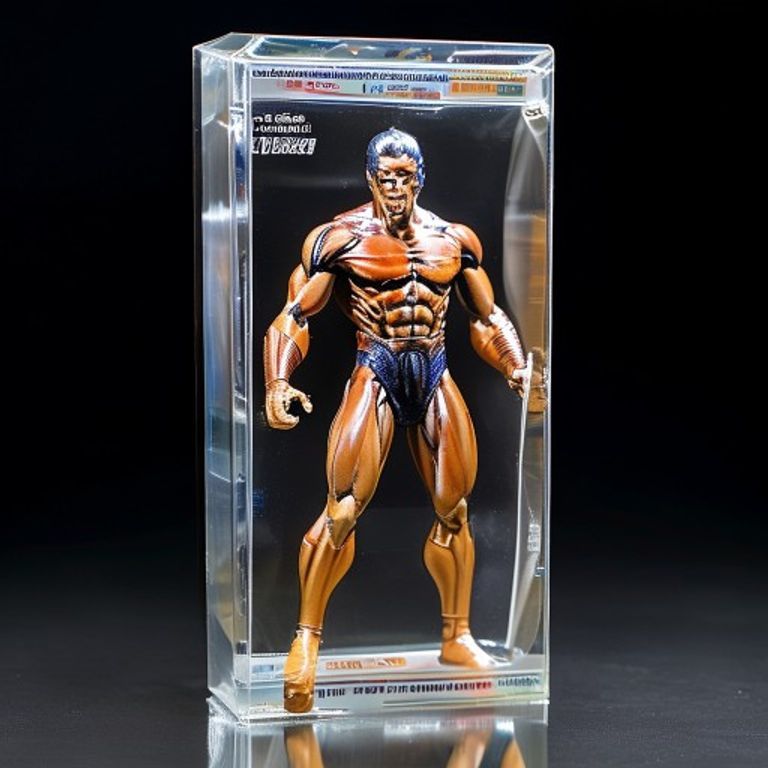
The prompt
Re-render this image as a third-party-graded mint-on-card action-figure package in its sealed acrylic display slab, the canonical AFA (Action Figure Authority) or CAS (Collectible Authentication Services) format used by the high-end toy-collector market for grading, encapsulating, and certifying vintage blister-card packages. Package format: an original blister-card action-figure package (any 1970s to 1990s vintage line: Kenner Star Wars, Mattel MOTU, Hasbro G.I. Joe, Hasbro Transformers, depending on subject) sealed inside a rigid clear acrylic slab approximately 25cm tall by 18cm wide by 5cm deep, the acrylic slab constructed of two precision-machined transparent halves bonded around the perimeter to create a permanent tamper-evident enclosure. The blister-card inside the slab: visible in full as a complete unaltered original package, the rigid coated cardback with the painted or photographic hero illustration, the clear vacuum-formed bubble cradling the action figure, all preserved exactly as the original retail object, no alteration to the package itself. The acrylic slab: clear museum-grade polycarbonate or PMMA, polished to optical clarity, with a printed label band sealed at the top of the front face running the full width (render as a flat colored rectangular band, no legible lettering but with the impression of structured grading-data layout). The label band: typically white or off-white background with a colored sub-band indicating the grade-tier (gold for the highest 90+ grades, silver for 85 to 89, bronze for 80 to 84, all rendered as flat colored rectangles with no legible numeric scores). Slab construction: visible perimeter seal-line, slightly rounded corners, museum-display weight and rigidity, the back face entirely clear so the rear of the original cardback is visible through the acrylic. Mood: museum-reliquary, permanent-collection, the package elevated from retail toy to certified-and-encapsulated cultural artifact, the kind of object a collector mounts on a display wall or stores in a fireproof safe. The slab should appear photographed straight-on against a neutral grey or black studio backdrop with soft directional lighting catching the polished acrylic edges. No on-canvas legible text, no logos, no franchise marks, no legible grade-numbers or grading-company identifiers. Preserve the subject, pose, and composition of the source image exactly within the blister bubble inside the slab, change only the medium and rendering of the surrounding slab and cardback context. Aspect ratio is graded-slab vertical portrait (roughly 3:4).
What it is doing
The third-party-graded mint-on-card slab is the absolute terminal form of the sovereign-object collector economy. The original package was a 1978 retail object intended to be opened by a child. The grading service (AFA founded 2000, CAS founded 2009) provides three things: authentication (it is the original 1978 package), preservation (encapsulated in inert acrylic that prevents further deterioration), and certified grading (a numeric score, typically 75 to 95+, that becomes the asset's pricing anchor). Once encapsulated and graded, the object is functionally permanent: it cannot be opened without destroying the grade, it cannot deteriorate further, it has a documented score that the global market accepts as authoritative. This is the closest the physical-object world gets to fungibility: a graded AFA 90 Kenner Star Wars Boba Fett trades at the same price-band as another graded AFA 90 Boba Fett regardless of who owns it. The graded slab is therefore the bridge between sovereign-object scarcity and quasi-financial-asset liquidity. The digital-economy equivalent (NFT) tried to replicate this and failed because the underlying object never had craft permanence to anchor.
Ways to change it
Pick any of these in the gallery and the choice is added to the prompt you copy.
- Grading-service register: AFA (Action Figure Authority) slab format with horizontal top-label band (canonical 2000s onward) vs CAS (Collectible Authentication Services) slab format with vertical side-label panel (newer alternative) vs pre-grading raw original blister with no encapsulation (uncertified reference state)
- Grade-tier dial: AFA 90+ gold-tier label band (top-tier collector grail) vs AFA 85 silver-tier label band (mid-collector premium) vs AFA 80 bronze-tier label band (entry-level collector)
- Vintage-line dial: Kenner Star Wars cardback inside slab (canonical highest-value vintage) vs Mattel MOTU cardback or boxed-figure inside slab (heroic-painted-keyart variant) vs Hasbro G.I. Joe Real American Hero cardback inside slab (military-line variant)
- Slab finish: crystal-clear polished acrylic with crisp edge highlights (signature) vs softly frosted acrylic, card slightly hazy behind it vs faint amber-tinted acrylic with a warm archival glow vs clear acrylic with bright mirror-like glare streaks across the front
- Display-orientation dial: vertical-portrait wall-mount orientation (canonical) vs horizontal-landscape display-shelf orientation (oversized SKU) vs dual-slab adjacent-display giftset format (matched-pair collector)
- Background-context dial: neutral gray studio backdrop with single-source lighting (canonical) vs black velvet display-case context (premium collector display) vs mounted on archival-foam display board within larger frame (museum-installation context)
Related prompts
See all 8 prompts in the Toy-Packaging grammar