Toy-Packaging / Style prompt
Hot Wheels Redline-Era Blister-Card Frame
The 1968 to 1977 Mattel Hot Wheels Redline-era blister-card, the package that holds a die-cast car with the diagnostic red-stripe tires. The first six-year production run that anchored a fifty-year collector economy.
Customize this prompt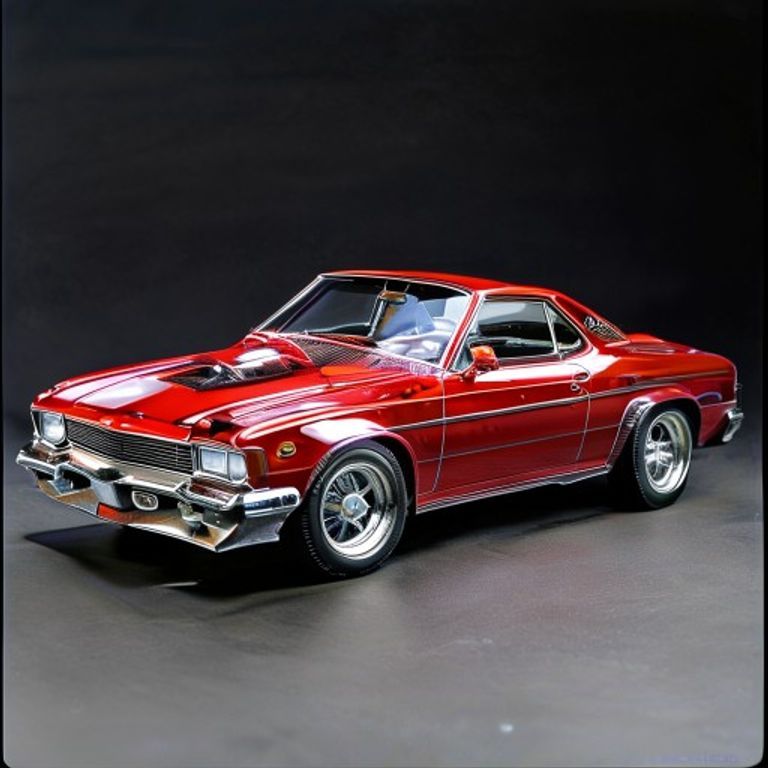
The prompt
Re-render this image as a 1968 to 1977 Mattel Hot Wheels Redline-era die-cast car blister-card package, the canonical first-generation format that established the entire Hot Wheels brand and its collector-grade aftermarket. Package format: a flat rigid coated cardback approximately 10cm wide by 14cm tall, with a clear vacuum-formed plastic blister bubble heat-sealed to the front face, the bubble shaped to cradle a single 1:64-scale die-cast car visible through the clear plastic. The car inside the bubble: a small die-cast metal body with chrome plating on the base and interior detail, painted in saturated metallic Spectraflame finish, a translucent candy-color anodized lacquer used in the period. Cardback art: bright California hot-rod illustration with exaggerated perspective, speed lines, flame accents, and period typography rendered as abstract non-legible shapes. The car must display the diagnostic thin red stripe around each tire sidewall. Show the blister's clear plastic reflections, slight yellowing at the edges if aged, cardback print registration and paper grain. Square or portrait aspect ratio matching the original package. No legible text, no logos, no catalog marks. Preserve the subject, pose, and composition of the source image exactly, change only the medium and rendering.
What it is doing
The Redline-era (1968 to 1977) Hot Wheels cars are the foundational layer of one of the most stable collector economies in the world. The red stripe on the tire wall is the diagnostic craft detail that separates the original ten-year production run from every cheaper post-1977 successor. A single Redline-era car in the original blister package can trade for thousands of dollars at the right auction; a rare prototype Beach Bomb with the original surfboards in the rear window cleared one hundred and seventy thousand dollars at a major collectibles auction house in 2022. The lesson is that one specific physical-craft detail (the red stripe), executed within a narrow production window (six years), creates the moat the entire collector economy depends on. Mattel cannot retroactively replicate the Redline. The successor wheels are recognizably different. The Redline-on-card is therefore a craft-permanence anchor: scarcity, specific-era diagnostic detail, sealed package, and a fifty-year-deep collector community all reinforcing one another.
Ways to change it
Pick any of these in the gallery and the choice is added to the prompt you copy.
- Spectraflame-color dial: hot-orange Spectraflame (peak collector-grade 1968 to 1970) vs lime-green Spectraflame (rare color premium) vs enamel post-1972 finish (later Redline-era, less premium)
- Cardback-era dial: 1968 to 1969 first-wave cardback (small format, period illustrator) vs 1970 to 1972 mid-Redline cardback (slightly larger, more elaborate illustration) vs 1975 to 1977 late-Redline cardback (full-color photographic-and-illustration hybrid)
- Car-style dial: California custom hot-rod (canonical 1968 wave) vs street-machine muscle-car (mid-cycle) vs fantasy-and-funny-car experimental (late Redline)
- Blister-condition dial: mint sealed unyellowed bubble (collector grail) vs light bubble yellowing (lived-in unopened) vs bubble crushed or punctured (relic)
- Cardback-flex dial: pristine flat cardback (collector grail) vs light corner-flex (acceptable) vs heavy creasing plus price-sticker residue (relic)
- Car paint rarity: common Spectraflame aqua or green paint on a fresh, bright cardback (entry-level) vs rare Spectraflame hot pink paint with a deep candy glow (premium) vs unpainted bare-metal prototype body on a plain cardback, yellowed bubble (grail)
Style lineage
Learn the visual culture this draws from: Redline Archeology.
Related prompts
See all 8 prompts in the Toy-Packaging grammar