Hofmann Black White Studies (Style-Only, Image-Conditioned)
Style register: Armin Hofmann's Basel School black and white studies, optical inversion, restrained asymmetry, and tactile print contrast.
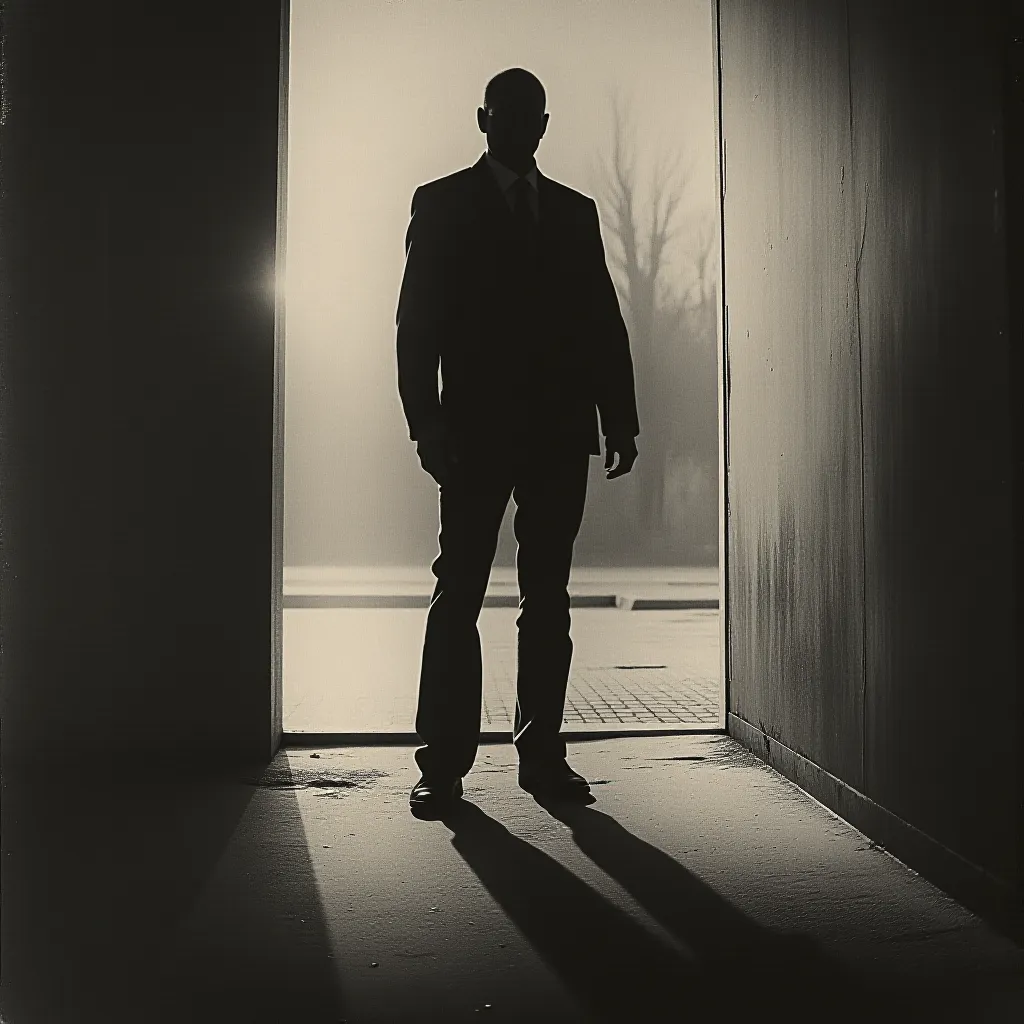
The prompt
Re-render this image as a stark image-only Basel School contrast study after Armin Hofmann's midcentury graphic experiments. Preserve the source subject and its spatial relationships, but reduce light and shadow to a small vocabulary of dense black ink, untouched paper white, and one narrow band of midgray produced by halftone dots. Make the subject legible through the contact between positive black mass and carefully carved white counterform. Use a strict underlying rectangular grid to set every crop and offset, then introduce one visually forceful asymmetry: the heaviest mass gathers on one side while a broad unprinted field holds the other in balance. Draw edges with a knife-clean screen-print stencil, interrupted in a few places by the tooth of matte paper and the granular edge of a transferred photograph. Allow a single hard diagonal to challenge the horizontal and vertical rhythm. No ornamental shading, decorative type, faux paper folds, or floating captions; the black-white boundary carries the whole argument. Reserve a large clean field for a later title overlay, preferably on the side already open in the source. Leave a calm, uncluttered band of negative space along the top or bottom edge where a title could sit. Mood: urgent but never frantic, austere but tactile. Strictly no on-canvas text, no legible lettering, no signature, no watermark, no logos. Preserve the subject, pose, and composition of the source image exactly, change only the medium and rendering. Aspect ratio matches source.
What it is doing
Contrast is not a cosmetic effect here. It is a decision about which boundaries survive when almost all intermediate description disappears. The missing middle becomes as active as the ink.
Tuning knobs
- Black mass: `one dominant slab` (signature) vs `two balanced slabs` vs `slender black frame`
- White counterform: `wide carved void` (signature) vs `narrow cutout` vs `several small openings`
- Gray bridge: `one halftone band` (signature) vs `no gray` vs `two gray densities`
- Paper: `matte tooth` (signature) vs `smooth coated white` vs `warm rough stock`
Related prompts
See all 5 prompts in the Swiss-Typographic grammar · Open in the gallery
Get the free sample. The intro plus the first three chapters of The Liberation Engine, delivered as a PDF. The full book and the complete 642-prompt method are the paid edition.