Surrealism / Style prompt
Max Ernst Frottage Forest
Petrified-forest verticals, scraped pigment crusts, sun-disc presiding, bird-king watching from a branch.
Customize this prompt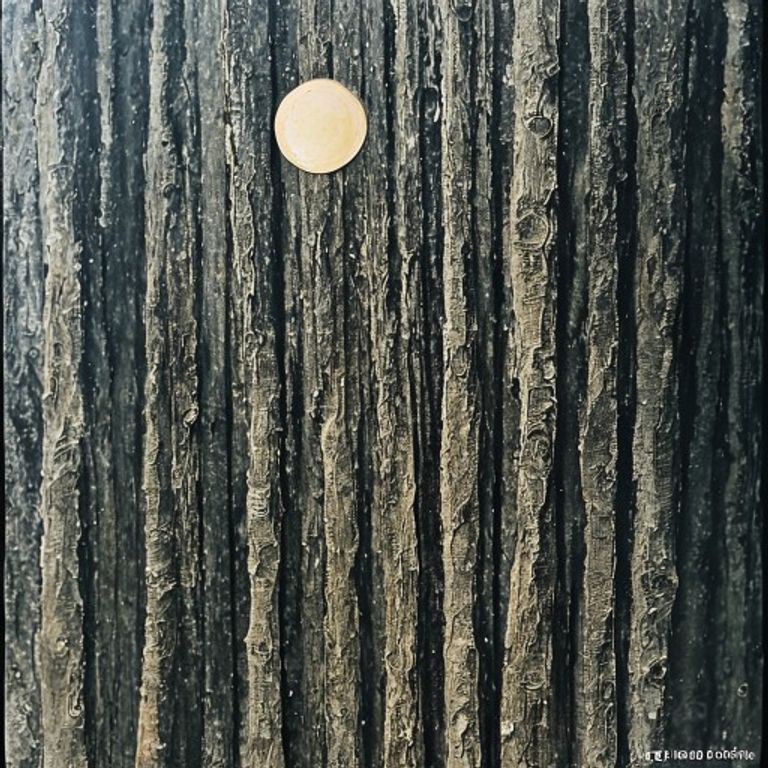
The prompt
Re-render this image in the visual register of a Max Ernst 1927 to 1942 frottage-grattage forest painting, as if pigment were laid on canvas over wood grain rubbed through with graphite, then partially scraped away with a palette knife to reveal layered geological strata of color underneath. Surface is dense crusty oil with visible parallel rubbing-grain striations, fan-shaped grattage marks, and a few decalcomania bubble-patterns from blotted paint. Palette: oxidized copper green, deep umber, blue-black night, with a single pale moon disc or sun disc rendered as a smooth circular halo of bone white or vermilion. The forest reads as vertical petrified columns or coral towers, dense and lateral. A small bird or hybrid creature occupies the foreground as silent witness. Mood: pre-human geological time, the unconscious presented as a forest older than language, an indifferent organic intelligence watching from inside the bark. Strictly no on-canvas text, no legible lettering, no signature, no watermark, no logos. Preserve the subject, pose, and composition of the source image exactly, change only the medium and rendering. Aspect ratio matches source.
What it is doing
Frottage means the painter stopped composing and let the rubbing surface compose for him. The unconscious is admitted as collaborator, which means the rational ego is admitted as insufficient, which means the regime built on rational-ego authority has lost its only claim to legitimacy.
Ways to change it
Pick any of these in the gallery and the choice is added to the prompt you copy.
- Scrape density: gentle vs full geological strata
- Palette temperature: cold petrified vs warm copper sunset
- Sun-disc presence: absent vs dominant haloed disc
- Bird-witness scale: tiny vs heraldic dominant
- Frottage grain orientation: vertical bark vs horizontal sediment
Style lineage
Learn the visual culture this draws from: Tate Modern.
Related prompts
See all 8 prompts in the Surrealism grammar
Read the full free book. All thirty-six chapters and the companion 657-prompt image library are free.