Sticker-Vinyl / Style prompt
Skateboard Deck Graphic Bottom (Style-Only, Image-Conditioned)
Style register: 1980s airbrushed skateboard-deck graphics through contemporary skate illustration, full-bleed illustration printed on 7-ply maple deck, the deck shape itself as the framing constraint, the bottom-side as the entire artistic canvas.
Customize this prompt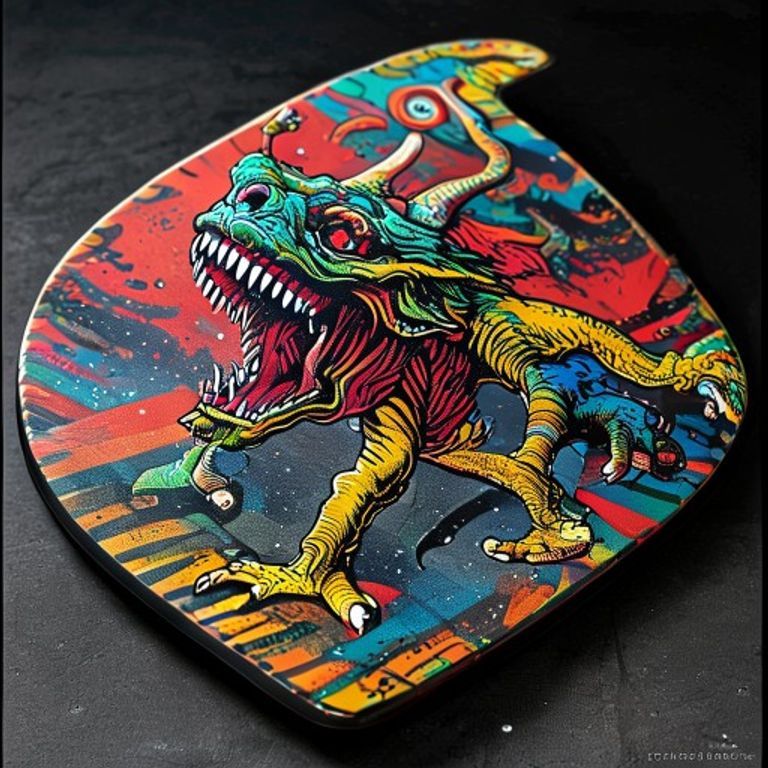
The prompt
Re-render this image as a skateboard-deck bottom-side graphic product photograph in the visual register of 1980s airbrushed skateboard decks (a dragon, hawk, or elephant rendered as a bold airbrushed mascot), Santa Cruz screaming-hand era with grotesque cartoon faces and bright color, Toy Machine expressive street-drawing era, and contemporary Palace / Polar / Fucking Awesome / Quasi decks. The illustration FULL-BLEEDS to the elongated rounded-rectangle deck shape (approximately 8 inches wide by 32 inches long, rounded nose and tail, four bolt-mounting hole positions visible at the corners as small empty circles). Visual register options for the illustration: (a) painterly airbrushed monster / animal / occult symbol in saturated colors on solid black, (b) screaming grotesque cartoon face in bright primary colors with heavy black outline, (c) naive street-drawing linework with flat fills and intentional roughness, (d) photographic collage or deconstructed image transferred to deck surface. Surface: slight gloss varnish over printed graphic, maple-wood edge visible, seven plywood laminations visible at the side profile. Lighting: clean studio product light, soft shadow beneath deck, no environmental context. Camera: top-down or shallow 3/4 showing entire deck. No legible text, no brand logos, no signature marks, no deck-model numbers. Preserve the subject, pose, and composition of the source image exactly, change only the medium and rendering.
What it is doing
The skateboard deck bottom is the most public-private art canvas in late-twentieth-century American culture: it goes through the air, it scrapes against the curb, it gets destroyed in six months, and during those six months it announces the rider's taste to every other rider in the park. From airbrushed skeletons and beasts to photo-collage minimalism, the deck graphic is a 32-inch-by-8-inch self-portrait of a subculture's current aesthetic position. Disposable, but the disposal is the point.
Ways to change it
Pick any of these in the gallery and the choice is added to the prompt you copy.
- Era register: 1980s airbrushed monster on black (signature for 1980s era) vs Santa Cruz bold-outline grotesque vs Toy Machine naive line vs Palace contemporary minimal collage
- Ground color: solid deep black (1980s register) (signature) vs solid saturated primary vs bare maple wood-grain visible
- Illustration style: painterly airbrushed (1980s signature) vs bold cartoon outline (Santa Cruz signature) vs naive expressive line (Toy Machine) vs photographic collage (Palace)
- Deck shape: classic 1980s wider with longer nose-tail vs contemporary 8.25 inch standard popsicle (signature)
- Surface finish: slight gloss varnish, wood grain in highlights (signature) vs matte vs heavy gloss
- Camera angle: straight-on bottom view (signature) vs 3/4 angle showing ply lamination
Related prompts
See all 7 prompts in the Sticker-Vinyl grammar