Sci-Fi-Concept / Style prompt
H.R. Giger Biomechanical Airbrush Monochrome Frame
The Giger biomechanical register. Airbrush-on-paper monochrome, fused biology and machinery, the Alien xenomorph lineage, the surface where flesh and tubing are no longer distinguishable.
Customize this prompt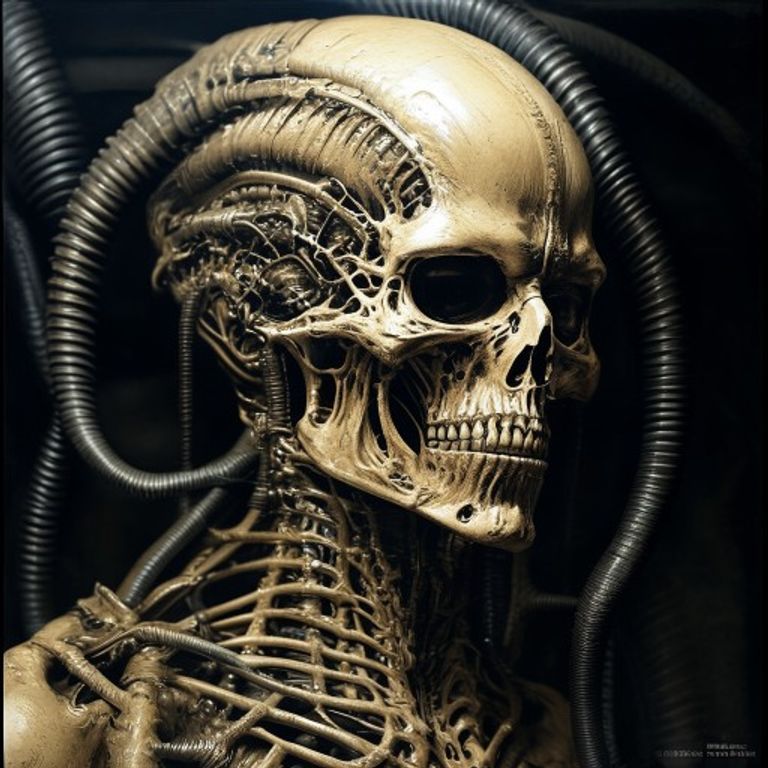
The prompt
Re-render this image in the style of biomechanical illustration, airbrush-and-acrylic-on-paper lineage from a landmark late-20th-century biomechanical art and science-fiction production-design tradition circa 1973 through 1992. Medium: airbrush acrylic on paper with fine-brush detail, near-monochrome palette in bone-and-iron tonality (warm-bone cream, dark-iron gray, occasional dried-blood ochre, deep-shadow charcoal, no full saturation anywhere). Surface treatment: biomechanical fusion dominant, ribbed flesh-tubes indistinguishable from hydraulic-tubing, vertebral-spine structures supporting machine-housings, exposed skeletal articulation merged with industrial fittings, surfaces simultaneously wet-organic and dry-machined. Composition: tight claustrophobic framing, subject occupying entire frame with no negative space relief, depth implied through tonal recession rather than perspective construction, symmetry frequent and obsessive. Lighting: single overhead or single-side hard light producing dramatic shadow-canyons in the rib-tubing surface, deep-shadow areas pure charcoal with no detail recovery, highlight areas bone-cream with crisp specular on wet-organic surfaces. Atmosphere: humid-industrial, surfaces faintly slicked with implied moisture, no environment beyond the biomechanical surface itself. Color palette: bone, iron, charcoal, occasional dried-blood ochre, never saturated, never warm in the comfort sense. Rendering precision: airbrush for soft-tonal gradient on volume modeling, fine-brush for sharp ribbed-tubing edges and skeletal-articulation detail, signature surface-density where every square centimeter contains structural-mechanical-biological information. Mood: dread-monumental, the body and the machine revealed as the same enemy, the surface where the distinction collapses, neither horror-of-biology nor horror-of-machinery alone but the horror of their fusion. No legible text, no studio watermark. Aspect ratio matching source. Preserve the subject and composition of the source image exactly, change only the medium and rendering.
What it is doing
This biomechanical register collapses the Cold War distinction between organic and mechanical horror into a single object. The xenomorph is not a creature inside a ship; the ship is the creature. The register asserts that any opposition between the biological and the industrial is a category mistake. Applied to any contemporary subject, the frame encodes the Schmitt friend-enemy distinction at the level of substance: the enemy is not biology vs machinery, the enemy is the fused-surface itself, and recognizing it as a single antagonist is the political-aesthetic act.
Ways to change it
Pick any of these in the gallery and the choice is added to the prompt you copy.
- Fusion-intensity dial: subtle, mostly-organic with hardware detail vs full-Giger, indistinguishable fusion vs mostly-mechanical with bone-detail
- Moisture dial: dry-Giger, all hardware register vs signature wet-organic slick vs dripping, body-horror peak
- Palette dial: pure bone-and-iron monochrome vs bone plus dried-blood-ochre accent vs bone plus deep cobalt for cooler register
- Symmetry: mirror-perfect bilateral symmetry, identical forms repeating left and right of center (signature) vs asymmetric sprawl, tubes and spines twisting off-center across the frame vs one central figure isolated against a deep charcoal void
- Density dial: every-square-cm packed, signature vs selective-density with breathing space vs extreme-density to abstraction
Style lineage
Learn the visual culture this draws from: Artsy Editorial.
Related prompts
See all 5 prompts in the Sci-Fi-Concept grammar