Propaganda / Style prompt
Velvet Revolution Eastern Bloc 1989
The moral register without weapons, just refusal. Subject rendered in the visual language of peaceful crowd, candlelight, chalk on concrete, the aesthetic of civil resistance.
Customize this prompt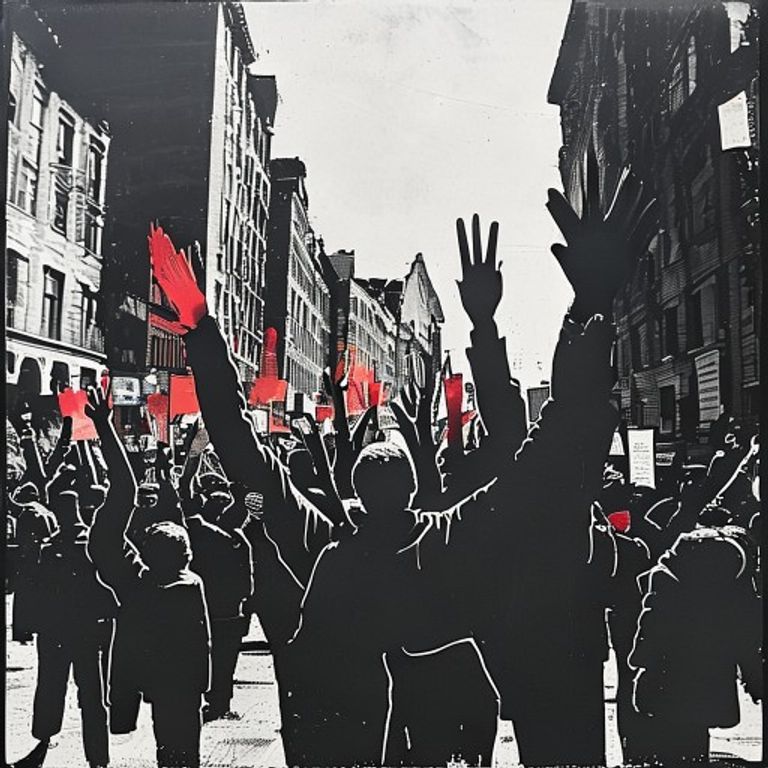
The prompt
Re-render this image as Velvet Revolution propaganda in the aesthetic register of Eastern Bloc 1989, emphasizing visual language of peaceful assembly, chalk-on-concrete street art, hand-drawn posters, and silkscreen flyers distributed by student networks. Media: hand-stenciled silkscreen on cheap paper, chalk drawn on pavement or building surfaces, printed by underground presses on borrowed supplies, materials of constraint turned into visual eloquence. Palette: stark blacks and whites with occasional single-color hand-applied emphasis (red or yellow), suggesting affordable production by volunteer effort. Composition: central figure or crowd rendered as silhouette suggesting unified moral stance, hands raised in peace gesture, candles arranged in formation, chain of linked arms, the crowd as the protagonist. Surround: repeated geometric patterns suggesting both wallpaper domesticity and revolution's infiltration of ordinary space, architectural elements (building facades, bridges, town squares) integrated as witness to the action. Typography: hand-drawn letters with consistent intention but visible human variation, Czech or Slovak language integrated as poetic phrase rather than command. Surface: rough paper stock showing fiber, visible stencil registration edges, hand-drawn irregularity suggesting amateur production with complete competence. Mood: moral clarity without aggression, the power of refusal, dignity in peaceful assembly, the state's machinery cannot prosecute what has no weapons. No legible text, no specific dates, no named political figures. Preserve the subject, pose, and composition of the source image exactly, change only the medium and rendering.
What it is doing
The Velvet Revolution's propaganda was made by students, teachers, and factory workers using borrowed equipment. The aesthetic asserts moral clarity without military capacity. The regime's tanks could not occupy a principle. Applied to any present-day nonviolent resistance or moral-clarity movement, the register asserts: the crowd's unified refusal requires no weapons to be lethal to the regime, and the regime knows it.
Ways to change it
Pick any of these in the gallery and the choice is added to the prompt you copy.
- Crowd formation: individual figures linked in chains vs dense crowd in public square vs candle arrangement as crowd substitute vs hands raised in unified gesture
- Domestic integration: street art on building facade vs posters pasted on everyday wallpaper patterns vs chalk drawing on pavement vs window installations visible from street
- Color emphasis: pure black and white vs single hand-applied color highlighting action point vs red and white national symbolism
- Urban context: abstract geometric surround vs recognizable town square architecture vs residential streetscape vs bridge or monument integrated
- Production visibility: clean stencil register vs rough hand-drawn variation vs multiple stencil pass layers vs deliberately unfinished quality
Style lineage
Learn the visual culture this draws from: Britannica.
Related prompts
See all 32 prompts in the Propaganda grammar