Propaganda / Style prompt
Imperial Japanese Rising Sun Woodblock
The senso-ga (war print) and Meiji-Shōwa militarist poster register, the ukiyo-e woodblock craft tradition deployed as cover for industrial-modern militarism, treated as visual grammar with all regime symbols forbidden.
Customize this prompt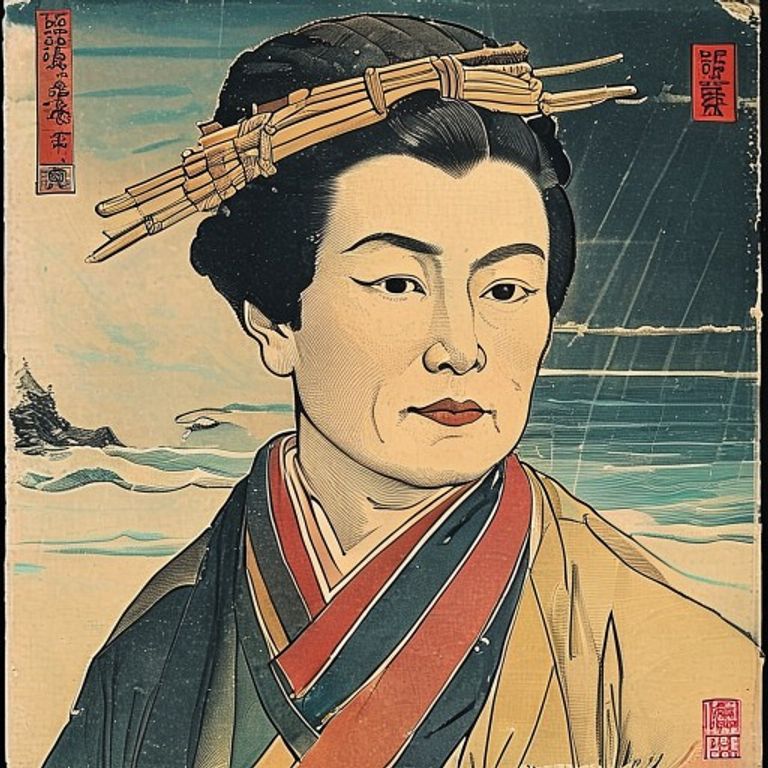
The prompt
Restyle the source image as a 1894 to 1942 Japanese senso-ga (war print) and militarist poster aesthetic in the ukiyo-e woodblock lineage, drawing on the visual register of Kobayashi Kiyochika, Migita Toshihide, and the Meiji-era senso-e print masters extending into early Shōwa propaganda graphics, treated PURELY as a craft register with all regime symbology forbidden. Render as a multi-block woodblock print on warm cream washi paper, with the characteristic registration marks of traditional Japanese printmaking: hand-carved key block providing dense black outline, color blocks layered with the slight mis-registration of hand-printed sheets. Palette: ink-black dominant contour, deep indigo and Prussian-blue water and sky, vermilion (red lead pigment), ochre and burnt sienna for earth tones, soft pink (beni) for skin highlights, washes of pale grey gradient (bokashi), warm cream paper ground. Light is flattened: traditional Japanese print convention uses no cast shadows, illumination is implied by color value rather than directional source. Composition uses ukiyo-e devices: dramatic diagonal foreground element, mid-ground figural action, distant atmospheric mountain or sea horizon with bokashi gradient, occasional decorative cloud bands separating registers. Atmospheric effects (rain, snow, smoke, water spray) rendered as schematic linear marks. ABSOLUTE PROHIBITION on every Imperial Japanese regime symbol, insignia, or marker: NO Hinomaru (rising-sun flag) of any kind, NO Imperial chrysanthemum crest (kiku-mon), NO rising-sun rayed flag (Kyokujitsu-ki), NO Imperial Navy or Army insignia of any kind, NO uniform rank markings, NO regimental banners, NO Yasukuni or shrine torii in nationalist context, NO Imperial Rescript scrolls, NO portraits of any Imperial figure or military leader, NO 1930s-1945 patriotic slogans in any script, NO kanji or kana propaganda text, NO Showa-era military caps with red star or imperial insignia. Caption-zones (if present in composition) must be empty: no letterforms, no kanji, no kana, no script, no signatures, no artist seal in propagandistic context. The exercise is to capture the WOODBLOCK CRAFT REGISTER (carved-line dominance, layered color blocks, ukiyo-e composition, bokashi gradients, washi paper warmth) WITHOUT any regime markers, so that the craft-laundering mechanism can be studied. Preserve the exact subjects, faces, poses, gestures, and spatial arrangement of the source image without alteration; restyle the rendering only.
What it is doing
Meiji and Shōwa-era militarist propaganda did something subtle: it laundered modern industrial militarism (steamships, machine guns, naval cannon) through the traditional craft register of ukiyo-e woodblock printing. The hand-carved line and hand-printed color signaled cultural continuity and artisanal authenticity, masking the regime's actual project, which was industrial-modern empire building on the Prussian model. The viewer received "this is part of our ancient tradition" while looking at images of distinctly modern violence. The mechanism: when a regime wraps its newest project in its oldest craft, the contradiction becomes invisible. The same template runs through any contemporary movement that wraps a modern political program in heritage aesthetics.
Ways to change it
Pick any of these in the gallery and the choice is added to the prompt you copy.
- Era beat: 1894-Sino-Japanese-War-Kiyochika vs 1905-Russo-Japanese-Toshihide vs 1937-late-Shōwa-poster
- Print register: traditional-multi-block-tight vs slight-mis-registration-craft vs lithograph-evolution-1930s
- Composition: dramatic-diagonal-foreground vs triptych-narrative-panels vs single-heroic-portrait
- Atmospheric effect: rain-snow-linear-marks vs smoke-and-water-spray vs bokashi-gradient-sky
- Palette weight: Prussian-blue-dominant vs vermilion-and-ochre-dominant vs monochrome-sumi-ink-only
Style lineage
Learn the visual culture this draws from: Victoria & Albert Museum.
Related prompts
See all 32 prompts in the Propaganda grammar