Propaganda / Style prompt
Nazi Aestheticized Monumental No Symbols
The Riefenstahl-Speer visual register stripped of every actual regime symbol: low-angle heroic figuration, torch-light spectacle, monumental architectural scale. The persuasion mechanism studied in isolation from the regime that deployed it, for forensic understanding of how aesthetics manufacture political consent.
Customize this prompt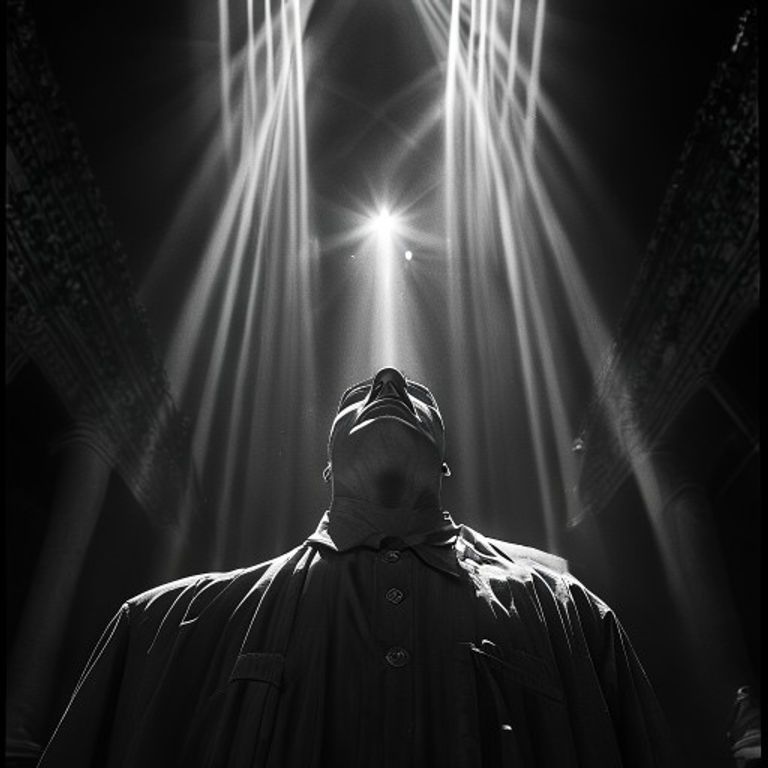
The prompt
Restyle the source image as a 1934 to 1938 German monumental documentary cinematography aesthetic in the technical register of Leni Riefenstahl's Triumph of the Will and Olympia camerawork, combined with Albert Speer's Cathedral of Light Nuremberg architectural spectacle, treated PURELY as a formal visual grammar with all political symbology forbidden. Render as a 35mm black-and-white motion-picture still or large-format silver-gelatin photograph with high tonal contrast, deep velvety blacks, and luminous specular highlights. Palette is monochrome: deep black shadows, mid-grey midtones, brilliant white highlights, occasional warm-amber tinting where torch-light or searchlight beams strike. Camera position is low-angle, looking up at the subject from below knee-height, with a wide-angle lens that exaggerates verticality and makes any figure or structure appear monumental. Lighting is theatrical and Wagnerian: high-contrast key from above and behind subject creating rim-light halation, searchlight beams or torch-beam columns rising vertically into night sky (the "Cathedral of Light" effect), deep dramatic shadows. Composition is severely symmetrical or radial, with the subject centered or arrayed in geometric formation against vast architectural scale. Mood is solemn, monumental, transcendent, the deliberate engineering of awe. ABSOLUTE PROHIBITION on every Nazi-era symbol, insignia, motif, or marker of any kind: NO swastika (in any orientation or stylization), NO Hakenkreuz, NO SS runes or Sig runes, NO Iron Cross, NO Reichsadler eagle, NO armbands of any color or pattern, NO Reich war flag, NO Sieg or Heil text, NO regime salutes, NO uniform insignia of any kind, NO peaked caps with totenkopf, NO Hitler Youth or BDM symbols, NO Nuremberg Party rally banners, NO portraits or imagery of any Third Reich figure, NO Wagnerian opera mythological figures (no Brünnhilde, no Siegfried), NO Nazi-era German script (no Fraktur slogans, no party mottoes), NO red-white-black flag motif. Caption-zones (if present in composition) must be empty: no letterforms, no kerned type, no script. The exercise is to capture the AESTHETIC REGISTER (monumentality, low-angle hero, torch column, symmetrical mass formation, awe engineering) WITHOUT any regime markers, so that the persuasion mechanism can be studied in isolation. Preserve the exact subjects, faces, poses, gestures, and spatial arrangement of the source image without alteration; restyle the rendering only.
What it is doing
Riefenstahl's defense after 1945 was that her films were "pure aesthetics," not politics. This was both false (the films were commissioned propaganda) and revealing: she was admitting that aesthetics alone could carry the political work. The low-angle hero shot, the searchlight column, the symmetrical mass formation: each technique manufactures awe and consent BEFORE any explicit political claim is made. By isolating the aesthetic register from the regime symbols, the persuasion mechanism becomes legible. The same camerawork now appears in superhero films, corporate-event keynotes, presidential debate staging, and stadium concert lighting. The mechanism did not die with the regime that perfected it. Understanding it is a defense against it.
Ways to change it
Pick any of these in the gallery and the choice is added to the prompt you copy.
- Light register: Cathedral-of-Light-vertical-beams vs single-rim-light-hero vs theatrical-rear-key-halation
- Camera angle: extreme-low-angle-monumental vs moderate-low-3-quarter vs eye-level-symmetric-mass
- Composition: single-hero-isolated vs symmetric-mass-formation vs radial-architectural-scale
- Film register: silver-gelatin-still vs motion-picture-frame-still vs documentary-grain
- Mood weight: upward gaze into glowing light beams, figure small beneath vast radiant sky (signature) vs still, heavy stone architecture, figure motionless in deep shadow, minimal light vs dense searchlight columns, sweeping beams and torch glow filling the frame
Style lineage
Learn the visual culture this draws from: Holocaust Encyclopedia (US Holocaust Memorial Museum).
Related prompts
See all 32 prompts in the Propaganda grammar