Propaganda / Style prompt
Maoist Dazibao Big Character Brush
The 1966-1976 Cultural Revolution wall-poster register: black ink and red accent on cheap paper, hand-brushed, mass-pasted on every public wall, the visual technology of distributed denunciation.
Customize this prompt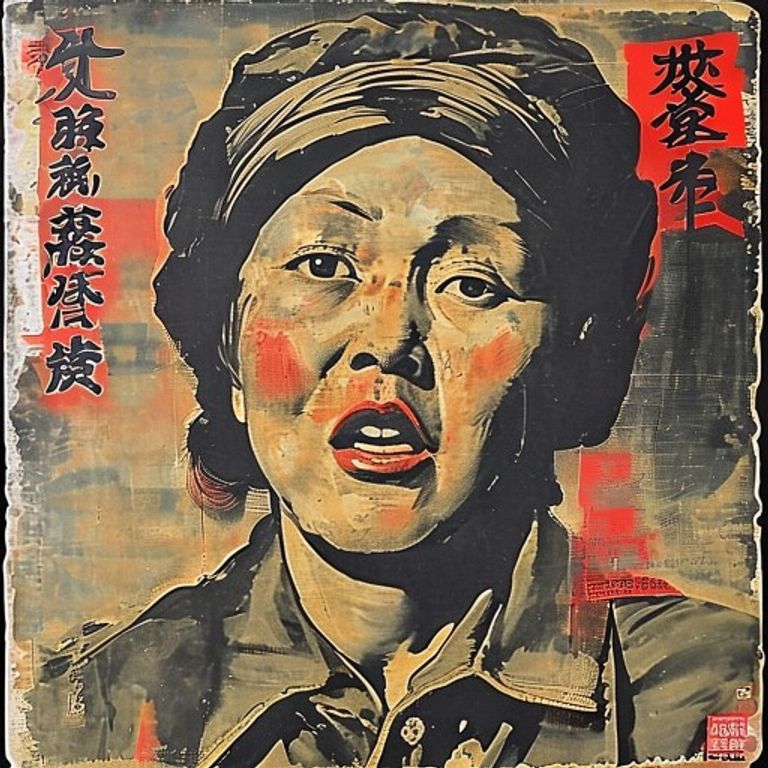
The prompt
Restyle the source image as a 1966 to 1976 Chinese Cultural Revolution era dazibao (big-character wall poster) aesthetic. Render as an urgent hand-painted poster on cheap newsprint or coarse rice paper, often pasted in overlapping layers on a brick or concrete wall surface. Palette is starkly restricted: dense matte ink-black brushwork as dominant, pure vermilion red as urgent accent (used for emphasis and exclamation strokes), cream-yellow or muddy-grey paper ground showing through, with occasional ink bleed and water stain. Brushwork is calligraphic but rushed: large dynamic strokes with the energy of mass production under political urgency, drips, splashes, partial coverage, evidence of haste. Composition is asymmetric and densely packed, multiple poster fragments overlapping at the edges where one denunciation poster has been pasted over a previous one, torn corners revealing the layer beneath. Figurative content (if present) is rendered in bold simplified brush contour, expressions exaggerated (accusing finger pointed, mouth open in shout, eyes wide), heavily caricatured in the manner of revolutionary woodcuts and Shanghai propaganda artists. The entire poster body is dominated by negative-space zones where large-character Chinese calligraphy would fill the surface, but render these zones EMPTY: no Chinese characters, no Latin script, no slogans, no denunciation text, no names, no dates, no signatures, no work-unit stamps. Forbid all regime-specific symbols absolutely: no Mao portrait, no Little Red Book imagery, no party star, no Red Guard armband insignia, no CCP emblems, no historical political slogans. Preserve the exact subjects, faces, poses, gestures, and spatial arrangement of the source image without alteration; restyle the rendering only.
What it is doing
The dazibao was a uniquely terrifying propaganda medium because it was distributed, anonymous, and immediate. Anyone could paste one. Once your name appeared on the wall, neighbors had read it before you knew. The handmade character was the persuasion: official state proclamations were printed, but a hand-brushed wall poster signaled "your neighbors are watching." The Cultural Revolution weaponized this medium into a feedback loop where every literate citizen became both target and informant. The visual register of urgent hand-brushed paper remains a template for any movement that wants to make surveillance feel local and grassroots.
Ways to change it
Pick any of these in the gallery and the choice is added to the prompt you copy.
- Era beat: 1966 Red Guard frenzy: wild splattered strokes, crooked torn sheets, raw haste vs 1969 mass campaign: neat uniform sheets in tidy rows, bolder vermilion blocks (signature) vs 1974 late period: faded weathered layers, peeling yellowed paper, sparse tired brushwork
- Surface: single-fresh-poster vs overlapping-layers-on-wall vs torn-and-weathered
- Brushwork urgency: controlled-calligraphic vs rushed-with-drips vs near-illegible-haste
- Figurative content: pure-typographic-empty-zones vs denunciation-caricature-figure vs heroic-worker-woodcut
- Vermilion ratio: black-dominant-red-accent vs red-and-black-balanced vs vermilion-overwhelm
Style lineage
Learn the visual culture this draws from: Britannica.
Related prompts
See all 32 prompts in the Propaganda grammar