Propaganda / Style prompt
Vichy France Pétain Cult
The 1940-1944 État Français visual register: warm sepia-toned paternal portraiture, peasant pastoral, and Catholic-coded restoration imagery that laundered military defeat and Nazi collaboration as moral revival.
Customize this prompt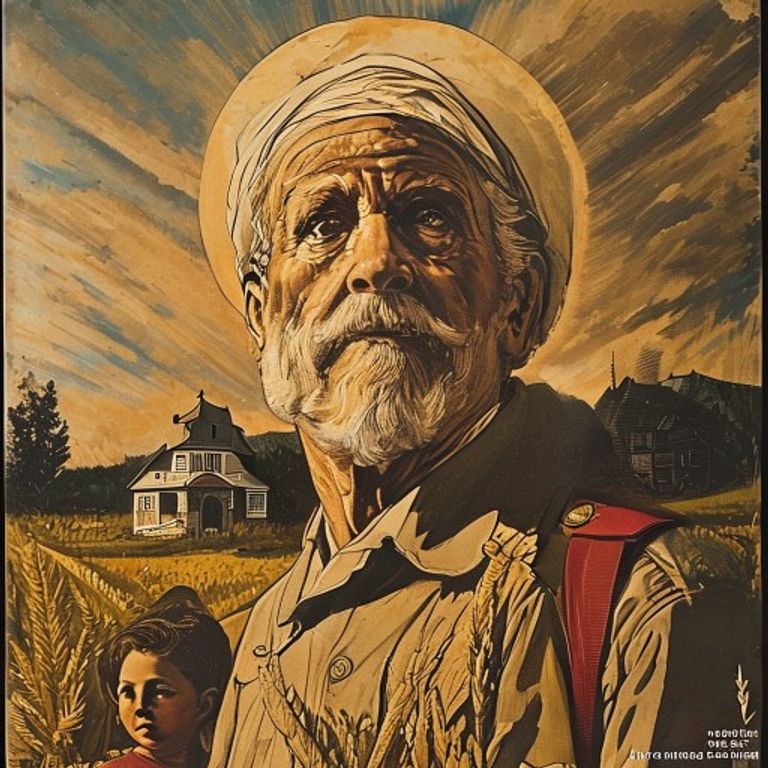
The prompt
Restyle the source image as a 1940 to 1944 État Français (Vichy regime) propaganda poster or magazine illustration aesthetic, in the visual register of the Travail Famille Patrie campaigns. Render as a lithograph or gouache illustration on warm cream poster paper. Palette: warm sepia and umber midtones, deep burgundy and burnt sienna accents, ochre wheat-gold, the muted blue-grey of provincial peasant smock, the soft green of pastoral hillside, cream-ivory for skin and key figures. Composition is reverent and paternal: a central elder figure rendered in low-angle three-quarter view, slightly heroic in scale relative to younger figures (children, peasants, soldiers) who orient toward him in receptive postures. Light source is warm rear-upper, halo-adjacent without being literal halo, drawn from Catholic devotional painting and Salon Romantic portraiture. Background suggests wheat field, village church silhouette, family hearth, or workshop, rendered with painterly softness. Mood is moral seriousness, calm restoration after catastrophe, the visual claim that order has returned. Forbid all regime-specific symbols absolutely: no francisque (the double-headed axe emblem), no Vichy state coat of arms, no military insignia of any kind, no uniform badges, no swastikas, no fasces, no SS runes, no eagle imagery, no armbands, no regime mottoes, no historical political slogans. Caption-zone bands at top or bottom should be empty: no letterforms, no kerned type, no script, no slogans. Preserve the exact subjects, faces, poses, gestures, and spatial arrangement of the source image without alteration; restyle the rendering only.
What it is doing
Vichy propaganda solved a uniquely difficult persuasion problem: how to make collaboration with an occupying power feel like moral revival. The answer was paternal aesthetics drawn from Catholic devotional painting and Belle Époque pastoral. Pétain was rendered as grandfather, not führer. The peasant, the family, the church steeple did the ideological work that argument could not. The buried thesis: when a nation has been defeated, the visual register of "restoration" can launder any political accommodation, including collaboration with the conqueror.
Ways to change it
Pick any of these in the gallery and the choice is added to the prompt you copy.
- Scene focus: central elder in low-angle portrait, younger figures small at his sides (signature) vs peasants harvesting a wheat field, village church on the horizon vs family gathered around a glowing hearth in a rustic farmhouse interior
- Light treatment: Catholic-devotional-soft vs harvest-golden-hour vs cold-morning-restoration
- Palette emphasis: sepia-warm-dominant vs burgundy-and-cream vs pastoral-green-and-ochre
- Generational composition: elder-with-children vs peasant-couple-alone vs multi-generational-family
- Background: wheat-field-village vs interior-hearth vs church-silhouette-distance
Style lineage
Learn the visual culture this draws from: Britannica.
Related prompts
See all 32 prompts in the Propaganda grammar