Propaganda / Style prompt
US WWII Rosie / Westinghouse (Howard Miller Internal Poster)
J. Howard Miller's 1943 Westinghouse internal-morale poster (now universally read as Rosie the Riveter). The format is a corporate-internal poster masquerading as a civic mobilization icon, the masquerade is the persuasion.
Customize this prompt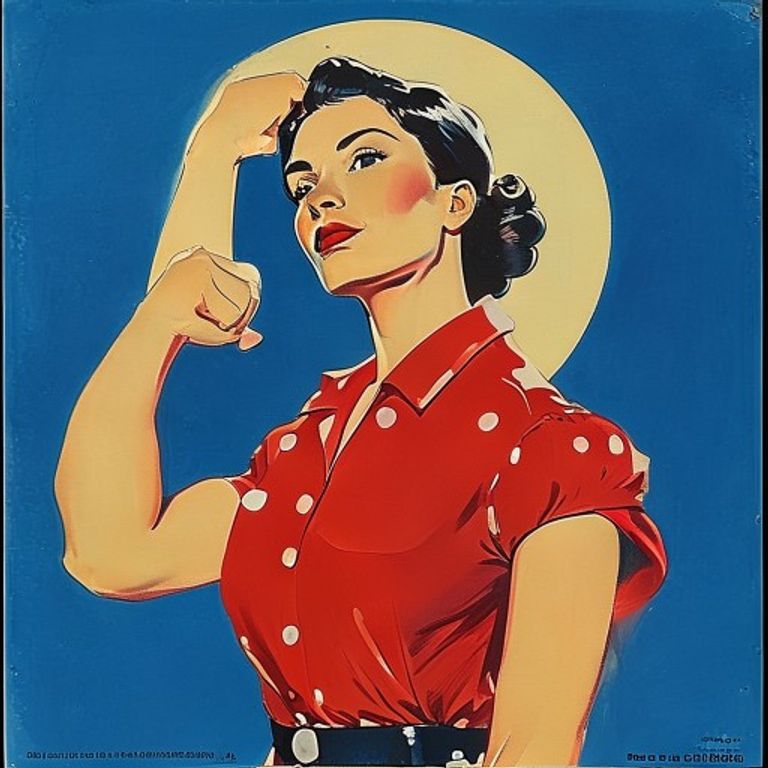
The prompt
Re-render this image in the visual register of J. Howard Miller's 1943 Westinghouse Electric internal morale poster series, the lineage now globally known as Rosie the Riveter. Composition: a head and upper-torso figure rendered in confident gouache poster style, flat color planes with crisp boundaries, no gradients. Palette: dominant clean blue background, the figure wearing a strong primary-red garment with white polka-dot accent, neutral skin in warm cream with subtle shadow modeling in cooler tone, deep navy for hair and outline. Pose conveys confident competence: a slightly upward gaze, jaw set, one arm flexed (modify only as the source-pose permits without overriding it). Background a flat field with a darker oval halo behind the figure's head to lift the silhouette. Type-treatment zones present at top of canvas as flat empty rectangular bands, intended for caption type but completely empty here of any text, glyph, letter, numeral, or character in any language or script. Surface treatment: matte poster paper with slight texture, subtle period color register, faint paper aging. Mood: domestic mobilization, dignified working-class competence, corporate-civic optimism. No watermarks, no Westinghouse logo, no on-canvas text of any kind. Preserve the subject and pose of the source image translated into this confident-flat-poster register, change only the medium and rendering.
What it is doing
The Howard Miller Westinghouse poster was never a public mobilization image during WWII. It was an internal corporate morale poster displayed in a single set of Westinghouse plants for two weeks. Its postwar recoding into the universal Rosie the Riveter icon is one of the most successful retroactive narrative captures in American visual history. Applied to a 2026 subject, the format inherits the laundered authority of a corporate-internal ask now read as civic mobilization, a perfect Bernays-grade source-disguise.
Ways to change it
Pick any of these in the gallery and the choice is added to the prompt you copy.
- Garment color: Westinghouse blue chambray (canonical) vs industrial olive vs factory khaki
- Halo treatment: darker oval (canonical) vs lighter halo vs no halo
- Background field: clean blue vs pale yellow alternate vs industrial gray
- Top type-band proportion: 15 percent top vs 25 percent top vs top and bottom bands
- Color register: clean 1943 fresh vs mildly aged vs heavily period-aged
Style lineage
Learn the visual culture this draws from: National Archives.
Related prompts
See all 32 prompts in the Propaganda grammar