Propaganda / Style prompt
1950s Esquire Magazine Cover (Sovereign Masculine)
The register the captured press cannot directly attack because nostalgia is encoded as innocent. Vitalist, physically grounded.
Customize this prompt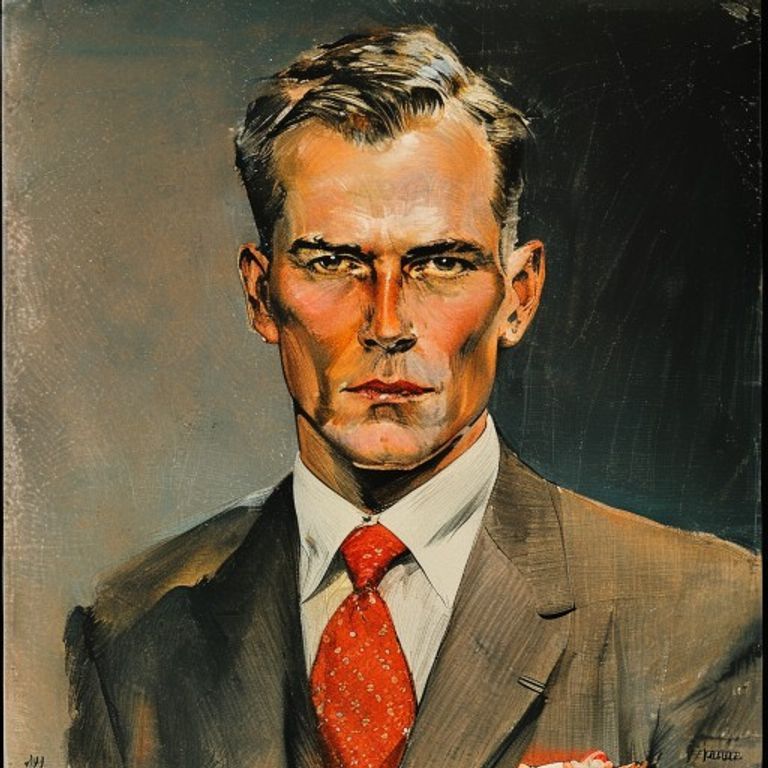
The prompt
Re-render this image as a 1950s Esquire or LIFE magazine cover illustration in the lineage of Bernard Fuchs, Robert McGinnis, and Albert Dorne. Painterly editorial illustration on textured magazine-cover stock, confident gouache and oil-pastel brushwork with visible mark-making. Subject rendered with sovereign masculine bearing: jaw set, gaze direct or slightly off-frame conveying interior gravity, posture relaxed but unmistakably authoritative. Clothing: tailored mid-century formal or smart casual (charcoal suit, knit polo, sport coat) rendered with attention to drape and fit. Palette: warm whiskey-amber midtones, smoky charcoal blacks, single saturated accent color in tie or pocket square or background field. Background simplified to flat color or atmospheric wash, all attention on the subject. Mood: pre-therapeutic masculinity, gravity over performance, the man as load-bearing structural element of his world, no irony, no apology, no contemporary self-consciousness. Slight grain of mid-century four-color magazine printing, subtle dot pattern visible in shadows. No text, no Esquire logo, no cover lines, no date stamp. Preserve the subject, pose, and composition of the source image exactly, change only the medium and rendering. Aspect ratio matches source, prefer 8.5x11 magazine portrait if source allows.
What it is doing
Pre-1965 American magazine illustration depicted male sovereignty as ambient and unremarkable. The captured contemporary press cannot directly attack this register because nostalgia coding makes the imagery readable as innocent period style. The thesis slips through the nostalgia filter: "this is what unbroken masculine bearing looks like, and your current cultural production cannot generate it."
Ways to change it
Pick any of these in the gallery and the choice is added to the prompt you copy.
- Subject elevation: quiet authority (relaxed posture) vs commanding authority (standing, three-quarter angle) vs interior authority (seated, reading, alone)
- Color accent dial: oxblood tie as the one saturated color vs peacock pocket square as the one saturated color vs mustard background as the one saturated color vs cobalt sky as the one saturated color
- Era within the 1950s: early fifties formality, charcoal suit, narrow tie, stiff upright pose vs late fifties ease, sport coat over knit polo, loose sketchy brushwork vs mid-decade polish, glossy smooth paint, crisp gray flannel suit, pocket square
- Companion register: add subtle period prop in frame, a Zippo, a leather-bound book, a watch face for the physically grounded signature object
Style lineage
Learn the visual culture this draws from: George Lois Archives.
Related prompts
See all 32 prompts in the Propaganda grammar
Read the full free book. All thirty-six chapters and the companion 657-prompt image library are free.